 Global
Expert Speak | 03 August, 2026
Building AI into the Energy Future
The following excerpt is from Chapter 1 — ORF Global Quarterly | Energy and Tech: Powering the Future.
The appeal of artificial intelligence (AI) to the Global South lies in its potential to narrow persistent structural gaps that constrain human and economic development. Across these geographies, large sections of the population grapple with the interconnected challenges of lack of clean water, food insecurity, limited access to affordable and quality healthcare, financial exclusion, and inadequate economic opportunities. Structural barriers to energy access aggravate each of these pressures, while climate change further strains the fragile ecosystems within countries that are simultaneously pursuing industrial decarbonisation agendas while seeking to reduce inequities in energy access and development. By improving productivity across critical sectors, optimising energy access and distribution, and strengthening climate change mitigation techniques, an effective, equitable, and calibrated diffusion of AI could help alleviate these pressures across the Global South.
The widespread adoption of AI, alongside efforts to address developmental gaps, holds economic and business potential for countries of the Global South. This embrace will, however, also impart a significant footprint on global energy and climate ecosystems, as energy is a core enabler of the AI revolution. Simultaneously, AI itself could also serve as a system-level facilitator to address concerns of reliability and compromised efficiency in energy ecosystems.[1] Yet, while the integration of AI offers benefits for the optimisation of energy systems through grid management, renewable energy integration, predictive maintenance, and accurate forecasting of alternative forms of energy, its energy-intensive nature could also negatively impact the countries and ecosystems seeking to adopt it.
This article examines the most important trendlines that underpin the paradoxical relationship between the benefits of AI’s deployment and the challenges it poses to energy and climate ecosystems in the Global South.
Setting the Context
AI investments continue at scale globally, with data centre projects under construction, or moving through planning pipelines. Although experts’ estimates of AI’s future electricity demand vary widely, the direction is clear: AI is a driver of new energy demand.[2], [3] The effects will be felt most acutely in the Global South, where AI infrastructure and data centres could place substantial pressure on electricity grids, regional energy systems, power markets, and emissions trajectories. Ultimately, the value of AI for these countries will depend on whether it can be deployed without exacerbating existing constraints around energy access, grid reliability, climate vulnerability, and public investment.
Global South countries that are emerging as regional hubs for AI infrastructure, such as the Gulf states, India, Brazil, Malaysia, Kenya, South Africa, Indonesia, and Mexico, have to address these energy and climate implications from the rapidly growing demand for AI deployments.[4] Despite differences in their economic development and approaches to deploy AI,[5] these countries are attracting substantial data centre investment to build sovereign AI capabilities and expand compute infrastructure as they seek to establish themselves as critical regional and global AI nodes.[6]
The AI Infrastructure Build-out
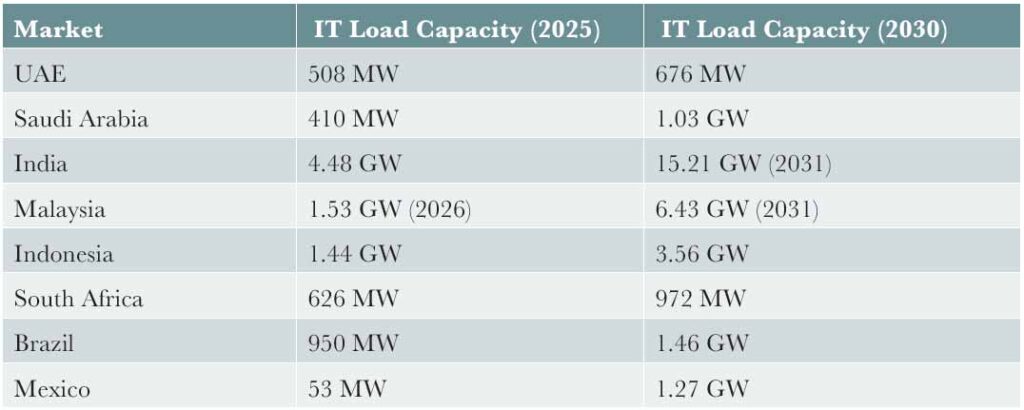
While overshadowed by the rapid expansion of AI infrastructure in the United States and China, AI infrastructure development across the Global South is well underway. The largest projects extend beyond conventional data centres and increasingly include gigawatt-scale AI infrastructure, particularly in the United Arab Emirates (UAE), Saudi Arabia, India, Brazil, and Kenya. Meanwhile, Malaysia, South Africa, Indonesia, and Mexico are developing AI infrastructure projects often at the scale of tens- to hundreds-of-megawatts.[7] Table 1 provides an overview of installed and estimated IT load capacity for data centres.[8]
Table 1: Data Centre Capacity per Market: Current (2025/2026) vs. Estimated (2030/2031)[9]
In the Middle East, the UAE and Saudi Arabia are building AI infrastructure at an extraordinary scale. Two factors enable this growth: sovereign wealth fund investments in AI infrastructure and ecosystem development, and US-linked agreements that provide access to advanced technologies. In the UAE, Stargate UAE is the flagship project—a planned 1 GW AI cluster in Abu Dhabi that forms part of the broader 5 GW UAE–US AI Campus, designed to host US hyperscalers and serve regional compute demand.[10] Saudi Arabia’s HUMAIN, backed by the Kingdom’s Public Investment Fund, has announced plans to invest around US$10 billion in deploying up to 500 MW of AI infrastructure over the next five years.
India, meanwhile, has the most extensive AI ecosystem in the Global South, supported by a large talent pool, a vibrant startup ecosystem, its Digital Public Infrastructure (DPI), and extensive datasets. Yotta Data Services has announced plans to deploy a US$2-billion AI supercluster at its 60 MW Greater Noida D2 data centre,[11] while Google is building a US$15- billion AI data centre hub in Visakhapatnam, expected to include a 1 GW facility.[12]
In Southeast Asia, Malaysia is emerging as a regional AI infrastructure hub, especially around Johor. Its YTL–NVIDIA AI data centre project received a US$4.3-billion investment at the 600 MW YTL Green Data Center Park.[13] In Indonesia, BDx’s CGK4 campus is designed as the country’s first renewable-powered AI data centre park and could scale to 500 MW.[14] In Africa, South Africa’s US$1-billion JNB1 campus in Johannesburg will reach 120 MW capacity once fully developed.[15] In Kenya, G42 and EcoCloud have announced a geothermalpowered data centre planned to open at an initial 100 MW capacity, with the potential to scale up to 1 GW.[16] In South America, Brazil’s Scala AI City is the region’s most ambitious project, beginning with an initial capacity of 54 MW and projected to expand to 1.8 GW by 2033.[17] In Mexico, CloudHQ’s Querétaro campus is planned for a 360 MW of critical IT load.[18]
Energy Demand and Grid Constraints
Energy intensity of data centres: The International Energy Agency (IEA) estimates that data centres accounted for around 1.5 percent of global electricity consumption in 2024, or 415 TWh, and projects that this could more than double to 945 TWh by 2030.[19] This is close to Japan’s annual electricity consumption in 2025 terms. AI is the most important driver of growth in electricity consumption. Demonstrative of this interface between AI and energy is the US$67-billion merger between two US companies, NextEra Energy and Dominion Energy,[20] creating the world’s largest regulated electric utility with 110 GW of electricity generation capacity.[21]
The planned 5 GW G42 AI Campus in the UAE, for instance, is estimated to consume 49.1 TWh annually, which is more than the entire nation’s annual electricity consumption. The Barakah Nuclear Energy Plant, which produces 25 percent of the UAE’s total electricity, would be insufficient to power the new campus.[22] To meet their growing energy demand, data centre operators have been considering captive or onsite power generation, raising concerns among some experts that this could further entrench fossil fuel consumption.[23]
Table 2: Energy Types Powering Data Centres
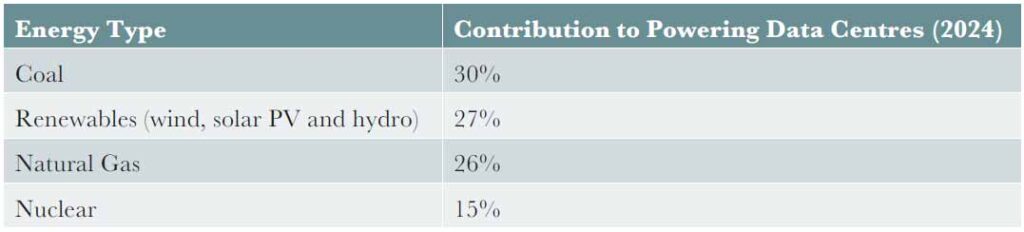
Source: IEA Energy and AI Special Report, 2024[24]
Shifting energy mix amid rising energy consumption: While the IEA projects a larger role for nuclear energy in powering data centres towards the end of the decade, data centres currently rely on a predominantly fossil fuel-based energy mix.[25] Furthermore, many AI data centre projects are expected to come online within the next few years, whereas major energy infrastructure projects require longer planning, permitting, financing, and construction timelines. Therefore, new AI infrastructure is likely to draw power from each country’s existing energy mix in the short term rather than from a decarbonised future grid. The need for baseload round-the-clock (RTC) reliable power that is needed by AI data centres has also meant that legacy systems such as coal and natural gas have found greater advocacy by policymakers on the grounds that they are needed to ensure uninterrupted grid reliability. In the US, for instance, which is seeing the largest build-out of AI infrastructure globally, coal is reflected in several Department of Energy initiatives to be central to powering “America’s reindustrialization and winning the AI race.”[26] Indicative of this is the launch of a US$625- million fund to retrofit and recommission old coal power stations in the country. This could create a structural feedback loop that may lock hydrocarbons into the AI build-out, keeping them not just relevant but central.
AI’s ancillary pressures on energy systems: Additionally, the high energy demand of data centres and integration of AI into energy systems can create additional pressures on local communities through increased energy utility bills.[27] Necessary grid expansions or modernisation could lead to some of the costs of AI’s expansion being one-sidedly and unfairly passed on to customers in geographies that house these data centres. The tensions and adverse public perceptions associated with the deployment of AI emerging in advanced economies such as the US, as shown in Figure 1, may be even more complicated in the Global South, where many countries already face financial and infrastructural constraints, while also grappling with competing development priorities.
Figure 1: US Public Perception on the Impact of Data Centres
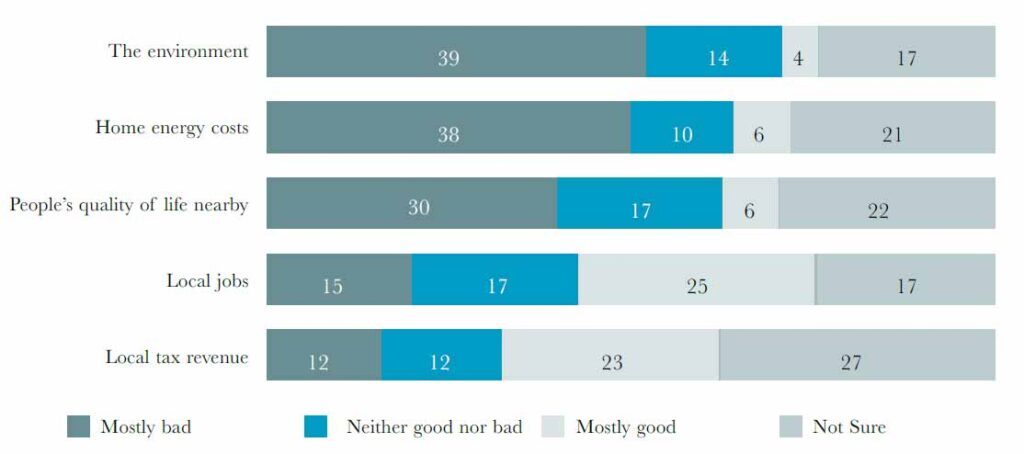
Note: Those who did not answer and those who have not heard about data centers are not shown. Source: Survey of U.S. adults conducted Jan. 20-26, 2026.
Source: Pew Research Centre[28]
The adverse public perceptions associated with the deployment of AI may be even more complicated in the Global South, where many countries already face financial and infrastructural constraints.
Structural concentrations strain local and regional energy systems: The IEA estimates that a typical next-generation data centre can consume as much electricity as nearly 2 million households.[29] Because this demand is often concentrated in single locations, such facilities can create local congestion points that place massive stress on electricity networks, increasing the risk of grid instability and failures.
This growing demand for energy and increasing stress on existing infrastructure is particularly consequential for many countries in the Global South, where electricity systems may already face severe challenges by way of shortages, unreliable grids, limited transmission and distribution capacity, and constrained public finance.
InsufficTable 3: Data Centre Electricity Consumption per Market: Current (2024/2025) and Estimated (2029/2030)31ient grid capacity: Concentrated AI electricity demand can intensify grid capacity constraints and are closely related. South Africa’s data centre build-out, for instance, is constrained by electricity reliability and grid capacity. Similarly, current grid capacity limits have also stalled a proposed project in Kenya over concerns that the 1-GW data centre would strain the national grid, which presently supplies 3 GW.[30] Table 3 illustrates current and projected data centre electricity consumption.
Table 3: Data Centre Electricity Consumption per Market: Current (2024/2025) and Estimated (2029/2030)[31]
The intent of more countries to host data centres must be considered against the backdrop of many among them contending with utilities and grids that were built in periods of lower industrial and public consumption.[32] This build-out of data centres is occurring at a time when countries are also looking at increased electrification and electromobility, and can therefore be expected to exert additional stress on a grid that is already experiencing mounting pressure.
This new energy demand could lead to considerable strain on these grids and lead to system paralysis, heightened risks of grid instability, higher electricity costs, delayed interconnections, and political contestation over energy allocation.
Climate Implications, Emissions, and the Environment
While AI is expected to support climate change mitigation, at present, the carbon footprint of data centres and the e-waste that is being generated from these facilities remain important points of concern. Data centres are among the fastest-growing sources of emissions, which are projected to rise from 180 million tonnes (Mt) to between 300 Mt and 500 Mt by 2035, accounting for less than 1.5 percent of the total energy sector emissions in this period.[33] While the hydrocarbons-powered data centres used to deploy this technology do contribute to greenhouse gas emissions, the integration of AI itself can have a positive impact on efforts to reduce emissions. AIenabled methane-emissions tracking satellites, for instance, can support the timely detection of methane leaks in oil and gas operations and thereby contribute to meaningful reductions in methane emissions.[34]
In addition to the emissions from the compute facilities themselves, the semiconductors and data centres that propel AI depend on extractive and environmentally damaging mining and processing of critical minerals and materials— much of which takes place in the Global South.
Further compounding the impact of AI deployment on environmental markers are concerns related to the stress it induces on water. Water is a highly salient constraint in local settings marked by water access and scarcity challenges, such as India and the UAE. Data centres require water directly for cooling, and indirectly for various forms of electricity generation to power them. In geographies where water scarcity is already being heightened by climate stress, urban growth, agricultural demand, and uneven provisioning, even efficient facilities may intensify concerns over freshwater allocation if they are perceived to compete with households, agriculture, or other industries.[35]
The wealthiest 10 percent of the world’s population are responsible for almost half of carbon released into the atmosphere, yet vulnerable populations in the Global South are most affected by climate-related loss and damage.[36] The challenge therefore is not simply whether Global South countries can attract AI investment, but whether they can build the clean, reliable, and resilient energy systems needed to power AI infrastructure without deepening existing climate inequities.
What Could Alter the Trajectory?
The implications for the Global South are uneven. Energy- and capital-rich states, particularly the UAE and Saudi Arabia, are better positioned to absorb rising electricity demand by mobilising sovereign capital, expanding generation capacity, and developing AI infrastructure hubs. Sustaining this approach, however, will require balancing growing energy consumption with climate commitments— including net-zero targets of 2050 for the UAE and 2060 for Saudi Arabia—as well as broader economic diversification objectives.
Large middle-income economies such as India, Indonesia, Malaysia, Brazil, South Africa, or Mexico face a more conditional opportunity. These countries must navigate trade-offs among grid reliability, electricity affordability, competing industrial demand, climate goals, decarbonisation commitments, and sovereign AI ambitions. Similar trade-offs over power, land, water, and public investment are emerging across much of the Global South. These challenges are particularly salient given that 666 million people worldwide still lack access to electricity, especially in rural areas in Central and Southern Asia and Sub-Saharan Africa.[37]
For lower-income and more grid-constrained countries, deploying AI infrastructure becomes a more acute challenge, as new demand for power, land, water, and public investment could compete with basic energy access and development priorities. The increased energy demand could, by way of increased competition between AI deployment and other economic sectors, lead to more tensions in subnational ecosystems, where electricity systems are already struggling to meet basic needs, and energy demands for AI may be politically and developmentally more difficult to justify.
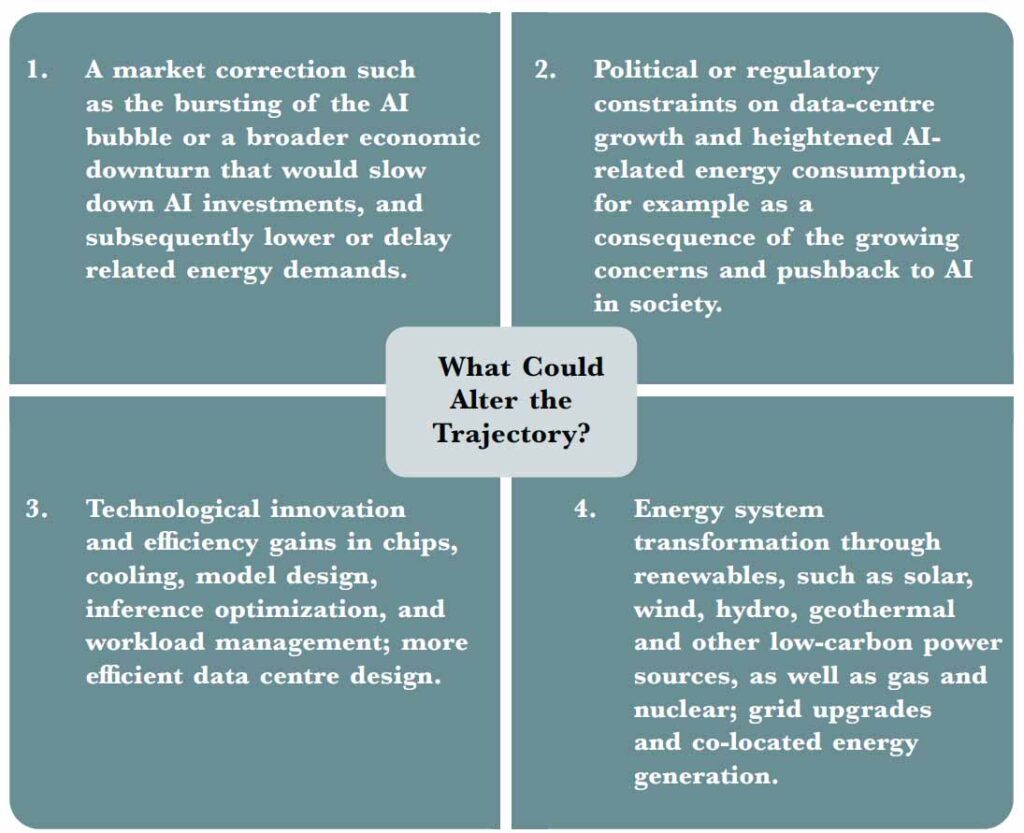
Figure 2: Forces Shaping AI, Energy, and Climate Megatrends
Source: Authors’ own
Technological innovation and energy system transformation, the third and fourth forces described in Figure 2, are likely to have the biggest influence on future megatrends trajectories because they can change the underlying energy equation. Technological innovation can lower the energy required per unit of AI activity, while energy-system transformation can increase the supply of reliable or low-carbon power available to data centres. For instance, an increase in the deployment of civilian nuclear energy,[38] including Small Modular Reactors (SMRs), and the larger-scale adoption and integration of Battery Energy Storage Systems (BESS) infrastructure could mitigate some of this concern but is unlikely to substantively reduce the pressure on existing grids in the immediate future.[39]
Strong hardware and model-efficiency gains could materially reduce future datacentre electricity demand but not eliminate uncertainty. The IEA’s projected range for 2035 spans from 700 to 1,700 TWh, with 20 percent less energy demand projected in the high-efficiency case when compared to the base case.[40] Under the circumstances, technical innovation and energy system transformation involve extended development and deployment cycles and, coupled with existing disparities, developing economies are finding themselves at a disadvantage. The short-term effect, therefore, is likely to be additional pressure on current power systems with larger shares of 40 “Energy and AI”. fossil fuels, with efficiency and infrastructure gains shaping the medium-term trajectory rather than immediately bending the curve. Economic downturns or geopolitical crises, although unpredictable, could have a more immediate effect on the AI- and energy-related megatrends.
Paradoxical Trendlines
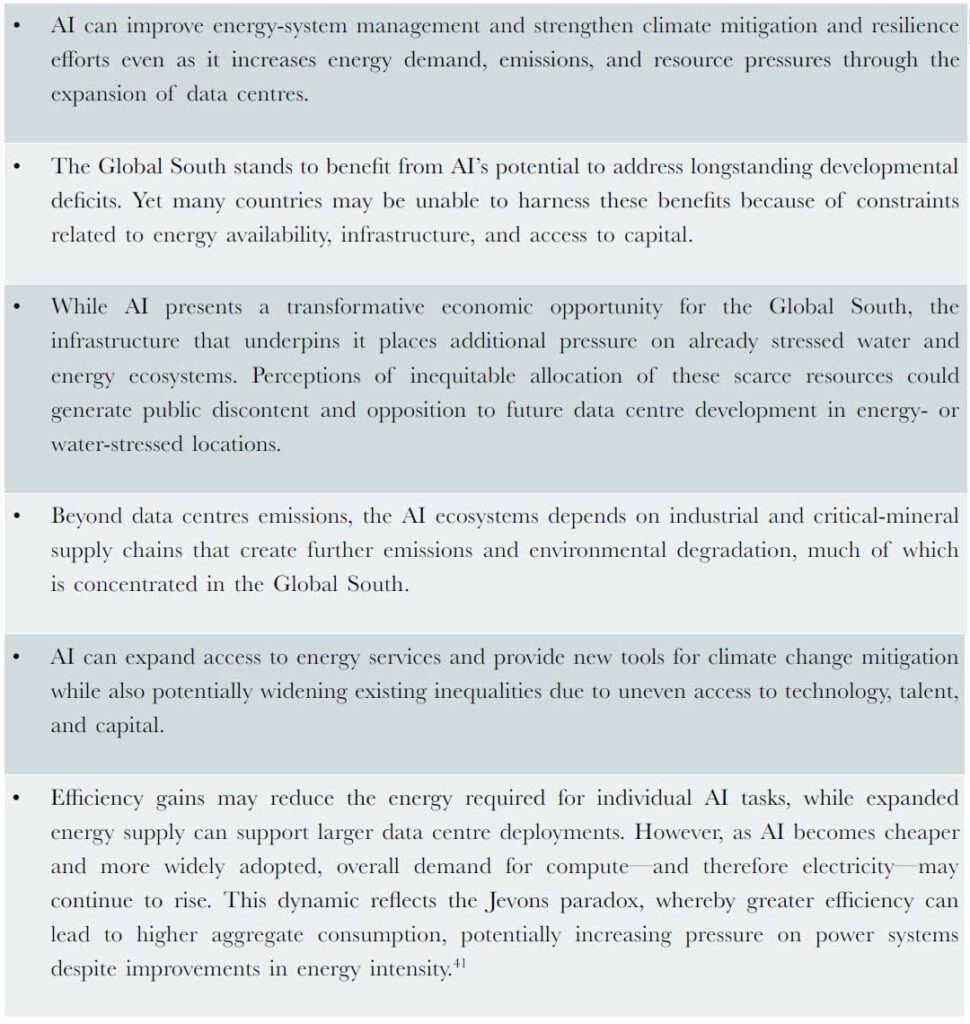
Based on the inherent tensions between AI deployment and its implications for energy and climate, the following paradoxes will shape future trajectories:
Table 4: Paradoxical Trendlines and Tensions Between AI and its Impact on Energy and Climate
Conclusion
The critical issue discussed in this article is not only how much electricity AI consumes, but whether the terms under which that demand is met align with national development priorities and climate goals, especially in the Global South where systemic disparities shape energy access and climate vulnerability. Relatedly, societal acceptance of AI is becoming a growing governance concern in the Global South. AI infrastructure investment may intensify public anxieties over already constrained electricity and water resources.42 Globally, broader concerns about AI’s disruptive economic and societal effects have been tilting public perception towards scepticism.43
Given structural differences among Global South countries, there is no one-size-fits-all approach to address the rising impact of AI on energy and climate policies. Yet across contexts, national AI strategies, energy policy, climate commitments, and development priorities need to be aligned and treated as interconnected rather than separate domains. The ability to ingrain these considerations into its deployment in the Global South will ultimately determine whether AI emerges as a positive catalyst and enabler for development or an amplifier of existing inequities.
Andreas Kuehn is Senior Fellow, Technology, ORF America.
Cauvery Ganapathy is Fellow, Climate and Energy, ORF Middle East.
The authors acknowledge the use of ChatGPT 5.5 to conduct a preliminary literature survey.
Endnotes
[1] IEA, Energy and AI, April 2025, Paris, International Energy Agency, 2025, https://www.iea.org/reports/energy-and-ai.
[2] IEA, Energy and AI, April 2025, Paris, International Energy Agency, 2025, https://www.iea.org/reports/energy-and-ai.
[3]“Energy and AI”. 3 Unless otherwise indicated, the IEA figures cited in this article refer to the IEA’s “base case” scenario: its central projection for global data centre electricity demand, against which the report compares its lift-off, headwinds, and high efficiency cases.
[4] The analysis focuses on 2025–2030 to examine near- and medium-term developments in AI infrastructure buildout and their effects on energy demand and climate.
[5] Although these countries have in common economic growth potential, vulnerability to impacts of climate change, and importantly, policy and business environments that prioritise AI adoption and deployment, the ‘Global South’ itself is a contested category and not homogenous. It includes the high-income, energy-abundant states, such as the UAE and Saudi Arabia that have robust technology partnerships with the United States, just as it counts less endowed countries of Asia, Africa, and Latin America.
[6] This article refers to ‘sovereign AI’ as a country’s ability to develop, deploy, and govern all relevant aspects of AI technology and systems, using domestic or foreign trusted infrastructure, data, talent, and institutions, in ways that align with national priorities, values, and regulatory requirements. See: McKinsey & Company, “What Is Sovereign AI?,” March 6, 2026, https://www.mckinsey.com/featured-insights/mckinsey-explainers/what-is-sovereign-ai; John Letzing, ”What is ‘Sovereign ‘AI? And Why is the Concept So Appealing?,” World Economic Forum, November 13, 2024, https:// www.weforum.org/stories/2024/11/what-is-sovereign-ai-and-why-is-the-concept-so-appealing-and-fraught.
[7] In some instances, capacity is undisclosed or data is not available.
[8] Data centres are a broader category and may support workloads beyond AI, including cloud services, enterprise computing, storage, networking, and content delivery.
[9] Numbers are based on Mordor Intelligence publicly available data sources, comparing current data centre IT load capacity in 2025 or 2026 with estimated capacity for 2030 or 2031, as indicated. IT load capacity refers to electrical power capacity (i.e., power demand) by installed computing, storage, and networking equipment, typically measured in megawatts (MW) or gigawatts (GW). It excludes additional facility power used for cooling, lighting, and other non-IT systems.
[10] OpenAI, “Introducing Stargate UAE,” May 22, 2025, https://openai.com/index/introducing-stargate-uae.
[11] Yotta Data Services, “Yotta to Deploy One of Asia’s Largest NVIDIA Blackwell HGX B300 Superclusters with Over 20,000 NVIDIA Blackwell Ultra GPUs,” February 18, 2026, https://yotta.com/press-releases/yotta-to-deploy-20000- nvidia-blackwell-ultra-gpus.
[12] Thomas Kurian, “Our First AI Hub in India, Powered by a $15 Billion Investment,” Google India Blog, October 14, 2025, https://blog.google/intl/en-in/company-news/our-first-ai-hub-in-india-powered-by-a-15-billion-investment.
[13] Chester Tay, “YTL Power Completes First Nvidia-Powered AI Data Centre in Johor, YTL AI Cloud Now Operational,” The Edge Malaysia, October 31, 2025, https://theedgemalaysia.com/node/776142.
[14] BDx Data Centers, “BDx Data Centers Launches the First Phase of 500MW Renewable-Powered AI Campus in Indonesia,” July 31, 2024, https://www.bdxworld.com/press-release/bdx-data-centers-launches-first-phase-of-500mwrenewable- powered-ai-campus-in-indonesia.
[15] Vantage Data Centers, “Vantage Data Centers Expands to Africa with US$1 Billion Flagship Johannesburg Campus in Continent’s Largest Data Center Market,” October 13, 2021, https://vantage-dc.com/news/vantage-data-centersexpands- to-africa-with-us1-billion-flagship-johannesburg-campus-in-continents-largest-data-center-market.
[16] G42, “G42 and Kenya’s EcoCloud Unveil Green-Powered Mega Data Center Collaboration,” March 6, 2024, https:// www.g42.ai/resources/news/g42-and-kenyas-ecocloud-unveil-green-powered-mega-data-center-collaboration.
[17] “Google to Invest $2 Billion in Malaysian Data Center and Cloud Hub,” Associated Press, May 30, 2024, https://apnews. com/article/malaysia-google-investment-94764341b721e1c1f3fb2d607604f011; Ministério de Minas e Energia, “MME Abre Caminhos para Conexão de Complexo de Data Centers à Rede Básica no RS,” May 13, 2025, https://www.gov. br/mme/pt-br/
[18] CloudHQ, “QRO Campus,” https://cloudhq.com/campus/qro-campus.
[19] “Energy and AI”.
[20] Nico Portuondo, Adam Aton, and Kelsey Tamborrino, “Super-Sized Utility Merger Runs through Virginia,” Politico, May 19, 2026, https://www.politico.com/news/2026/05/19/power-companies-merger-lower-bills-affordabilitypolitics- 00927494.
[21] NextEra Energy, “NextEra Energy and Dominion Energy to Combine, Creating the World’s Largest Regulated Electric Utility Business and North America’s Premier Energy Infrastructure Platform Benefiting Customers,” May 18, 2026, https://newsroom.nexteraenergy.com/2026-05-18-NextEra-Energy-and-Dominion-Energy-to-Combine,-Creatingthe- Worlds-Largest-Regulated-Electric-Utility-Business-and-North-Americas-Premier-Energy-Infrastructure-Platform- Benefiting-Customers.
[22] “UAE Data Center Capacity to Surge 165% by 2028,” Emirates NBD Research, October 14, 2025, https://www. emiratesnbdresearch.com/-/media/emirates_nbd_research_-_macro_economics_10142025.pdf.
[23] Mike Jacobs, “Power Hungry: Why Data Centers are Developing their own Energy Sources to Fuel AI,” Union of Concerned Scientists, July 10, 2025, https://blog.ucs.org/mike-jacobs/power-hungry-why-data-centers-are-developingtheir- own-energy-sources-to-fuel-ai.
[24] “Energy and AI”.
[25] “Energy and AI”.
[26] U.S. Department of Energy, “Energy Department Announces $625 Million Investment to Reinvigorate and Expand America’s Coal Industry,” September 29, 2025, https://www.energy.gov/articles/energy-department-announces-625- million-investment-reinvigorate-and-expand-americas-coal.
[27] Miguel Yanes Barnuevo, “Data Center Power Demands are Contributing to Higher Energy Bills,” Environmental and Energy Studies Institute, February 24, 2026, https://www.eesi.org/articles/view/data-center-power-demands-are-contributing-tohigher- energy-bills.
[28] John Gramlich et al., “How Americans View Data Centers’ Impact in Key Areas, From the Environment to Jobs,” Pew Research Centre, March 12, 2026, https://www.pewresearch.org/short-reads/2026/03/12/how-americans-view-datacenters- impact-in-key-areas-from-the-environment-to-jobs.
[29] “Energy and AI”; IEA, World Energy Outlook Special Report, ‘Energy and AI’, International Energy Agency, 2024, https://iea. blob.core.windows.net/assets/de9dea13-b07d-42c5-a398-d1b3ae17d866/EnergyandAI.pdf.
[30] Georgia Butler, “Microsoft and G42 Data Center in Kenya Stalled Due to Lack of Power Capacity,” Data Center Dynamics, May 7, 2026, https://www.datacenterdynamics.com/en/news/microsoft-and-g42-data-center-in-kenyastalled- due-to-lack-of-power-capacity.
[31] Author’s compilation from multiple sources, including industry reports, government statistics, and market estimates. Sources include Wood Mackenzie for the UAE; KAPSARC for Saudi Arabia; The Financial Express for India; Ember for Malaysia and Indonesia; and Brasscom for Brazil. No direct reported data were found for South Africa and Mexico.
[32] World Economic Forum, “This is the State of Play in the Global Data Centre Gold Rush,” April 22, 2025, https://www. weforum.org/stories/2025/04/data-centre-gold-rush-ai.
[33] “Energy and AI”.
[34] Jade Sterling, “Methane Leak Detection Using Tracking Satellites,” Khalifa University, November 23, 2020, https://www.ku.ac.ae/methane-leak-detection-using-satellite-imagery.
[35] UNCTAD, Digital Economy Report 2024: Shaping an Environmentally Sustainable and Inclusive Digital Future, July 2024, New York, United Nations Conference on Trade and Development, 2024, https://unctad.org/publication/digital-economyreport- 2024.
[36] Luiz Inácio Lula da Silva, “Speech by President Luiz Inácio Lula da Silva at the Opening of the 78th UN General Assembly,” Planalto, September 19, 2023, https://www.gov.br/planalto/en/follow-the-government/speechesstatements/ 2023/speech-by-president-luiz-inacio-lula-da-silva-at-the-opening-of-the-78th-un-general-assembly.
[37] World Bank, Tracking SDG 7 – The Energy Progress Report 2025 (Washington, DC: World Bank, June 2025), https://www. worldbank.org/en/topic/energy/publication/tracking-sdg-7-the-energy-progress-report-2025.
[38] IEA, The Path to a New Era for Nuclear Energy, January 2025, Paris, International Energy Agency, 2025, https://www.iea.org/reports/the-path-to-a-new-era-for-nuclear-energy/executive-summary.
[39] World Economic Forum, “Large-Scale Battery Systems,” https://initiatives.weforum.org/future-power-system/casestudy- details/large-scale-battery-systems/aJYTG00000013Ld4AI
[40] “Energy and AI”.
[41১] Jevons paradox challenges the common intuition that greater technological efficiency necessarily reduces total resource use. By lowering the per-unit cost of use, efficiency gains can stimulate wider adoption and more intensive deployment, causing aggregate resource consumption to rise. See: Blake Alcott, “Jevons’ Paradox,” Ecological Economics 54, no. 1 (2005): 9–21, https://doi.org/10.1016/j.ecolecon.2005.03.020.
[42] “Digital Economy Report 2024: Shaping an Environmentally Sustainable and Inclusive Digital Future”.
[43] Jacob Poushter, Moira Fagan, and Manolo Corichi, “Concern and Excitement About AI,” in How People Around the World View AI, Pew Research Center, October 15, 2025, https://www.pewresearch.org/global/2025/10/15/concern-andexcitement- about-ai/.