 Global
Expert Speak | 24 August, 2026
Global AI: A Story of Fragmentation
The following excerpt is from Chapter 5 — ORF Global Quarterly | Energy and Tech: Powering the Future.
The inaugural issue of this series identified the rapid, fragmented growth of artificial intelligence (AI) as a megatrend for 2026.[1] This article revisits that trend at the year’s midpoint to examine how it has unfolded across the AI stack, and the challenge it poses for the Global South. The layers that require significant amounts of capital and expertise—frontier research, compute, and the investment that sustains them—have become increasingly concentrated in a handful of jurisdictions. Meanwhile, the user-facing layer has dispersed widely across the Global South. Global corporate AI investment reached US$581.7 billion in 2025, more than double the previous year’s total, with most of it flowing to the economies that already dominate research and hardware. This creates a structural vulnerability for countries outside the core. Economies with nascent domestic digital infrastructure, investment vehicles, research ecosystems, and governance frameworks risk being marginalised by the AI-driven future.
That concentration has a distinct geography. Frontier model development, chip design, and cutting-edge research remain concentrated in the United States (US); sovereign capital, energy, and connectivity corridors in the Gulf; and talent and advanced manufacturing in Asia, particularly China. Beneath these are a series of niche chokepoints—from leading-edge fabrication to specialist materials—controlled by a small number of actors elsewhere. In response, countries across the Global South have sought to build domestic capacity in selected layers of the stack. However, these efforts remain sub-frontier in scope, and no single country has pursued the entire value chain.
Yet concentration characterises only the supply side. Demand is moving in the opposite direction, reflecting the shift towards diffusion and use cases identified in the inaugural issue of this publication. The largest and fastest-growing user bases for frontier systems are now found in India, Indonesia, Brazil, Nigeria, and neighbouring markets. It is here that the region’s leverage—substantial but largely unrealised—is accumulating.
The rest of this article examines how growth has remained fragmented across research, infrastructure, investment, commercialisation, and governance; assesses the developments that, since the trend was first identified, have begun to reshape this landscape; and considers whether these emerging opportunities can be institutionalised before concentration becomes entrenched.
The Story of Fragmented Growth
Research in AI has historically been led by the US, but the frontier and the broader research base have increasingly diverged. In terms of notable model releases, the landscape remains highly concentrated: the US and China together account for the large majority each year,[2] while every other country named in the Stanford AI Index contributes only low single-digit shares. New entrants have emerged at the margins, from Saudi Arabia and the United Arab Emirates to scattered launches across Latin America and Southeast Asia. Publications are far more geographically distributed. China now produces 17.8 percent of all papers on AI globally; India accounts for 7.6 percent, and the steadily declining share of the US is at 7.3 percent.[3] This divergence between a broadening publication base and a concentrated frontier defines the conditions under which the Global South enters the next phase of AI development. It demonstrates that wider participation in research does not, by itself, convert into frontier capability.
Figure 1: AI Model Releases, by Country (2023-2025)
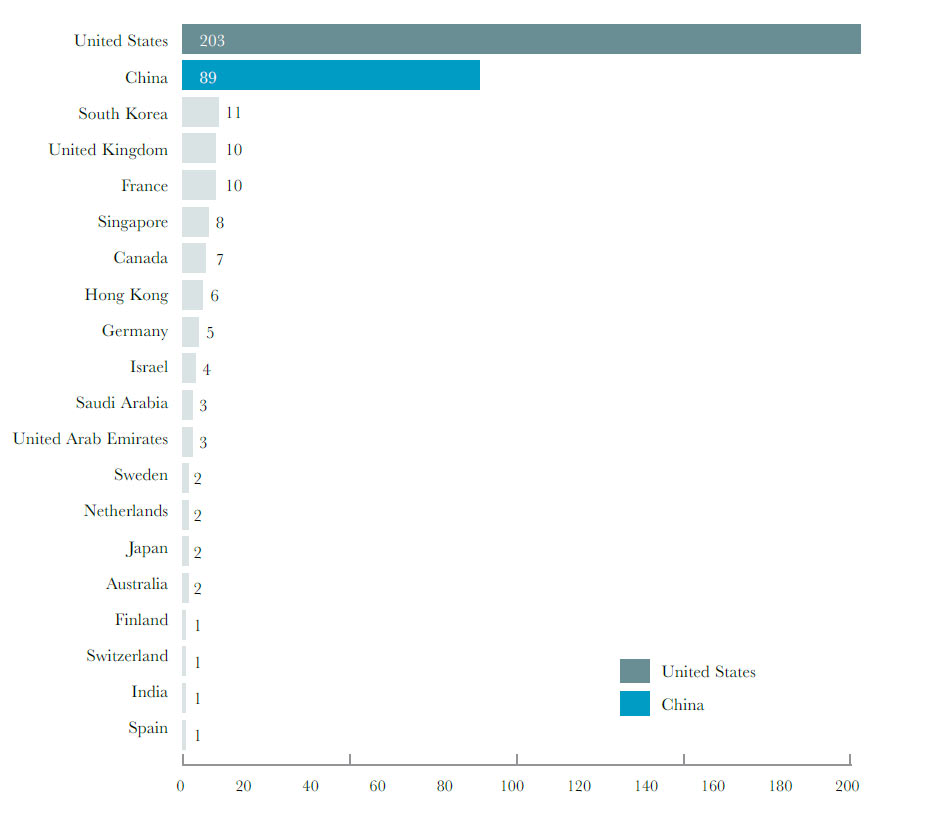
Source: Author’s own, using data from Epoch AI[4]
Infrastructure Development
Research participation has broadened, but infrastructure remains concentrated. The United States retains the largest share of global data-centre capacity by far,[5] and the electricity consumed by its data centres—around 31 GW in 2025—is expected to roughly double by 2027.[6] Spending by the largest cloud companies has risen in step, from about US$256 billion in 2024 to a projected US$600–750 billion in 2026.[7] The Gulf joined this expansion at scale in 2025. The UAE’s MGX helped finance OpenAI’s Stargate project, while Saudi Arabia’s HUMAIN, backed by its sovereign wealth fund, committed to data centres on a similar scale.[8] Both, however, remain dependent on American chips and the firms that operate these facilities.
India’s IndiaAI Mission was launched in 2024 with roughly 34,000 GPUs against a US$1.25- billion budget.[9] Although comparatively small, the mission sets a precedent on which the region’s leverage may later depend, that of an early case of a country building AI capacity of its own, short of the frontier but tailored to its strengths and challenges. Through all of this, close to 90 percent of TSMC’s chipmanufacturing capacity, and effectively all production of the most advanced AI chips, has stayed in Taiwan. Computing power, therefore, remains with US cloud giants and a small group of Gulf and East Asian state-backed players, leaving most of the Global South reliant on outside providers.
Figure 2: Data Centre Concentration, by Country
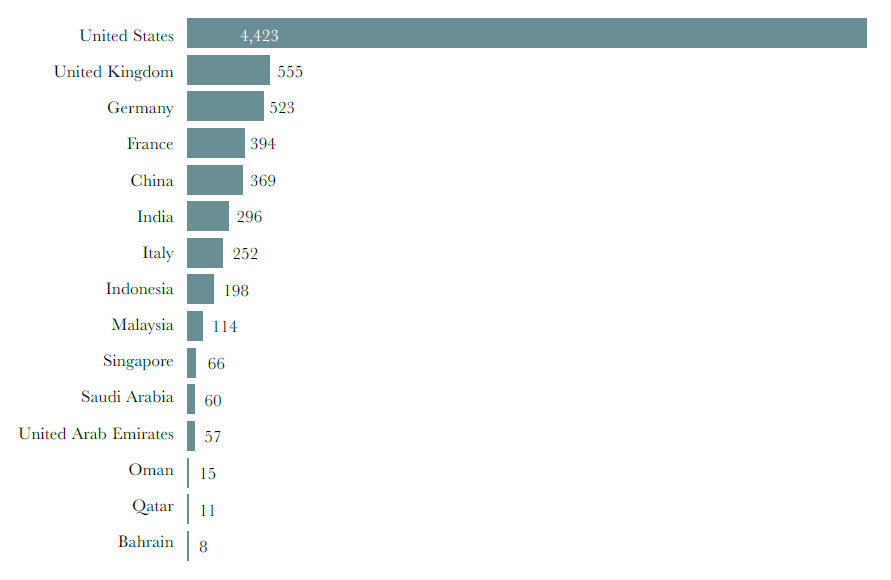
Source: Author’s own, using Statista[10]
Investment Flows
AI investment has consolidated into three pools over recent years. Global corporate AI investment hit US$581.7 billion in 2025, more than double the US$253 billion recorded in 2024 and well above the previous peak of US$360 billion in 2021.[11] Of this total, US$344.7 billion came from private investment, with the United States capturing US$285.9 billion—roughly 83 percent of the global private pool. Foundationmodel labs alone accounted for an estimated US$80 billion.[12] China represents a second pool, supported by state guidance funds that have deployed an estimated US$184 billion into AI firms since 2000.[13] The third is emerging in the Gulf. Mubadala, with US$326.7 billion in assets under management (AUM), became the world’s most active sovereign wealth fund in 2024, while MGX was launched that year as its dedicated AI investment vehicle.[14] Saudi Arabia’s Public Investment Fund (PIF) has similarly channelled investment through HUMAIN, launched in May 2025. Efforts to mobilise capital elsewhere are also underway. India’s IndiaAI Mission, approved in 2024 with US$1.25 billion over five years, and Africa’s cumulative AI startup funding of US$803 million since 2019 reflects growing interests in building AI ecosystems across the Global South.[15] However, the gap in the availability of capital remains structural, not transitional.
Commercialisation
Deployment is the least concentrated layer of the AI stack and the one where the weight of the Global South is apparent. The fastest and most intensive adopters are often small, advanced economies like the UAE and Singapore, which have led global AI adoption through 2025 and into 2026.[16] The scale, however, sits elsewhere. India is now OpenAI’s second-largest market, with around 100 million of the platform’s users,[17] while Indonesia, Brazil, Egypt, Mexico, and Vietnam rank among its fastest-growing markets.[18] Enterprise adoption is following a similar pattern: 87 percent of Indian firms report active AI use, and many have already deployed generative-AI applications in production.[19]
This weight, however, should not be mistaken for market power. Revenue per user and enterprise spending remain higher in North America and Europe and are likely to do so for some time. A large user base, therefore, does not automatically translate into commercial leverage. What it creates is potential: sustained growth in these markets and incentives for developers to adapt products to local languages, costs, and conditions. This gives the region a hold on the demand side that the supply side does not offer. That hold is not without cost, however. Rapid adoption can also displace existing work, as it threatens to do in India’s IT and business-process sectors, so the same demand that confers leverage carries disruption alongside it.
Policy and Governance
Governance has fragmented as the supply layers concentrated, splitting along bloc lines that reflect distinct regulatory philosophies. The European Union has gone furthest in establishing binding rules. Its AI Act, which entered into force in 2024, adopts a risk-based approach that scales obligations according to the risks posed by a system. Yet even the EU has moderated its approach, deferring core obligations for high-risk systems to 2027 and 2028 through a 2026 simplification package amidst growing competitiveness concerns.[20]
The US has moved in the opposite direction. The Biden administration’s 2023 executive order was rescinded in January 2025 in favour of an openly deregulatory stance in its July 2025 AI Action Plan.[21] China, meanwhile, combines targeted rules on generative-AI and data with a state-directed industrial push, its 2026 Five-Year Plan elevating AI to a national priority built around economy-wide diffusion and home-grown compute. Global South frameworks are taking shape in the gaps these three leave, and tend to converge on data sovereignty and localisation, with India’s data protection law and the African Union’s 2024 continental strategy among the early markers.[22]
Above these national and bloc-level frameworks sit voluntary initiatives such as UNESCO’s 2021 Recommendation on the Ethics of Artificial Intelligence[23] and the G7’s Hiroshima process.[24] These provide a shared language but lack enforcement mechanisms. The summit process that began at the United Kingdom in 2023 and continued through South Korea, France, and India has become the main forum through which this voluntary layer develops. Its southward drift, with India co-hosting in 2025 and hosting the 2026 Impact Summit, demonstrates the growing footprint of the Global South in AI development and governance agendas.
This is where the region’s governance leverage lies, and where its priorities diverge from the North. While the United States and Europe foreground frontier safety, security, and risk, Global South governments press for access to models and compute, for data sovereignty, and for rules that serve development goals as much as control. The largest concentrations of AI users already sit in the Global South, and the authority to convene around governance, set against that demand-side weight, gives middle powers a hand they have yet to fully play. Building a common position across these priorities is the leverage the summit series makes possible.
Shifting Trajectories
Shift from Multilateral to Bilateral Frameworks: The frontier advances of 2026 are further widening existing divides. The India AI Impact Summit briefly suggested that multilateral deliberations were expanding to include the Global South, but two developments since then have narrowed that opening. The first is the arrival of gated frontier models. Anthropic’s Claude Mythos, released through Project Glasswing, and OpenAI’s GPT-5.5 alarmed regulators with their cybersecurity capabilities.[25] Access has been extended selectively but without any predictability. India is among the small group of countries granted entry to Glasswing in late May. However, on 12 June, the White House ordered Anthropic to restrict access to Mythos and Fable— the commercial version of Mythos—only to Americans due to national security reasons,[26] making the question for most of the Global South one of the terms of access to the frontier.
The second development is a shift in US posture. Washington’s containment strategy had isolated China from advanced hardware while promoting bilateral deals with the UAE, Qatar, and India and underwriting frameworks such as Pax Silica. The May 2026 Beijing visit, in permitting Nvidia H200 exports to China and opening talks on AI guardrails, marked a notable departure from that line,[27] though the wider architecture remains in place. The move also carries a security dimension since exporting advanced compute and loosening guardrails widens access to capabilities with clear dualuse and military potential. Consequently, Gulf players are likely to scrutinise the security conditions attached to US hardware more closely, and a formalised US-China channel that excludes them could push the multilateral platforms they host towards the narrower work of managing dependencies.
Regional Tensions and Second- Order Effects
The US-Israel-Iran conflict is repricing the cost of building compute. The roughly US$300 billion in investment pledges, along with the Pax Silica framework aligning the UAE and Qatar with US chip controls, have so far remained intact. However, the strain is now showing on the supply side. Strikes on Qatar’s Ras Laffan have disrupted the global supply of helium, a gas the chip industry depends on for cooling critical equipment. The shortfall fed through to Samsung and SK Hynix in Korea, the two firms that make most of the high-bandwidth memory used to train AI models, with the resulting shortages projected to run into 2027.[28] The costs compound through 2026 as warrisk insurance for Gulf shipping has already risen several times over.[29] The next phase of construction will divert significant spending into physical and cyber defence, making resilience a built-in feature of AI infrastructure in the region.
The effects extend beyond the Gulf. For much of the Global South, where growth in AI users is concentrated, higher infrastructure costs may translate into more expensive compute and AI services. At the same time, politically stable countries with sufficient scale become more attractive as alternative locations for investments. This strengthens the case for building sovereign AI capacity short of the frontier and reducing dependence on any single regional axis. One knock-on effect may be faster adoption of open-weight models, a market that Chinese developers currently lead,[30] and which offers the region a way to deploy capability it does not have to build itself.
Conclusion
The fragmentation in the global AI landscape that began to emerge in the past few months has hardened in some areas and loosened in others The layers that lend towards concentration— research, infrastructure, and investment—have become more tightly clustered around the United States and a small number of allied partners, while deployment has continued to shift towards the Global South. Events in 2026 have further reshaped this landscape. The Pax Silica framework, the repricing of compute by the US-Israel-Iran conflict, and the energy and cybersecurity pressures that followed have together reset what AI infrastructure costs and what it takes to keep it safe.
The leverage of countries of the Global South runs along the demand side, in the scale of its user base, its strength in application and use cases, and the pull towards openweight models, together with the room for sovereign capacity short of the frontier in stable geographies and the convening authority earned by hosting the summits. None of it is yet converted into outcomes. Whether these countries can institutionalise the opening before the configuration hardens again is the open question of the year ahead.
Siddharth Yadav is Fellow, Technology, ORF Middle East.
Gemini 3.5 Flash was used by the author for preliminary literature review.
[1] Sharon Stirling and Eszter Karacsony, Eds., ORF Global Quarterly: Navigating Megatrends for 2026, ORF Global, January 2026, https://www.orfonline.org/english/research/orf-global-quarterly-navigating-megatrends-for-2026.
[2] Nestor Maslej et al., Artificial Intelligence Index Report 2025, Chapter 1: Research and Development, Stanford, CA, Stanford Institute for Human-Centered Artificial Intelligence, 2025, https://hai.stanford.edu/assets/files/hai_ai-indexreport- 2025_chapter1_final.pdf.
[3] Nestor Maslej et al., Artificial Intelligence Index Report 2026, Research and Development, Stanford Institute for Human- Centered Artificial Intelligence, April 2026, https://hai.stanford.edu/ai-index/2026-ai-index-report/research-anddevelopment.
[4] Epoch AI, “AI Models,” June 25, 2026, https://epoch.ai/data/ai-models?view=graph&tab=notable
[5] United States International Trade Commission, Recent Trends in U.S. Services Trade: 2022 Annual Report, Publication No. 5325, Washington DC, United States International Trade Commission, May 2022, 54, https://www.usitc.gov/publications/ services/pub5325.pdf; “Artificial Intelligence Index Report 2026”.
[6] “US Data Center Power Demand Projected to Double by 2027,” Goldman Sachs, May 20, 2026, https://www. goldmansachs.com/insights/articles/us-data-center-power-demand-projected-to-double-by-2027.
[7] Sharon Goldman, “Big Tech is About to Spend $700 Billion on AI this Year. No One Knows Where the Buildout Ends,” Fortune, April 30, 2026, https://fortune.com/2026/04/30/big-tech-hyperscalers-will-spend-700-billion-on-aiinfrastructure- this-year-with-no-clear-end-in-sight-eye-on-ai/.
[8] “Announcing The Stargate Project,” OpenAI, January 21, 2025, https://openai.com/index/announcing-thestargate- project/; “G42 to Lead Consortium of US Partners to Build 5GW UAE-US AI Campus,” G42, May 2025, https://www.g42.ai/resources/news/g42-lead-consortium-us-partners-build-5gw-uae-us-ai-campus; Donovan Vanderbilt, “HUMAIN’s AI Infrastructure Machine: 600,000 GPUs, $77 Billion, and the Race to Build Saudi Arabia’s Compute Future,” Vision2030, April 18, 2026, https://vision2030.ai/analysis/humain-ai-infrastructure/.
[9] Ministry of Electronics and Information Technology, Government of India, “IndiaAI Compute Capacity,” IndiaAI Mission, 2024, https://www.indiaai.gov.in/hub/indiaai-compute-capacity; “Artificial Intelligence Index Report 2026”.
[10] Statista, “Number of Data Centers Worldwide as of June 2026, by Country or Territory,” June 2026, https://www.statista.com/statistics/1228433/data-centers-worldwide-by-country/.
[11] “Artificial Intelligence Index Report 2026”.
[12] Partech Partners, 2025 Africa Tech VC Report, Partech, 2025, https://partechpartners.com/africa-reports/2025-africa-techventure- capital-report/topline-deals-and-volumes-(equity-&-debt)
[13] “Artificial Intelligence Index Report 2026”.
[14] Shweta Jain, “Mubadala Asset Base Grows to $326bn on AI and Future-focused Investments,” The National, May 8, 2025, https://www.thenationalnews.com/business/2025/05/08/mubadala-asset-base-grows-on-back-of-ai-and-futurefocused- investments/; “Mubadala is 2024’s Most Active Sovereign Wealth Fund,” Gulf News, January 1, 2025, https://gulfnews.com/business/markets/mubadala-is-2024s-most-active-sovereign-wealth-fund-1.500009652.
[15] Ministry of Electronics and Information Technology, “IndiaAI Compute Capacity”; StartupList Africa, “The AI Revolution in Africa 2025,” June 2025, https://blog.startuplist.africa/articles/ai-revolution-in-africa-2025.
[16] “Artificial Intelligence Index Report 2026”.
[17] Jagmeet Singh, “India has 100M Weekly Active ChatGPT Users, Sam Altman Says,” TechCrunch, February 15, 2026, https://techcrunch.com/2026/02/15/india-has-100m-weekly-active-chatgpt-users-sam-altman-says/.
[18] “ChatGPT Usage by Country Statistics: February 2026,” Siana Marketing, March 2026, https://www.sianamarketing. com/resources/chatgpt-usage-by-country-2026.
[19] “Indian Companies are Investing in AI for the Long Term,” IBM Newsroom India, February 12, 2025, https://in.newsroom. ibm.com/2025-02-12-Indian-Companies-Are-Investing-In-AI-For-The-Long-Term-IBM-Study; “India’s AI Shift from Pilots to Performance: 47% of Enterprises Have Multiple AI Use Cases Live in Production,” EY Newsroom India, November 16, 2025, https://www.ey.com/en_in/newsroom/2025/11/india-s-ai-shift-from-pilots-to-performance-47-percent-ofenterprises- have-multiple-ai-use-cases-live-in-production-ey-cii-report.
[20] “Artificial Intelligence: Council and Parliament Agree to Simplify and Streamline Rules,” Council of the European Union, May 7, 2026, https://www.consilium.europa.eu/en/press/press-releases/2026/05/07/artificial-intelligence-counciland- parliament-agree-to-simplify-and-streamline-rules/.
[21] White House, “Executive Order on Initial Rescissions of Harmful Executive Orders and Actions,” Executive Order 14148, January 20, 2025, https://www.federalregister.gov/documents/2025/01/28/2025-01901/initial-rescissions-ofharmful- executive-orders-and-actions.
[22] Parliament of India, The Digital Personal Data Protection Act, 2023, Act No. 22 of 2023, Gazette of India, August 11, 2023, https://www.indiacode.nic.in/bitstream/123456789/22037/1/a2023-22.pdf; African Union, Continental Artificial Intelligence Strategy, African Union, July 2024, https://au.int/sites/default/files/documents/44004-doc-EN-_ Continental_AI_Strategy_July_2024.pdf.
[23] UNESCO, Recommendation on the Ethics of Artificial Intelligence, Paris, UNESCO, 2022, https://unesdoc.unesco.org/ ark:/48223/pf0000381137.
[24] G7, Hiroshima Process International Code of Conduct for Organizations Developing Advanced AI Systems, 2023, https://www.soumu. go.jp/hiroshimaaiprocess/pdf/document04_en.pdf.
[25] “Project Glasswing: Securing Critical Software for the AI Era,” Anthropic, April 7, 2026, https://www.anthropic.com/ glasswing; “Introducing GPT-5.5,” OpenAI, April 23, 2026, https://openai.com/index/introducing-gpt-5-5/.
[26] Maxwell Zeff, “Anthropic Says It’s Taking Claude Fable 5 Offline to Comply With US Government Order,” Wired, June 12, 2026, https://www.wired.com/story/anthropic-says-us-government-ordered-it-to-shut-down-mythos-models/.
[27] Trisha Ray, “Three Elements Trump’s ‘Pax Silica’ Needs to Succeed,” Atlantic Council, April 15, 2026, https://www.atlanticcouncil.org/dispatches/three-elements-trumps-pax-silica-needs-to-succeed/.
[28] Prateek Tripathi, “Has the Iran War Triggered Another Semiconductor Crisis?,” Observer Research Foundation, April 13, 2026, https://www.orfonline.org/expert-speak/has-the-iran-war-triggered-another-semiconductor-crisis.
[29] “Strait of Hormuz Reopening Won’t Mean Cheaper Shipping as Insurance Premiums Surge,” Khaleej Times, May 12, 2026, https://www.khaleejtimes.com/world/strait-hormuz-reopening-shipping-costs-insurance-premiums.
[30] Siddharth Yadav, “After Project Glasswing: Frontier AI and Sovereign Recovery,” ORF Middle East, May 11, 2026, https://orfme.org/expert-speak/after-project-glasswing-frontier-ai-and-sovereign-recovery/.