 Global
Expert Speak | 13 November, 2026
Subsea Cable Connectivity and Regional Cooperation in the Gulf
Spotlight
- The Gulf’s undersea cables are at risk of being targeted in the ongoing military strikes. The regional conflict has already seen data held in Amazon Web Services’ Bahrain and UAE regions become irrecoverable, which, according to the International Telecommunication Union (ITU), appears to be a first for an armed conflict.
- More cables are scheduled to come online by 2027, but every new cable risks expanding exposure to disruption caused by regional conflict.
- GCC governments have been quicker to put cable damage on record at the ITU, the UN agency for telecommunications, than to plan for repair. That leaves the region with a diplomatic record of harm but no shared means to undo it.
Military confrontations in the Gulf since 28 February 2026 have turned civilian digital infrastructure into strategic targets. Iran has now explicitly identified subsea internet cables running beneath the Strait of Hormuz as viable targets. On 23 October 2026, two of its senior security officials stated that Tehran had detailed plans to strike subsea cables if Iran was attacked again. The impact of such attacks on digital infrastructure was made apparent on 15 September, when Amazon Web Services (AWS) announced that it could not restore data that was held exclusively in its data centre in the Bahrain and UAE regions, more than six months after its facilities were taken offline due to drone strikes. According to the International Telecommunications Union’s (ITU) interim report on the attacks, the permanent loss of data was “without precedent” in an armed conflict.
The capacity to repair subsea cables may be as consequential in the region as the ability to damage them.
The capacity to repair subsea cables may be as consequential in the region as the ability to damage them. The smaller Gulf states through which the subsea cables pass—whether over land or under water—hold part of that capacity, a leverage they can convert into diplomatic standing. This, however, will only last if GCC governments pool the repair ships, permits, and backup sites that cannot be supplied by any one state.
Four Gulf States Have No Subsea Route Around Hormuz
Currently there are six cables in service across the Strait of Hormuz. Two new cables are due in 2027 that will follow the ones along the existing route. Therefore, the Gulf’s capacity to route data might increase, but so will the region’s security exposure. Maritime analytics show that Iraq, Kuwait, Bahrain, and Qatar have no subsea cable route outside the region that avoids the Strait. For them, laying more cables adds bandwidth but they have no way to circumvent the chokepoint.
Of the six cables currently under the Strait, three (FALCON, Gulf Bridge International or GBI, and Omran/EPEG) also land in Iran. Cutting them would therefore also disrupt Iran’s own links. The other three cables (2Africa, AAE-1, and Tata TGN-Gulf) do not touch Iran. Neither will the FIG and SEA-ME-WE 6, the two new cables due to open in 2027. Therefore, five of the eight cables in the Strait will not land in Iran. As the number of cables bypassing Iran increases, the dependence of Iran on the subsea cable network decreases. With the increased exposure, the four states without another subsea route would gain more from a binding commitment that allows repair ships to reach damaged cables.
Iran is now intervening in cable repairs as well. An Iranian security official stated that the country would aim to prevent cable repairs after any attack to prolong the disruption to communications. In May 2026, an Islamic Revolutionary Guard Corps (IRGC)-affiliated news agency went even further to propose that only Iranian companies should maintain and repair the cables in the Strait and levy licensing fees upon foreign operators.
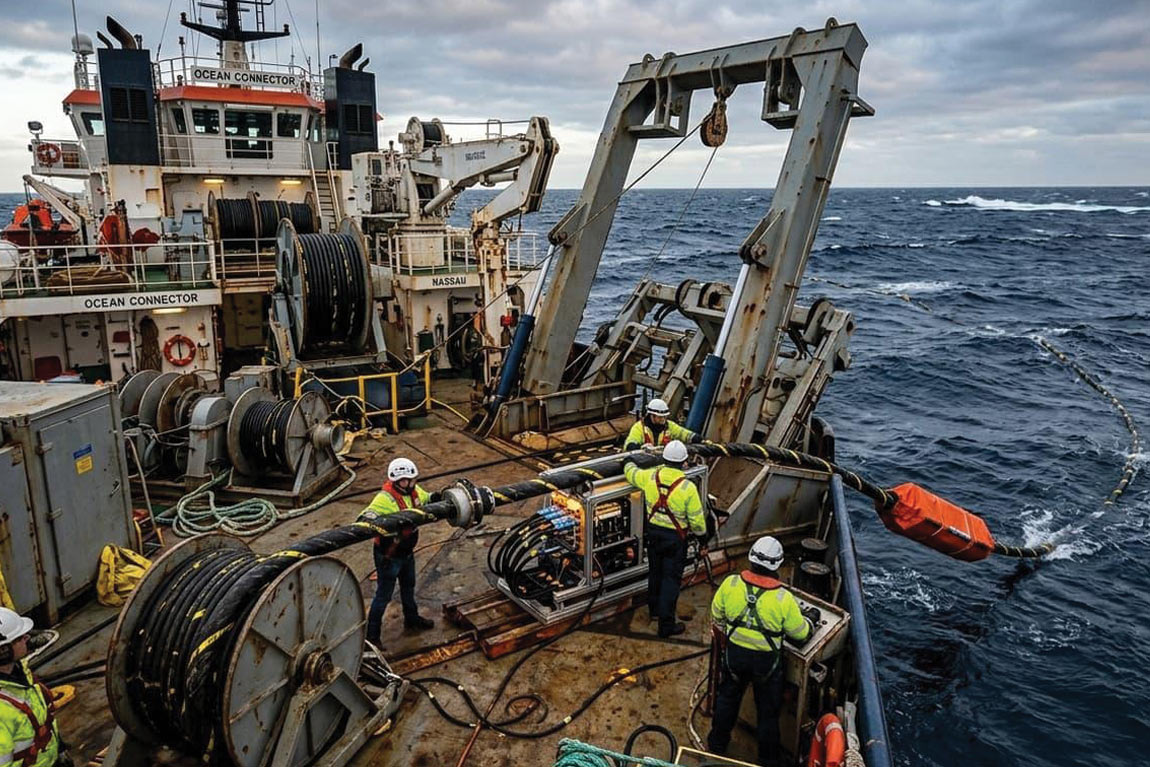
The resumption of data traffic through subsea cables entirely depends on the capacity to repair. In the Red Sea, three cables damaged in 2024 took six months to fix. Following the Iranian statements, cable repair permits in the Strait have become a political rather than a logistical issue. While these are stated positions rather than policy, they leave repair ships and operators unsure about the feasibility of repair work in the Strait.
Waters, Land, and Hosting Give Transit States a Stake
Once the permit to repair cables in the Strait of Hormuz becomes a political question, so does the legal status of the waters the cables cross. In a joint statement on 23 October 2026, the United Kingdom (UK) and Oman reaffirmed Oman’s sovereignty over Omani waters in the Strait under the United Nations (UN) Convention on the Law of the Sea. This gives Oman a stake in the repairs because every cable in the Strait passes through Omani waters. Oman can now raise the cable-repair question bilaterally with Iran. While Oman Foreign Minister Sayyid Badr Albusaidi stated on 26 October that talks with Tehran have produced an outline of a temporary arrangement on the Strait, there was no mention of cables.
Such arrangements, whether arranged bilaterally or at the GCC level, will be key to the future of digital connectivity in the region, particularly for smaller states.
The other option is a cable-repair arrangement run jointly by Gulf Cooperation Council (GCC) governments. Such arrangements, whether arranged bilaterally or at the GCC level, will be key to the future of digital connectivity in the region, particularly for smaller states. If cables are damaged, Iraq, Kuwait, Bahrain, and Qatar will have to move their internet traffic onto overland cables across neighbouring states’ territories, giving the latter a stake in cable repair as well. Google and Meta have reportedly started routing data over a land route, a backup to the Red Sea cables running between Europe and Asia.
Iraq, in turn, has started to turn its position on the land route between the Gulf and Europe into contracts. On 10 September 2026, its Minister of Communications Mustafa Sanad announced a contract for Qatar’s Ooredoo to carry internet capacity across Iraq to Europe. The route across Iraq is the only overland alternative being built by any of the four states. Carrying the region’s internet traffic over land comes with its own set of security risks, but it can also improve Iraq’s diplomatic standing. Hosting data from other states is not a new regional arrangement. For instance, under a 2018 law, Bahrain lets designated foreign states store their data in its data centres under the origin state’s laws and regulations.
GCC Governments Need a Joint Plan for Repair
Bahrain’s 2018 law is a national policy, not a collective GCC-wide step. So far, GCC governments have put the damage to the region’s digital infrastructure on record at the ITU, which then adopted Resolution 1436 on the impact in Bahrain, Kuwait, the UAE, and Jordan as well as regional connectivity. There is, however, no joint arrangement for repairing cables. At a meeting of GCC telecom ministers in Manama on 18 October 2026, the GCC General Secretariat received a proposal to link member states’ digital networks, following the GCC electricity grid model. The grid was mainly built so that members could share reserves in emergencies. Using the same model would mean that digital links can serve as shared insurance when one state’s digital infrastructure is disrupted. However, no arrangement so far allows for GCC states to share repair ships or to grant repair permits in anticipation of a possible cable disruption.
The gap in cable-repair arrangements remains, despite calls for Gulf security cooperation. Oman’s foreign minister called for a non-aggression pact among states on the Gulf’s shore on 27 October 2026, whereas Qatar’s foreign ministry has asked for a new regional security framework. Neither, however, mentions subsea cables.
Transit states have leverage due to their geography, which allows them to facilitate digital connectivity in the region. However, this geography can turn into lasting influence only if there is a collective effort to protect connectivity.
The necessity of digital connectivity has so far given every side a reason to leave the cables alone. Disruptions to the cable network would hurt everyone, including Iran. But this incentive weakens as more new cables bypassing Iran come into service. Limiting exposure right now would require a binding arrangement on pooling repair ships and on advance repair permits that allow the ships to reach the damaged cables. The ITU’s member states meet in Doha in November 2026; a joint GCC proposal there would give multilateral backing to the states that carry the region’s internet traffic. Transit states have leverage due to their geography, which allows them to facilitate digital connectivity in the region. However, this geography can turn into lasting influence only if there is a collective effort to protect connectivity.
Siddharth Yadav is Fellow, Technology, ORF Middle East.