 Global
Expert Speak | 05 November, 2026
The Resilience Premium: Which Alternative Route Is Worth Paying For?
Spotlight
- The Hormuz crisis has highlighted the economic value of alternative energy corridors, but not every bypass justifies its cost.
- Alternative routes do not necessarily eliminate geopolitical vulnerabilities. They can sometime simply relocate chokepoints and create new dependencies.
- Three tests—persistence, connection, and duration—determine whether an alternative corridor is worth its resilience premium.
Since it was commissioned, Saudi Arabia’s East–West pipeline mostly amounted to an expensive insurance against a potential contingency. Constructed in 1981, amid the Iran–Iraq war, this Hormuz by-pass was moving only around 2 million barrels a day (mb/d) against a reported capacity of 7 mb/d. This was until the United States (US)-Israel–Iran conflict starting on 28 February 2026 largely closed the Strait of Hormuz; thereafter, it operated at capacity. Aramco’s Chief Executive Officer (CEO) Amin Nasser has argued that the pipeline contributed more to stabilising oil markets than strategic reserve releases. The investment in this pipeline can thus be understood as four decades of premium with one exceptionally large payout.
Governments in the Gulf region have absorbed this lesson. Abu Dhabi is speeding up the development of a new West–East pipeline, expected to double export capacity through Fujairah in 2027, and DP World has reached an agreement to develop two terminals there. Simultaneously, Iraq and Syria have agreed to reconstruct a pipeline connecting to the Mediterranean. With Tehran maintaining that Hormuz will remain closed until Iran’s demands are satisfied, this rush for alternatives is hardly surprising. However, the real questions are: are insurance corridors worth purchasing and will these assets remain usable in the face of the contingencies for which they were constructed?
Pricing the Premium
This insurance cost can be called the ‘resilience premium:’ the net additional cost of maintaining essential flows during geopolitical disruptions measured against a realistic baseline. Three elements in this definition matter.
This insurance cost can be called the ‘resilience premium:’ the net additional cost of maintaining essential flows during geopolitical disruptions measured against a realistic baseline.
‘Net’ accounts for multiple costs. First, it requires separating an asset’s security value from the commercial returns it would generate. DP World has partly justified its proposed Fujairah terminals by highlighting high utilisation at Jebel Ali and ADNOC’s additional pipeline will likewise accommodate its planned increase in production capacity. Treating the entire capital cost of either project as expenditure on resilience would therefore exaggerate the true premium. Further, calculating the benefit of alternative routes involves more than projecting the traffic volume. A barrel exported despite transit route closure commands the price prevailing during the crisis: Brent averaged US$91 in 2026, compared with US$69 over 2025. The value of a bypass rises during the circumstances in which demand for it is highest. Therefore, the export revenue is particularly useful when emergency expenditure raises fiscal needs. Yet, the benefit should not be overstated, as higher insurance costs continue to impact export margins. All these costs must be considered while pricing an alternative.
‘Realistic’ requires comparing a new investment with the counterfactual that would occur in its absence. While an alternative route is unavailable, exporters can still use inventories and exploit the flexibility embedded in contracts. If these measures are ignored, almost any additional corridor can be made to appear essential.
‘Maintaining’ draws an equally important distinction between possessing an option and continuously exercising it. Alternative routes are often less time- and cost-efficient, compared to the primary infrastructure. If these routes are maintained only for emergencies, they incur upkeep expenses. Using these routes regularly during normal times imposes an additional expense on every shipment. An Iraq–Syria pipeline would complement rather than replace Hormuz because the bulk of Iraqi crude is sold to Asian customers, who can be reached faster from Gulf ports. Unused routes also deteriorate as they eventually shed their personnel and operational capacity. For example, a petroleum products pipeline in southern Africa that was shut down for 17 years faced heavy deterioration and required substantial rehabilitation before it could operate reliably again. Therefore, a balance must be struck between maintaining and operating these routes in ordinary times.
There is also a strategic component to the return. Control over critical nodes in international networks can generate coercive power. The existence of a credible alternative weakens such leverage and creates additional room for negotiation. To maintain strategic autonomy, it is crucial to identify precisely which choices the investment makes less vulnerable to external constraint.
What the War Revealed
The Middle East war has supplied real-world evidence regarding the importance of alternate routes. Between March and June 2026, Saudi Arabia and the United Arab Emirates (UAE) (both of which maintain alternative routes) had roughly 25 percent of their pre-war crude production shut in, whereas Hormuz-dependent countries like Kuwait and Iraq faced shut-ins of nearly 65 percent. Qatar incurred over 80 percent.
Table 1: Estimated Strait of Hormuz Closure-Related Disruptions in Crude Oil Production (1,000 bp/d)
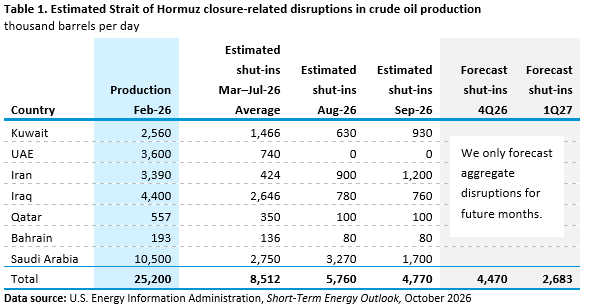
Source: US Energy Information Administration, Short-Term Energy Outlook, October 2026.
An alternative route only has value if it remains operational when the original one fails. While Saudi Arabia’s East–West pipeline by-passes Hormuz, it still remains vulnerable to Yemen’s Houthi-induced disruptions on the Red Sea. In September 2026, Saudi Arabia decided to shut down this pipeline when the Houthi attacks intensified. War-risk premiums on Saudi-linked tankers entering Yanbu had climbed to roughly 3 percent of vessel value, while ships traversing the same waters without a Saudi connection faced premiums of only 0.2–0.3 percent. In other words, the risk attached is less about geography and more about affiliation. Alternative routes sometimes only move chokepoints elsewhere.
Once the East–West pipeline went offline, Aramco redirected cargoes towards its Gulf terminals. The route designed to bypass Hormuz thus rerouted traffic to Hormuz itself. Therefore, what matters is not so much the resilience of an individual piece of infrastructure as that of the entire portfolio. The ability to shift rapidly among berths, vessels, contracts, naval protection, and insurance arrangements constitutes an asset in itself.
Which Alternative Route Is Worth Paying For?
Aramco’s CEO has called on the energy industry to “assign an economic value to resilience at last.” He elaborated that strengthening the resilience of vital supplies is a global strategic necessity as resilience and growth are not competing priorities. Iraq, whose southern crude currently lacks an operational pipeline circumventing Hormuz, is discounting its barrels by US$26.5–28, while Kuwait and Qatar are reportedly offering discounts of up to US$35. By comparison, war-risk insurance for a Saudi-linked tanker at Yanbu is quoted at roughly US$3 million, assuming a 2 million barrel capacity of a super tanker that is equivalent to roughly 1.5 per barrel. Thus, exposure to Hormuz has acquired an observable market price, which probably exceeds the marginal cost of routing crude through an alternative corridor. The relevant investment question is, therefore, which bypass justifies the capital required to build it. Three tests will help answer this.
The first is persistence. Most of the Gulf’s alternative outlets did not prove immune to attacks. The more resilient ones stood out for their ability to remain operational or return rapidly to service. Despite being repeatedly struck in March, Fujairah increased exports to 1.62 mb/d in the same month. Saudi Arabia’s East–West pipeline was similarly struck but resumed operations days later. Conversely, a corridor is of poor value if politics can easily close it permanently. In 1982, Damascus shut Iraq’s pipelines to the Mediterranean, halving its exports and leaving only the line to Türkiye open. That line sat largely idle from 2023 onwards over legal and commercial disputes. Working with unreliable transit partners can turn an oil chokepoint into political leverage.
The second is connection. The Kirkuk–Ceyhan system between Türkiye and Iraq possesses approximately 1.5 mb/d of capacity, yet carried only 250,000 b/d in September 2026 because of insufficient connectivity, as the line does not serve its southern fields. The proposed Basra–Haditha pipeline would change that by connecting to southern barrels. Iraq has allocated US$1.5 billion to the project after losing an estimated US$60 billion in oil revenue since February 2026. Therefore, alternative routes need to be well connected to exporters and importers.
Ultimately, the war’s biggest lesson is that resilience belongs to an architecture of alternatives, not individual pipelines.
The third is duration. A corridor is worth investing in when a closure seems prolonged. When disruptions are brief, stocks near customers are the cheaper hedge. In March 2026, Aramco met most customers’ requirements through overseas storage. Meanwhile, the International Energy Agency’s (IEA) unprecedented 400-million-barrel emergency release represented only about 20 days of normal oil exports through Hormuz. Emergency inventories might carry markets through the winter, but they cannot substitute indefinitely for functioning export infrastructure. Strategic stocks insure against interruptions measured in weeks, while alternative routes provide protection against disruptions measured in years. However, this variable might be the most difficult to forecast.
Ultimately, the war’s biggest lesson is that resilience belongs to an architecture of alternatives, not individual pipelines. A few exposed bypasses can be closed individually, but a system of alternatives would have to be closed altogether. Four qualities are important to develop an effective architecture: a) uncorrelated routes so that no single threat can disable multiple routes; b) switchable corridors so that barrels can move among exits in real time; c) repairable corridors so that local capacity can restore infrastructure quickly; and d) permanently functioning routes, which remain operationally relevant even in peacetime.
The routes worth paying for are not necessarily those with the greatest capacity, but ones that keep a diversified system functioning.
An International Monetary Fund (IMF) study shows that diversifying strategically vulnerable import sources—particularly those highly exposed to shocks, located upstream in supply chains, and constrained by greater rigidities—can improve expected welfare when the risk of a huge trade disruption is sufficiently high. Thus, the relevant criterion is what is protected, not how much capacity is built. The routes worth paying for are not necessarily those with the greatest capacity, but ones that keep a diversified system functioning.
Samriddhi Vij is Associate Fellow, Geopolitics, ORF Middle East.
The author acknowledges the use of Google Gemini 3.1 Pro for research purposes.