 Global
Policy Briefs | 12 October, 2026 Download Report (PDF)
Green Steel and the Future of the Japan–Australia Resource Partnership
Japan's steel sector is undergoing a structural decarbonisation shift, driven by the country's Green Transformation strategy, which includes a mandatory emissions-trading scheme and a national target to supply 10 million tonnes of green steel annually by 2030. As it transitions from blast-furnace-based production to hydrogen-based direct reduced iron (H-DRI), its demand for raw iron ore and coking coal will gradually give way to green iron, green hydrogen, and low-carbon industrial inputs. This shift carries important implications for Australia, for which iron ore exports to Japan represent a cornerstone of the bilateral relationship and a key source of export revenue. This brief examines three interlinked dynamics shaping the future of the Japan–Australia resource relationship: Japan's emerging green steel strategy and technology pathways; the economic and industrial realities of low-carbon steelmaking; and Australia's capacity to reposition itself as a supplier of green iron and hydrogen within a rapidly evolving regional supply chain.
Attribution: Parul Bakshi and Antara Mascarenhas, “Green Steel and the Future of the Japan–Australia Resource Partnership,” ORF Issue Brief No. 900, Observer Research Foundation, October 2026.
Introduction
Steel is among the most emissions-intensive industrial sectors globally, responsible for around 8 percent of total greenhouse gas emissions.[1] To meet Paris Agreement targets, the global iron and steel industry must reduce its emissions intensity by over 90 percent from the 2020 levels by 2050.[2] Long-term projections see global steel production continuing at a similar pace to current levels; however, emissions are projected to either stay flat or grow moderately.[3] In response, government policies and industrial initiatives to decarbonise steel production have accelerated through the manufacturing of ‘green steel’[4] as countries seek to reconcile continued steel demand with tightening climate commitments.
‘Green steel’ broadly refers to steel produced with substantially lower carbon emissions than conventional methods, achieved by substituting fossil fuels with low-carbon energy sources and deploying carbon-reduction technologies. Central to this transition is direct reduced iron (DRI), an intermediate product made by removing oxygen from iron ore using a reducing agent—most commonly natural gas. The DRI is then melted in an electric arc furnace (EAF) to produce steel. When natural gas is replaced by green hydrogen produced from renewable electricity, the result is ‘green iron:’ DRI that carries near-zero embodied emissions and forms the feedstock for green steel.[5]
Japan—currently the third-largest steelmaker globally—has emerged as a central test case for industrial decarbonisation.[6] Australia remains the dominant supplier of iron ore, the primary raw material for steel production, holding around 56 percent of the Asian iron ore export market, while Japan imports over 50 million tonnes of Australian ore annually.[7]
Thus, Japan’s transition carries manifold implications for Australia, a long-standing resource partner since the 1960s supplying iron ore, coking coal, and liquefied natural gas (LNG) to the Japanese industry.[8] As decarbonisation accelerates across Japan and wider Asian markets, demand will gradually shift from raw iron ore towards low-carbon iron, hydrogen, and other green industrial inputs.[9] Australia’s potential role in this transition extends across both dimensions of this shift. As a supplier of green hydrogen and producer of green iron for export, it could directly supply the low-carbon feedstock that Japan’s steelmakers will increasingly require as the economics of hydrogen-based steelmaking mature.
For Australia, the world’s largest iron-ore exporter, this transition represents both a strategic risk and a major industrial opportunity. Iron ore alone generated approximately AUD$138 billion (~US$98.5 billion) in export revenue in FY 2023–24, underscoring the scale of potential economic disruption or transformation facing Australia’s resource sector.[10]
This brief argues that green steel can transform the Japan–Australia resource relationship, shifting the foundation of trade from coking coal and raw iron ore towards hydrogen, green iron, and low-carbon industrial supply chains. Understanding this transition requires examining three interlinked dynamics: Japan’s emerging green steel strategy, the technological and economic realities of low-carbon steelmaking, and Australia’s capacity to reposition itself within a rapidly evolving industrial landscape.
Japan’s Steel Decarbonisation and Emerging Supply Chains
The decarbonisation of steel production is central to Japan’s broader industrial and energy transformation. Steel currently accounts for roughly 13 percent of the country’s industrial carbon emissions, making it one of the most difficult sectors to decarbonise.[11] In response, the Japanese government has embedded steel decarbonisation within its wider Green Transformation (GX) strategy. It aims to mobilise around ¥150 trillion (~US$1 trillion) in public and private investment over the forthcoming decade to decarbonise heavy industry, expand hydrogen supply chains, and deploy carbon capture technologies.[12] The GX 2023 Basic Policy established a national target to supply 10 million tonnes of green steel annually by 2030, while the GX 2040 Vision, adopted in 2025, reaffirmed the long-term investment roadmap and extended support for steel decarbonisation pathways, including hydrogen-based production.[13]
Today, the steel industry is dominated by two primary technologies: the blast furnace–basic oxygen furnace (BF–BOF) route and the electric arc furnace (EAF) route. Decarbonisation potential varies sharply between these pathways, making upstream energy sourcing, feedstock quality, and scrap availability as important as the plant-level technologies. The BF–BOF route begins with the reduction of iron ore to pig iron using coke in a blast furnace, followed by refining in a basic oxygen furnace. This pathway accounts for over 70 percent of global steel production, with Japan as one of the top BOF operators.[14] EAFs produce steel using electricity to melt scrap steel or, increasingly, DRI; Japan’s EAF share is approximately 25 percent.[15] However, Japan’s limited domestic scrap availability relative to its steel output constrains how rapidly it can expand the EAF route, making new sources of imported DRI a strategic necessity.
As a resource-constrained economy dependent on imported fuels and raw materials, Japan’s steel decarbonisation relies on the development of international supply chains capable of providing stable long-term access to energy and industrial inputs.[16] Japanese steelmakers are thus pursuing multiple technological routes simultaneously, reflecting both the scale of existing blast-furnace assets used in conventional steelmaking and the uncertainty surrounding future hydrogen costs.
Near-term efforts focus on reducing emissions from existing infrastructure. Nippon Steel’s COURSE50 programme (CO₂ Ultimate Reduction System for Cool Earth 50) uses hydrogen injection into blast furnaces to partially substitute for coke, achieving around 30 percent emission reduction while maintaining stable furnace operation.[17] Its successor, Super COURSE50, combines higher hydrogen injection with Carbon Capture, Utilisation and Storage (CCUS) and targets a reduction of roughly 50 percent or more.[18]
Japan’s long-term pathway centres on the shift towards hydrogen-based direct reduced iron (H-DRI). The emergence of green hydrogen as a reducing agent has been central to the pursuit of near-zero-emission steelmaking. When used in the DRI process, green hydrogen can achieve emissions reductions of up to 90 percent compared to BF–BOF production.[19]
Leading producers, including Nippon Steel, JFE Steel, and Kobe Steel, are developing pilot-scale H-DRI technologies, often in collaboration with global equipment suppliers. However, hydrogen-based steelmaking remains substantially more expensive than conventional production, reflecting the high cost of renewable electricity and clean hydrogen. Current estimates suggest that costs could be roughly two to three times higher than blast furnace steel and are therefore unlikely to reach commercial scale before the mid-2030s to 2040.[20] This timeline implies that Japan’s demand for imported hydrogen or green iron will emerge gradually rather than immediately, shaping the pace of regional supply-chain transformation.
Figure 1: Decarbonisation Timeline for the Domestic Steel Industry
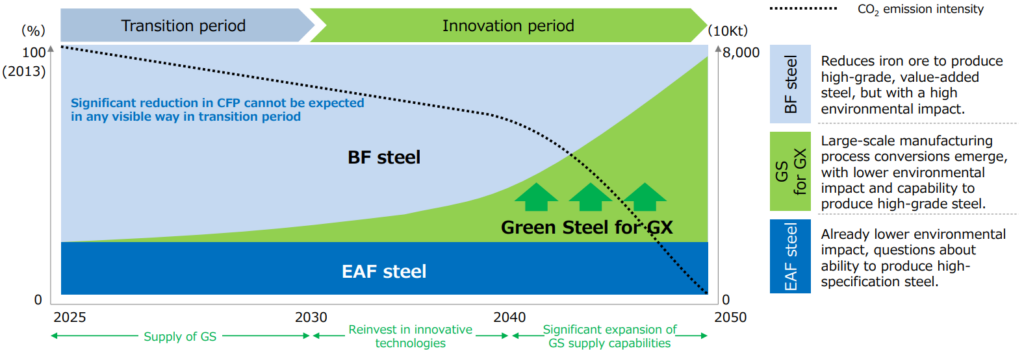
Source: Accenture, 2025[21]
Anticipating this gradual transition, Japanese steelmakers have already begun sourcing imported reduced iron. In 2024, Itochu Corporation partnered with JFE Steel and Emirates Steel to establish a supply chain for reduced iron from the United Arab Emirates (UAE), targeting supply to Japanese steel operations by 2027. This signals that Japan is actively building green iron import corridors ahead of domestic H-DRI commercialisation.[22]
Japan’s steel transition is also constrained by geography and resource endowment. The country lacks large-scale domestic iron ore reserves and relies heavily on imports, bringing in over 100 million tonnes of iron ore annually despite producing roughly 87 million tonnes of crude steel.[23] This deep resource dependency means that Japan’s steel decarbonisation strategy is reliant upon and shaped by long-standing trade relationships with suppliers like Australia.
The scale of what that relationship could deliver is massive. Ironmaking is the most energy-intensive step in steel production, accounting for around 85 percent of total energy consumption.[24] The Lowy Institute estimates that importing green iron from Australia, rather than producing it domestically, could enable Japan to reduce its energy consumption by nearly 1.1 exajoules or 70 percent more than Japan’s entire planned nuclear energy use in 2040, cover about 40 percent of the emissions reductions it needs to achieve between 2030 and 2040, and bolster the long-term competitiveness of its steel and downstream industries.[25]
Japan’s national GX Emissions Trading System (ETS), set to become fully operational in FY 2026, will introduce mandatory caps for large emitters and allow emissions trading across industrial sectors. While sector-specific allocation rules covering process-specific benchmarks (for example, for blast furnaces, scrap EAF, and special steel EAF) are still being finalised, the scheme sets a threshold of 100,000 tonnes of CO₂ annually for mandatory participation and is expected to cover 300–400 of Japan’s largest emitting facilities, accounting for 60 percent of national CO₂ emissions.[26]
The ETS is expected to affect all leading integrated steel producers, including Nippon Steel, JFE Steel, and Kobe Steel, through obligations for verifiable emissions reporting, target-setting, and the purchase of credits where decarbonisation obligations are unmet.
In 2025, the Japanese government introduced measures under the Act on Promoting Green Procurement and linked subsidies for clean energy vehicles to green steel content, creating an emerging demand-pull for domestically certified low-carbon steel. Limited domestic scrap availability relative to its steel output constrains how rapidly the country can scale the EAF route without new sources of DRI: a gap that directly underpins its strategic interest in imported green iron.[27]
Given the limited land availability and renewable-energy resources relative to future hydrogen demand, Japan’s long-term strategy is unlikely to rely on domestic production. This evolving structure positions the country not only as a decarbonising steel producer, but also as an emerging market for regional green-industrial supply chains: a dynamic with profound implications for Australia’s resource economy.
Challenges and Opportunities for Australia
With iron ore exports being a key driver of Australia’s sustained economic prosperity, the government recognises the urgency of and economic benefit from transitioning to green metals. As shown in Figure 2, Australia, along with Brazil, currently dominates global iron ore production. As the World Economic Forum notes, Australia stands to gain AUD$250 billion (~US$178.61 billion) annually by converting ore into low-carbon DRI through renewable energy and green hydrogen.[28]
Figure 2: Global Iron Ore Production and Exports
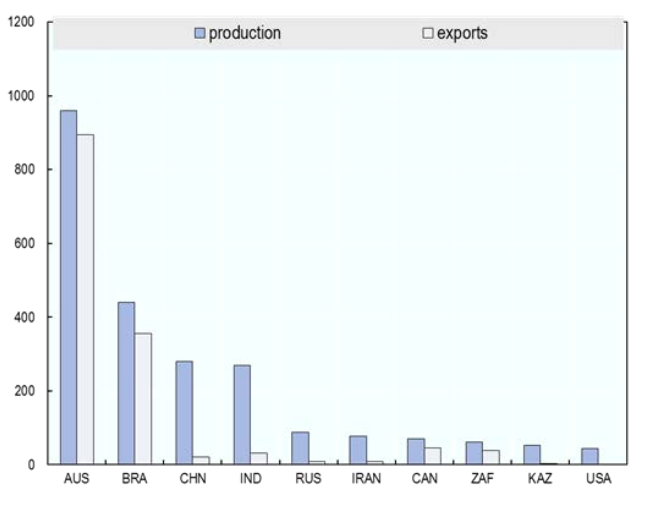
Source: OECD, 2025 [29]
The Australian government invested AUD$18.1 million (~US$12.93 million) in the 2024–25 Federal Budget over six years for the Green Metals Foundational Incentives fund and in the development of technologies and facilities linked to green metal and hydrogen production.[30] The Green Iron Investment Fund allocated a further AUD$1 billion (~US$714.4 million) to support the manufacture of green iron and its supply chains, as part of the broader Future Made in Australia Plan.[31]
While Australia awaits the readiness of its first commercial-scale DRI facility, three green steel projects in Western Australia are undertaking the early development of green steel production. This includes a mill owned by Green Steel of Western Australia (GSWA) that recycles scrap steel into green steel through an EAF powered by renewable energy.[32] Another GSWA project near Geraldton aims to convert iron ore to DRI for export, using the Italian company Danieli’s ENERGIRON technology, which enables operations to transition from natural gas to green hydrogen as supplies become available.[33]
Meanwhile, bilateral decarbonisation cooperation is emerging across the Japan–Australia steel value chain. Rio Tinto and Nippon Steel signed agreements to jointly explore technologies capable of delivering a low-carbon steel supply chain, extending a resource partnership dating back to the first Pilbara iron ore shipments to Japan in the 1960s.[34]
The importance of the Japan–Australia relationship is reinforced by recent Japanese investments in Australian iron ore and critical mineral projects, including Mitsui and Itochu’s joint acquisition of 15 percent of BHP’s Ministers North deposit and Mitsui’s staged acquisition of a 40 percent interest in the Rhodes Ridge iron ore project.[35]
While the Australian government is investing in green metals and some commentators see the country as well placed to produce green iron and steel,[36] development remains in its infancy and faces a few key hurdles. These include slow bureaucratic project-permitting processes, low-grade quality of iron ore, and limited economic incentives to support the investment business case.
Bureaucratic Project-Permitting Processes
Projects in Australia face bureaucratic and lengthy project-permitting processes and long development cycles, typically characterised by feasibility studies spanning several years and extensive hurdles for engineering design and financing prior to construction.[37] Australia must prioritise streamlining these hurdles to be better placed as a green-steel and green-iron producer and become a more attractive investment destination.
Low-Grade Iron Ore
Australian iron ore is generally too low-grade to process directly into steel with renewable energy, due to low iron content and a high level of impurities (mainly silica and alumina).[38] Processing is further challenged by deposit size, closeness to enabling infrastructure, mining costs, and limited avenues for purification.[39]
With this low-grade iron ore quality, Australia must leverage its vast raw magnetite resources to maintain its comparative advantage by developing new magnetite mines that can produce higher-grade DRI. It could also leverage emerging technologies that can use the existing low- to mid-grade ore for Japan to process into green steel.[40]
The country is in the early stages of investing in such facilities: some projects are progressing, although they are yet to reach the final investment decision (FID) stage.[41] There are significant reserves of high-grade magnetite supply to support the scale of transition needed, concentrated across South Australia (5.7 billion tonnes, 44 percent), Western Australia (4.8 billion tonnes, 37 percent), and New South Wales (2.3 billion tonnes, 18 percent).[42] South Australian magnetite, in particular, is most suitable for DR-grade processing. The Australian government’s Commonwealth and Science Research Organisation is also testing adaptations of existing DRI technology with Pilbara ore from Western Australia. [43]
Limited Economic Incentives
Currently, there are limited economic incentives to use an unproven technology such as hydrogen-based DRI. High production and construction costs are exacerbated by the lack of a carbon price and unclear demand at the other end of the pipeline.[44] No large-scale initiatives have reached FID across the ironmaking value chain to date. Some commentators advocate for a hub or industrial precinct approach, which lowers production costs through the sharing of infrastructure and inputs such as ports, roads, and electricity among developers.[45] Such an approach is being used in China, Germany, and the Netherlands.
Progress in these three areas towards operationalisation by the mid-2030s is critical, with competitors like Sweden, Canada, and Brazil having abundant high-grade iron ore resources. Several green-iron and steel projects are advancing globally, albeit slowly, including Sweden’s Stegra project and Namibia’s Oshivela HyIron process.[46] The Middle East is also establishing itself as a leading hub for production and export of lower-emissions iron to European and Asian steelmakers, although the impact of the war in Iran is currently unknown.[47]
To develop such technologies, Australia could leverage its ongoing green metals relationship with China. As recently as December 2025, Australia and China signed a Memorandum of Understanding (MoU) for policy dialogue on steel decarbonisation, to explore opportunities for dialogue and cooperation on iron and steel value chain decarbonisation, markets, and trade.[48] While the details are still developing, technology transfer should be one important area of cooperation. For meaningful progress, this should also extend to expanded investment from Chinese companies to shore up demand in the long-term pipeline.
With China’s steel demand in decline, Australia should continue to diversify partnerships with other countries and actively secure other export markets.[49] For instance, the Australian government is working with India through a three-year India–Australia Green Steel Partnership supporting five projects to reduce emissions, focusing on processing low-grade iron ores without fossil fuels—in particular—by removing silica and alumina before grinding.[50]
Along similar lines, Australia and Japan would do well to extend their Memorandum of Cooperation on Energy and Minerals to formalise a relationship in green metals. This should focus on production efficiencies, pilot projects, technological development, and industrial synergies. For Australia to remain competitive internationally, it will need to address the above challenges and continue investing in technological development and projects located appropriately, having low relative capital costs, advantages in existing infrastructure, and superior renewable energy resources. [51]
Conclusion: Recasting the Japan–Australia Resource Partnership
The transition to green steel is unlikely to dissolve the long-standing resource relationship between Australia and Japan. Instead, it points to a structural transformation of one of Asia’s most enduring industrial partnerships. While twentieth-century trade was centred on coking coal and raw iron ore, the forthcoming decades are more likely to be defined by hydrogen, green iron, and low-carbon industrial supply chains.
Yet this transformation is far from assured. Several uncertainties remain across technology costs, infrastructure deployment, certification standards, and long-term off-take agreements. Hydrogen-based steelmaking is not expected to reach commercial scale until the mid-2030s or later, while Australia’s own green-hydrogen and green-iron industries still need to overcome the above-mentioned challenges. Misaligned timelines between future Japanese demand and Australian supply capacity therefore pose a material strategic risk.
At the same time, global competition is intensifying. Resource-rich producers in Brazil, Canada, the Middle East, and parts of Africa are positioning themselves as alternative suppliers of DRI, hydrogen, and other low-carbon inputs. In this context, the central question is not whether green steel will emerge, but which countries will capture value across its evolving supply chains.
For Australia, maintaining relevance will depend on moving beyond raw material exports toward participation in low-carbon processing, hydrogen production, and green-industrial infrastructure. For Japan, success will hinge on securing reliable, affordable, and scalable imports of low-carbon inputs capable of supporting domestic industrial transformation.
Ultimately, the future of the Japan–Australia partnership will depend on how effectively both countries adapt a historically resource-based relationship to the realities of industrial decarbonisation. If successful, green steel could mark the next strategic phase of this partnership while supporting the decarbonisation ambitions of both countries.
Parul Bakshi is Deputy Director, Energy Transitions, Observer Research Foundation (ORF) Global.
Antara Mascarenhas is General Manager of Policy, Global Power Energy.
The authors acknowledge the use of Claude Sonnet 4.6 as an editorial support tool while preparing this paper.
Endnotes
[1] Stefan Ellerbeck, “What Is Green Steel and How Can It Help Us Reach Net Zero?” World Economic Forum, 2022, https://www.weforum.org/stories/2022/07/green-steel-emissions-net-zero/.
[2] “Decarbonizing the Steel Industry—Have Your Say,” Science Based Targets Initiative, January 2023, https://sciencebasedtargets.org/blog/decarbonizing-the-steel-industry-have-your-say.
[3] OECD Science, Drivers of Green Iron Production: Green Iron Opportunities in Australia, OECD, October 2025, https://www.oecd.org/en/publications/green-iron-opportunities-in-australia_bbd1e2b8-en/full-report/component-6.html (2025).
[4] Responsible Steel, Global Steel Decarbonisation: From Complexity to Coherence, July 2026, https://cdn.prod.website-files.com/653ed7060b01292cd4518d0e/6a607a811685c6dfeb06469e_edited-Final%20Responsible%20Steel%20Policy%20Report%20v4.pdf.
[5] “Direct-Reduced Iron – An Overview,” ScienceDirect Topics, https://www.sciencedirect.com/topics/engineering/direct-reduced-iron.
[6] Worldsteel Association, “World Steel in Figures 2025,” worldsteel.org, https://worldsteel.org/data/world-steel-in-figures/world-steel-in-figures-2025/.
[7] Unlocking Asia-Pacific as a First Mover: Australia’s Green Iron Opportunity, World Economic Forum, November 2025, https://reports.weforum.org/docs/WEF_Unlocking_Asia-Pacific_as_a_First_Mover_2025.pdf.
[8] Ministers for the Department of Industry, Science and Resources, “Australia as a Long-Term and Reliable Energy Supplier,” January 2024, https://www.minister.industry.gov.au/king/media/australia-long-term-and-reliable-energy-supplier.
[9] Noam Boussidan and Julia Franchi Scarselli, “How Australia Can Lead the Global Transition to Green Iron,” World Economic Forum, December 2025, https://www.weforum.org/stories/2025/12/australia-global-transition-green-iron/ (2025).
[10] Boussidan and Scarselli, How Australia Can Lead the Global Transition to Green Iron.”
[11] “Japan 2021: Energy Policy Review,” International Energy Agency, 2021, https://www.iea.org/reports/japan-2021.
[12] Lee Clements and Alexis R. Rocamora, “Japan’s $1trn Bet on the Climate Transition,” LSEG Insights, October 2025, https://www.lseg.com/en/insights/ftse-russell/japans-1trn-dollar-bet-on-the-climate-transition.
[13] InfluenceMap, “Policies for Steel Decarbonization,” April 2026, https://japan.influencemap.org/policy/Japan-Steel-Policy-5558.
[14] Astrid Grigsby-Schulte et al., Pedal to the Metal 2025, Global Energy Monitor, https://globalenergymonitor.org/research/pedal-metal-2025.
[15] Akira Kanno, Kenta Kubokawa, and Lauren Huleatt, Japanese Electric Arc Furnace Steel: A Market Ready for Low-Carbon Growth, Transition Asia, 2025.
[16] Agency for Natural Resources and Energy (ENECHO), Energy White Paper 2025, Ministry of Economy, Trade and Industry, https://www.enecho.meti.go.jp/about/whitepaper/2025/html/2-1-0.html.
[17] Nippon Steel, “Nippon Steel’s Green Transformation (GX) Initiatives,” May 2026, https://www.nipponsteel.com/en/ir/library/strategy/pdf/20260514_100.pdf.
[18] Nippon Steel, “Nippon Steel’s Green Transformation (GX) Initiatives, May 2026.”
[19] “Iron and Steel Technology Roadmap,” International Energy Agency, October 2020, https://www.iea.org/reports/iron-and-steel-technology-roadmap.
[20] “Iron and Steel – Latest Findings,” International Energy Agency, https://www.iea.org/energy-system/industry/steel.
[21] “Green Steel Demand in Japan – Market Status and Enabler,” Accenture, October 2025.
[22] Helen Cecile Nowatka, “Japan’s Green Steel Transition Faces a Paradox,” Tokyo Review, May 25, 2026, https://www.tokyoreview.net/2026/05/japans-green-steel-transition-faces-a-paradox/.
[23] Grigsby-Schulte et al., “Pedal to the Metal 2025.”
[24] Reuben Finighan and Ryan Neelam, “Reframing the Australia–Japan Energy Relationship,” Lowy Institute, December 2025, https://www.lowyinstitute.org/publications/reframing-australia-japan-energy-relationship.
[25] Finighan and Neelam, “Reframing the Australia–Japan Energy Relationship.”
[26] Aliana Zulaika Yeong, “Japan Mulls Barring International VCM Credits Before GX-ETS Launch; Move to Be Bullish for Domestic Credits,” SP Global, July 2025, https://www.spglobal.com/energy/en/news-research/latest-news/energy-transition/070725-japan-mulls-barring-international-vcm-credits-before-gx-ets-launch-move-to-be-bullish-for-domestic-credits.
[27] Akira Kanno, Kenta Kubokawa, and Lauren Huleatt, “Japanese Electric Arc Furnace Steel: A Market Ready for Low-Carbon Growth.”
[28] Unlocking Asia-Pacific as a First Mover: Australia’s Green Iron Opportunity, 2026.
[29] OECD Science, Drivers of Green Iron Production: Green Iron Opportunities in Australia.
[30] Australian Trade and Investment Commission, “Australia Forges a Future made from Green Steel,” News and Insights, August 2024, https://international.austrade.gov.au/en/news-and-analysis/news/australia-forges-a-future-made-from-green-steel.
[31] Department of Industry, Science and Resources, “A $500 Million Grant to Grow Green Iron Production Capability,” September 2025, https://www.industry.gov.au/news/500-million-grant-grow-green-iron-production-capability.
[32] Australian Trade and Investment Commission, “Australia Forges a Future made from Green Steel.”
[33] Australian Trade and Investment Commission, “Australia Forges a Future made from Green Steel.”
[34] Kanno, Kubokawa, and Huleatt, “Japanese Electric Arc Furnace Steel: A Market Ready for Low-Carbon Growth.”
[35] “Acquisition of Interest in Rhodes Ridge Iron Ore Project in Australia,” Mitsui & Co., February 2025, https://www.mitsui.com/jp/en/release/2025/1250897_14855.html
[36] Tony Wood, Guy Dundas, and James Ha, “Australians Want Industry and they’d Like It Green. Steel Is the Place to Start,” Grattan Institute News, May 2020, https://grattan.edu.au/news/australians-want-industry-and-theyd-like-it-green-steel-is-the-place-to-start/.
[37] Noam Boussidan and Julia Franchi Scarselli, “How Australia can Lead the Global Transition to Green Iron;” Soroush Basirat, “Could the Middle East Conflict Help Australia Catch Up in Green Iron?” IEEFA, 2026, https://ieefa.org/resources/could-middle-east-conflict-help-australia-catch-green-iron.
[38] Soroush Basirat and Simon Nicholas, “Australia Faces Growing Green Iron Competition from Overseas,” IEEFA, 2023 https://ieefa.org/resources/australia-faces-growing-green-iron-competition-overseas ; Fran Molloy, “Australia’s Green Metals Gambit: the Technologies to Decarbonise Steel Using Pilbara Iron Ores,” CSIRO, March 2026, https://www.csiro.au/en/news/All/Articles/2026/March/Green-metals.
[39] “Australian Green Iron Tracker,” IEEFA, https://ieefa.org/australian-green-iron-tracker.
[40] Soroush Basirat, “Australia’s Green Iron Journey: Racing against Time, Waiting on Technology,” IEEFA, May 2025, https://ieefa.org/resources/australias-green-iron-journey-racing-against-time-waiting-technology.
[41] Australian Trade and Investment Commission, “Australia Forges a Future made from Green Steel.”
[42] “Australian Green Iron Tracker”
[43] Molloy, “Australia’s Green Metals Gambit: the Technologies to Decarbonise Steel Using Pilbara Iron Ores.”
[44] Rio Tinto, https://www.riotinto.com/en/news/releases/2020/rio-tinto-and-nippon-steel-corporation-sign-climate-mou.
[45] Changlong Wang and Rahman Daiyan, “Can Australia Green Its Heavy Industry? It’s Hard – But Necessary,” The Conversation, May 2026, https://theconversation.com/can-australia-green-its-heavy-industry-its-hard-but-necessary-271313.
[46] Basirat, “Australia’s Green Iron Journey: Racing against Time, Waiting on Technology.”
[47] Molloy, “Australia’s Green Metals Gambit: the Technologies to Decarbonise Steel Using Pilbara Iron Ores.”
[48] Department of Industry, Science and Resources, “Australia and China sign MoU to Advance Steel Decarbonisation,” December 2025, https://www.industry.gov.au/news/australia-and-china-sign-mou-advance-steel-decarbonisation.
[49] Soroush Basirat, “Australia’s Iron Ore Sector at a Crossroads – Business as Usual or Time to Embrace Green Iron?” IEEFA, 2026, https://ieefa.org/resources/australias-iron-ore-sector-crossroads-business-usual-or-time-embrace-green-iron.
[50] Molloy, “Australia’s Green Metals Gambit: the Technologies to Decarbonise Steel Using Pilbara Iron Ores.”
[51] Ingrid Burfurd et al., A Green Iron Plan for Australia: Securing Prosperity in a Decarbonising World, The Superpower Institute, May 2025.