 Global
Policy Briefs | 16 November, 2026 Download Report (PDF)
Economic Deterrence in the Middle East
This issue brief examines the emergence and limitations of economic deterrence in the Middle East through the framework of Mutually Assured Economic Destruction (MAED), whereby economic interdependence raises the anticipated costs of military escalation. It argues that while Gulf states have increasingly leveraged trade, investment, and financial integration to incentivise regional stability, these same interdependencies generate vulnerabilities that adversaries can exploit. Drawing on Iran’s 2026 attacks on Gulf economic infrastructure and the Houthis’ disruption of Red Sea commerce, the paper identifies two conditions under which economic deterrence fails: existential threats to regime survival and asymmetric actors operating outside shared economic networks. It proposes an inducement-enforcement framework, combining economic integration with credible military and institutional protection, to address these limitations. Ultimately, the paper demonstrates that economic interdependence neither guarantees peace nor replaces traditional deterrence; rather, its stabilising potential depends on the interaction between economic incentives, political imperatives, and credible enforcement capabilities.
Attribution: Samriddhi Vij and Kleanthis Kyriakidis, “Economic Deterrence in the Middle East,” ORF Issue Brief No. 908, Observer Research Foundation, November 2026.
Introduction
Several Middle Eastern security analysts have pointed out that apart from military deterrence, ideological rivalry rooted in the post-Ottoman territorial settlement, sectarian competition between Sunni and Shia political orders, and proxy conflict are occurring across at least six active theatres. However, recent regional developments suggest that economic vulnerability and interdependence have become increasingly important components of deterrence. Over the past decade, especially, a quieter but consequential transformation seems to have reshaped the Middle East’s strategic architecture. Gulf states have demonstrably and systematically discovered and applied a new form of deterrence in which the primary threat is not of kinetic destruction but economic ruin.
This brief uses the term ‘Mutually Assured Economic Destruction (MAED)’ as an analytical framework in which the prohibitive cost of aggression is measured not in casualties but in macroeconomic collapse. This concept draws on the idea of Mutual Assured Destruction,[1] a deterrence principle under which an attack, particularly a nuclear strike, by one power would trigger a devastating retaliation, resulting in destruction on both sides.
While MAED draws upon several established concepts in international relations, it remains analytically distinct from them. Unlike economic sanctions, which are coercive measures imposed by one actor to compel policy change in another, MAED is based on the expectation of reciprocal economic harm resulting from conflict. Economic statecraft broadly encompasses the use of economic instruments to achieve political objectives, but MAED focuses specifically on deterrence through the anticipated costs of economic disruption. The concept also differs from weaponised interdependence,[2] which emphasises how actors exploit asymmetries within global economic networks to gain coercive leverage. MAED instead assumes a higher degree of mutual vulnerability, whereby all parties possess substantial economic assets that would be endangered by escalation. Finally, contrary to traditional deterrence theory, which relies primarily on the threat of military punishment or denial, MAED expects that decision-makers will refrain from aggression because of the anticipated macroeconomic consequences of conflict, including capital flight, trade-flow disruption, loss of investor confidence, and damage to long-term development strategies. MAED should therefore be understood as a specific form of economic deterrence operating through mutual exposure to economic risk rather than direct military retaliation.
For some time, the MAED proposed framework delivered. While the importance of political motivations cannot be understated, economic peace appeared to be substituting for military deterrence as the organising logic of regional order. However, developments in recent years have shattered that confidence. Iran has deliberately weaponised Gulf economic vulnerability and the Yemeni Houthis have continued to disrupt Red Sea commerce. These events have exposed a structural flaw at the heart of the MAED framework: the architecture of economic attraction may have been constructed without the necessary architecture of enforcement. This brief examines the logic of economic deterrence, its limits, case studies where it failed, and the framework required to correct it.
The Shift to Economic Deterrence
The strategic architecture of the contemporary Middle East is shaped by several geopolitical and ideological factors, of which one of the most important yet less acknowledged is economic deterrence. Consequently, the biggest leverage in interstate competition is no longer just kinetic power but the ability to disrupt capital flows, investor confidence, and macroeconomic stability. Hence, states are increasingly deterring their adversaries by threatening catastrophic economic disruption rather than outright military defeat.[3] This logic mirrors the Cold War nuclear deterrence rationale but substitutes financial ruin for nuclear annihilation: the cost of aggression is rendered prohibitively expensive not just by the prospect of physical destruction but by the certainty that any escalation will trigger cascading economic consequences that will impact the aggressor’s prosperity.[4]
This framework largely helps explain the restraint states have exercised in the Middle East despite persistent structural and ideological misalignments and deep-seated strategic rivalries, including the Sunni–Shia schism, competing claims to Arab leadership, normalisation politics, regime-security narratives, and the unresolved Palestinian question. There is a growing understanding among regional powers that any escalation could trigger rapid capital flight and deter the foreign direct investment (FDI) critical to national economic diversification and growth aspirations—a factor that possibly contributed to the Abraham Accords of 2020, Saudi Arabia’s rapprochement with Iran, and the broader regional normalisation trend.[5],[6],[7] The United Arab Emirates (UAE), for instance, attracted US$45.6 billion in FDI inflows in 2024 alone, the highest in the Arab world, a figure that would be jeopardised by open regional conflict.[8]
Most analyses narrowly focus on security and diplomatic calculations. They often point out shared concerns, alignment with the United States (US), regime legitimacy, regional repositioning, and diplomatic signalling, but overlook the importance of economics. Nonetheless, without downplaying or disregarding security concerns, the Abraham Accords have played an important role in what is seen as economic peace: normalisation driven not only by the resolution of underlying political grievances but also by shared economic gains for all parties through trade. The future of regional powers, from Riyadh to Abu Dhabi, depends on diversification strategies that require sustained foreign investment, stable capital markets, and uninterrupted global connectivity. In this calculus, military victories might lead to strategic economic defeats.
States have therefore structurally engaged in what can be called preventive diplomacy through economic signalling. Capital investments, sovereign wealth fund placements, trade agreements, and infrastructure corridors can now function as instruments of de-escalation. Of course, this logic cannot be applied uniformly. When the UAE became Iran’s second-largest trade partner with bilateral trade reaching US$27 billion in fiscal year 2023–24, or when Saudi Arabia reopened diplomatic channels with Tehran after years of animosity, economic considerations substantially shaped the underlying logic: the cost of conflict was being deliberately raised through deepening mutual financial exposure.[9],[10] Many analyses only consider Saudi security concerns following attacks on oil infrastructure, the Yemen conflict, and Iranian sanctions pressure. However, the economic factor represents a nuanced but decisive shift in the strategy of modern statecraft. Increasingly, financial metrics dictate geopolitical security outcomes.
In the contemporary Middle East, MAED eventually arises from increasing economic interdependence that leads to greater economic vulnerability and forces adversary states to exercise restraint.
The Double-Edged Sword of Economic Peace
The economic deterrence framework introduces an important vulnerability paradox. While economic prosperity enhances deterrence by raising the stakes for disruption, it simultaneously generates acute vulnerabilities. The very openness that attracts global capital, the connectivity that facilitates trade, and the infrastructure that enables logistics hubs to function as nodes in global supply chains become targets when deterrence fails. This vulnerability is particularly pronounced as economic peace is built on shared prosperity without resolving underlying political animosity. Consequently, partners can become hostile quickly if the financial incentives guiding the partnership erode or political imperatives trump economic benefits. Therefore, a state that becomes hypersensitive to capital flight and depends on the continuous inflow of foreign investment for its fiscal stability transforms into an easy target for external coercion.
The concept of weaponised interdependence, as developed by Farrell and Newman (2019), describes how the asymmetrical structure of global networks creates leverage for actors to exploit chokepoints and critical nodes.[11] In the Middle Eastern context, the pursuit of economic peace aggressively pushes for deeper integration through expanded trade, transnational corridors such as the India-Middle East-Europe Economic Corridor (IMEC), and cross-border financial infrastructure.[12] While integration might also generate resilience, alliances, and external balancing support, paradoxically, it also creates vulnerabilities to disruption. The more a state integrates into global networks, the more it could lose from instability and the more leverage its adversaries have by threatening that instability.
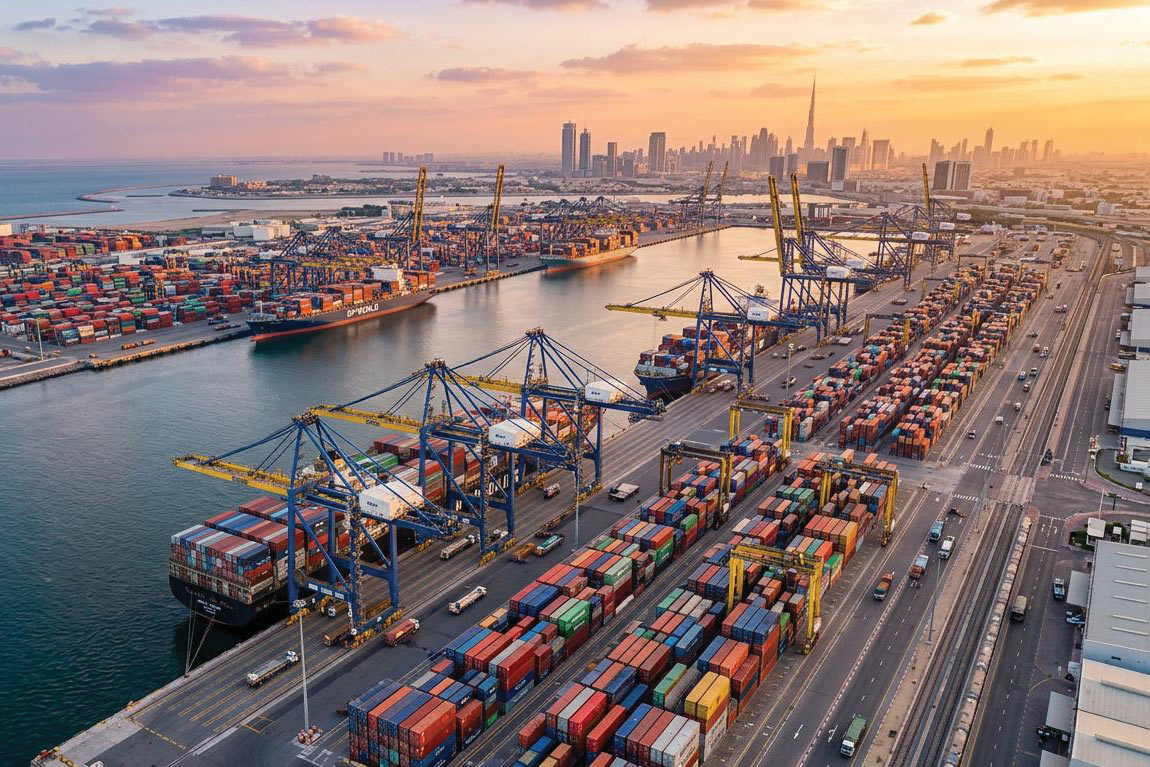
The Gulf states exemplify this tension. Dubai’s Jebel Ali Free Zone accounts for approximately 36 percent of its gross domestic product (GDP) through the integrated ecosystem.[13],[14] Approximately 93 percent of Qatar’s liquefied natural gas (LNG) exports transit through the Strait of Hormuz, with no viable alternative route.[15] Saudi Arabia’s NEOM and Red Sea megaprojects require decades of political stability to generate returns.[16] While these are economic assets, they are also strategic liabilities in a region where the threat of military escalation persists. The more connected the region becomes, the more it can be held hostage to critical chokepoints and adversaries willing to exploit them.
Case Studies: Iran and the Houthis
Case Study 1: Iran’s Weaponisation of Gulf Economic Integration
Iran’s retaliatory military campaign against the Gulf states in response to the US–Israeli strikes in February 2026 represents the most striking illustration of economic deterrence logic being inverted and weaponised.[17] The campaign was swift, calculated, and deliberately targeted. Its celerity indicates a premeditated strategy to strike precisely where maximum global economic damage could be inflicted.
Tehran did not confine its retaliation to US military bases and assets; it chose to strike economic centres like Dubai, along with critical refineries and energy infrastructure. It understood that threatening the nexus of global capital, logistics, and aviation would instantly send international markets into a panic, thereby coercing its Gulf neighbours to pressure Washington for immediate restraint.[18] This situation was further worsened by the closure of the Strait of Hormuz, which many Gulf countries depend on for transporting their hydrocarbon exports.[19] The Strait carried approximately 25 percent of the world’s seaborne oil trade and 20 percent of global LNG in 2025, with the International Energy Agency (IEA)’s executive director describing the combined impact as “the greatest threat to global energy security in history.”[20] For decades, the Gulf operated on the fundamental assumption that economic prosperity creates strong incentives for geopolitical stability. After the UAE became a leading global financial hub, it aimed to establish economic deterrence through MAED and wagered that the global powers would have strong incentives to protect it, as they would therefore be inherently protecting their own economic interests.[21] It even became one of Iran’s largest trading partners, accounting for 22.6 percent of the latter’s total trade, reflecting the depth of mutual financial exposure.[22],[23] Geographical and demographic factors reinforced this: the UAE hosts an Iranian diaspora estimated at 400,000 to 500,000 persons.[24] However, this interdependence did not restrain Tehran; rather, this economic integration was weaponised to inflict maximum damage.
The strategic lesson is profound. Economic deterrence ultimately operates on shared rationality. It assumes that most actors value financial preservation over ideological or existential imperatives. Facing acute domestic strain and overwhelming external attacks, Iran possibly faced an existential crisis, recognising that anything short of maximum impact retaliation could accelerate its collapse.[25]
Case Study 2: The Houthis and the Negative Externalities of Economic Peace
The more connected a region becomes, the more it can be held hostage to critical chokepoints like the Bab el-Mandeb strait at the southern entrance to the Red Sea, through which approximately 12 percent of global trade passes.[26] Since November 2023, the Houthis have attacked over 100 merchant ships passing through the Red Sea, allegedly in solidarity with Palestinians in the war on Gaza.[27] The consequences have been devastating for global commerce. The cost of Red Sea shipping insurance has risen by 2,700 percent.[28] Leading shipping lines have instead rerouted around the Cape of Good Hope, adding 10–14 days to Asia-Europe transit times as well as raising costs.[29]
The strategic importance of this case cannot be overstated. A non-state actor, operating with a budget that is negligible relative to state defence expenditures, has effectively had a significant economic impact on vastly superior conventional militaries, simply by holding a vital commercial route hostage. The US and its coalition partners spent between US$1 million and US$4.3 million per interceptor missile to neutralise Houthi drones that cost a fraction of that sum, a strategically unsustainable cost-exchange ratio by any military accounting.[30]
The Houthi campaign has exposed the fundamental asymmetry at the heart of the MAED framework: the costs of disruption are comparatively inexpensive to impose and devastatingly expensive to absorb. Similar to Iran, the Houthis did not necessarily need to win the war; they only needed to raise uncertainty above the threshold at which rational commercial actors would be unwilling to operate on the contested routes. By doing so, they demonstrated the most alarming corollary of economic integration: a deeply integrated global economy does not merely incentivise stability among its participants but presents exploitable vulnerabilities to every actor positioned at its pressure points.
Limits to Economic Deterrence
Economic deterrence seemingly works powerfully when both parties are genuine stakeholders in a system of shared prosperity. The MAED framework can help deter integrated state actors because shared prosperity creates a mutual aversion to conflict. The Gulf Cooperation Council (GCC) states exercised substantial restraint in the face of Iranian strikes in 2026; this was driven not necessarily by military weakness but probably by the recognition that any escalation would trigger capital flight, disrupt logistics corridors, and destroy their own economies.[31] For instance, the UAE’s non-oil economy, which comprised over 79 percent of its GDP in 2025, constituted a clear material stake in restraint.[32] Additionally, political considerations like the fear of broader spillovers from a regional war, the uncertainty about the US’s intentions in a war largely considered unnecessary by the GCC, and a lack of clear political goals or war end-state pushed the Council towards self-restraint. However, contrasting the GCC’s restrained defensive (motivated by economic preservation) with Iran’s unrestrained offensive (instigated by an existential threat), clearly highlights the limits to economic deterrence.
The deterrence paradigm fails catastrophically under two conditions: existential threat and out-of-system actors.
In the case of Iran, the first condition led to the failure. Tehran was not immune to economic deterrence under normal circumstances as Iran’s currency dropped to a historic low of 1,500,000 rials to the US dollar in January 2026.[33] However, when the regime faced what it perceived as an existential threat from the US–Israel strikes, economic rationality constraints dissolved. When survival becomes paramount, economic interdependence ceases to function as a deterrent, instead becoming a pressure point open to exploitation. Iran’s decision to strike Gulf economic infrastructure was not irrational. It was hyper-rational within the framework of a regime fighting for its survival and deliberately choosing targets that would maximise global economic pain and thereby generate external pressure for a ceasefire.
The Houthis demonstrate the second condition for failure, as they derive no real benefit from regional economic corridors and possess minimal economic infrastructure to hold at risk. They are therefore comparatively ‘immune’ to economic pain. Any non-state actor with no sovereign credit rating, no stock exchange, no tourism industry, and no FDI to protect cannot be directly coerced by the threat of economic disruption. Some might argue that while they are less vulnerable to conventional forms of economic deterrence, they are not immune to all economic, political, or coercive pressures. However, the MAED logic requires symmetric vulnerability. The Houthis embody the precise opposite: asymmetric invulnerability.
Political Analysis and Economic Deterrence
One of the greatest challenges, arguably, in assessing deterrence, integration, and regional order in the Middle East is that the political and economic domains cannot be fully separated. They are more of a continuum than a dichotomy. In practice, economic relations are embedded in political concerns, strategic rivalry, domestic legitimacy, institutional power, and geopolitical signalling. Investment, infrastructure, logistics hubs, pipelines, corridors, and sovereign fund placements are never merely economic arrangements; they are also instruments through which states promote and achieve their influence, shape their alignments, reward their partners, and hedge against potential adversaries. Consequently, this brief explicitly acknowledges that economic behaviour in the Middle East is politically mediated.
Political considerations are determinative when granting access to ports, airspace, or transit routes. Moreover, customs systems, free trade agreements (FTAs), and economic sanctions are never mere economic decisions. Corridors are not simply economic arteries, and foreign investment does not flow into a politically detached neutral marketplace. The political domain is especially visible in the way states use economic tools to reorder relationships. Furthermore, economic transformation becomes a source of domestic legitimacy and international status. In that sense, the political function of the economy is not secondary but constitutive. States pursue growth not only because it is profitable, but because it strengthens regime durability, enhances diplomatic weight, and broadens strategic options.
Regarding coercion, economic disruption is never purely economic. When Iran targets infrastructure, shipping, energy assets, or symbolic commercial nodes, the effect is financial, but the message is political. Such actions communicate resolve and impose reputational costs, which are highly important in the case of the UAE. Given that Dubai’s financial services sector depends disproportionately on perceptions of stability and rule of law, this shapes diplomatic calculations and can alter the behaviour of rivals and external powers. Similarly, when the Houthis threaten shipping routes, they are not only imposing higher insurance costs or leading to transit delays, but also inserting themselves into regional politics, demonstrating relevance, claiming ideological agency, and transforming geography into political leverage.
A fuller political analysis vis-à-vis economic deterrence should therefore identify the following political domains that interact continuously with economic logic:
First, the domain of regime security. Leaders do not assess costs only in macroeconomic terms but in relation to regime survival, internal legitimacy, elite cohesion, and public order. A policy that appears economically irrational may be politically rational if it preserves domestic authority or projects strength at a moment of vulnerability.
Second, regarding regional power competition, states often enter economic partnerships while balancing one another politically and militarily. Integration can coexist with rivalry and commercial ties may serve as hedges rather than as evidence of genuine political reconciliation.
Third, concerning international diplomatic signalling—corridors, investment, and FTAs are often diplomatic messages about alignment, inclusion, and the vision of a regional political future. They indicate who is central, who is peripheral, and who is to be trusted.
Fourth, there is the domain of ideology and identity. In the Middle East, political choices are often shaped by narratives of sovereignty, resistance, sectarianism, tribalism, Arab leadership, Islamic legitimacy, or anti-imperial positioning. These factors can at times override narrow economic rationality or alter how economic costs are interpreted.
Finally, there is the domain of external ‘patronage’ and great power competition. Regional states do not make economic decisions in a vacuum but in relation to the US, China, Russia, and European countries, whose security commitments, sanctions regimes, diplomatic preferences, and market roles shape their calculations.
For these reasons, this brief’s argument is not that economics have replaced politics, but that economics has become the primary arena through which politics is now conducted. Economic deterrence is never purely economic. It is political economy in strategic form: an attempt to shape behaviour by linking prosperity, vulnerability, credibility, and coercion.
The preceding analysis suggests that economic interdependence by itself does not automatically generate durable deterrence. Rather, its effectiveness depends on two complementary mechanisms. The first is inducement, which seeks to increase the opportunity costs of conflict by creating economic incentives for restraint through trade, investment, infrastructure connectivity, financial integration, and shared development projects.
The second is enforcement, which seeks to ensure that actors cannot exploit these interdependencies without incurring costs. Enforcement therefore requires credible punishment and denial capabilities, including military protection of critical infrastructure, maritime security arrangements, air and missile defence systems, sanctions mechanisms, and collective responses to coercive behaviour. Economic deterrence is most likely to succeed when both mechanisms operate simultaneously: inducement encourages actors to value stability, while enforcement reduces the incentives and opportunities to weaponise economic vulnerabilities. The absence of either component creates strategic imbalances that can undermine the deterrent value of economic interdependence.
The Inducement–Enforcement Framework of Economic Deterrence
The central lesson for deterrence theory is the importance of what might be termed the ‘inducement–enforcement framework.’ Inducement includes the full architecture of economic attraction: the trade agreements, sovereign wealth placements, infrastructure corridors, financial integration, and diversification megaprojects that raise the cost of conflict by making prosperity a shared stake. Enforcement includes the coercive infrastructure that protects inducement: the naval power projection, layered missile defence, standing multilateral patrols at critical chokepoints, and a defence capacity that protects against the threat of economic disruption. Neither pillar is sufficient without the other. Inducement without enforcement enriches the system’s participants but provides a limited mechanism to punish defection or asymmetric spoilers. Enforcement without inducement is coercion without purpose: it generates compliance through fear alone and does not develop any sustainable mechanism for peace. The two generally need to operate together, each reinforcing the other. Inducement expands the circle of states with a rational interest in stability, while enforcement ensures that actors who step outside that circle face proportional consequences.
Developing this framework in the Middle Eastern context requires simultaneous action on both dimensions. On the inducement side, it means deepening the financial and logistical integration that has already demonstrated its pacifying effect among rational state actors. This can be envisaged in terms of accelerating corridor development, expanding cross-border payment infrastructure, and ensuring that the economic dividends of stability are distributed broadly enough to enlarge the constituency for peace. On the enforcement side, it means institutionalising what has till now been improvised, replacing episodic coalition operations with standing multinational maritime patrol arrangements, and investing in sufficient defence capabilities.
Striking a balance between these two dimensions is particularly consequential because the asymmetry runs in a deeply dangerous direction. A world of deepening economic integration without appropriate enforcement capacity is a more lucrative target. Economic interdependence in the absence of enforcement might not deter aggression; in some cases, it may even reward it. Therefore, inducement and enforcement are the two load-bearing pillars of any deterrence architecture and the removal of either could lead to collapse.
Conclusion
The modern Middle East has enthusiastically embraced economic deterrence as a pragmatic substitute for kinetic conflict. Gulf states have invested trillions in constructing an economic architecture designed to make war structurally irrational. For a time, this paradigm succeeded, but regional powers are now confronting its structural limitations.
Economic deterrence presumes that most actors value financial preservation over ideological or existential imperatives. This premise fails for a state facing existential threats, as strategic constraints become irrelevant when survival is paramount, as well as for non-state actors who mainly operate structurally outside the system of economic integration. When confronting an adversary willing to unleash asymmetric chaos to ensure its own survival or with nothing to lose, economic deterrence incentives evaporate.
The inducement–enforcement framework provides a solution. It holds that economic integration and coercive capacity are mutually dependent pillars of deterrence. Inducement raises the cost of conflict by making prosperity a shared stake and enforcement punishes defection. Economic integration and hard security are jointly sufficient fundamental conditions for successfully crafting economic deterrence in the Middle East.
Finally, the region’s recent crises show that interdependence can not only constrain, but also be weaponised, reinterpreted, or subordinated to political priorities. The key analytical lesson is that the political and economic domains are deeply entangled. Any deterrence framework that treats them as completely separable risks understating the stabilising force of shared prosperity while overstating the enduring power of regime survival, identity, strategic competition, and geopolitical ambition. This brief therefore contributes to deterrence studies by showing that economic interdependence in the Middle East is not only a stabilising mechanism but also a coercive vulnerability when enforcement capacity is weak.
Samriddhi Vij is Associate Fellow, Geopolitics, ORF Middle East.
Kleanthis Kyriakidis is Associate Professor, College of Security and Global Studies, American University in the Emirates.
The authors acknowledge the use of Google Gemini 3.1 Pro for research purposes.
All views expressed in this publication are solely those of the authors, and do not represent the Observer Research Foundation, either in its entirety or its officials and personnel.
Endnotes
[1] “Mutual Assured Destruction,” Encyclopaedia Britannica, https://www.britannica.com/topic/mutual-assured-destruction.
[2] Henry Farrell and Abraham L. Newman, “Weaponized Interdependence: How Global Economic Networks Shape State Coercion,” International Security (2019), 44 (1): 42–79, https://doi.org/10.1162/isec_a_00351.
[3] Gary D. Philman, “Mutually Assured Economic Destruction: The Next Military Revolution?” Army History (Fall 2010), 77, US Army Center of Military History: 31-32, https://www.jstor.org/stable/pdf/26296806.pdf.
[4] Thérèse Delpech, “Nuclear Deterrence in the 21st Century: Lessons from the Cold War for a New Era of Strategic Piracy,” (RAND Corporation, 2012), http://www.jstor.org/stable/10.7249/mg1103rc.
[5] Dahlia Scheindlin, “How to Salvage Progressive Policies from the Abraham Accords,” The Century Foundation, March 2, 2022, https://tcf.org/content/report/salvage-progressive-policies-abraham-accords/.
[6] Daniel Schatz, “The Abraham Accords: Politico-Economic Drivers and Opportunities,” TRENDS Research and Advisory, November 15, 2020, https://trendsresearch.org/insight/the-abraham-accords-politico-economic-drivers-and-opportunities/.
[7] Yasmine Farouk, “Riyadh’s Motivations Behind the Saudi-Iran Deal,” Carnegie Endowment for International Peace, March 30, 2023, https://carnegieendowment.org/posts/2023/03/riyadhs-motivations-behind-the-saudi-iran-deal?lang=en.
[8] Foreign Direct Investment (FDI), Ministry of Investment, United Arab Emirates, https://u.ae/en/information-and-services/finance-and-investment/Investment/foreign-direct-investment.
[9] Policy Brief Program, “Iran, UAE Boost Economic Ties,” Middle East Policy Council, May 9, 2024, https://mepc.org/commentaries/iran-uae-boost-economic-ties/.
[10] “China, UAE Lead Iran’s External Trade Links,” Voronoi, January 14, 2026, https://www.voronoiapp.com/geopolitics/China-UAE-Lead-Irans-External-Trade-Links-7513
[11] Farrell and Newman, “Weaponized Interdependence.”
[12] IMEC International, “India-Middle East-Europe Economic Corridor (IMEC),” 2023, https://www.imec.international/.
[13] “Dubai’s Jafza Celebrates 40 Years and $30 Billion in Investment as Key Trade Hub in Emirate,” Economy Middle East, May 6, 2025, https://economymiddleeast.com/news/dubai-jafza-celebrates-40-years-and-30-billion-in-investment-as-key-trade-hub-in-emirate/.
[14] “Jafza Turns 40 with Record $190bn in Trade,” DP World, May 6, 2025, https://www.dpworld.com/en/news/jafza-turns-40-with-record-190bn-in-trade.
[15] “Strait of Hormuz Factsheet,” International Energy Agency, 2026, https://www.iea.org/about/oil-security-and-emergency-response/strait-of-hormuz.
[16] Turki Faisal Al-Rasheed, “Saudi Arabia’s Calculated Approach Is Built on Strategic Patience,” Eurasia Review, March 26, 2026, https://www.eurasiareview.com/26032026-saudi-arabias-calculated-approach-is-built-on-strategic-patience-analysis/.
[17] Human Rights Watch, “Iran: Unlawful Strikes Across Gulf Endanger Civilians,” March 17, 2026, https://www.hrw.org/news/2026/03/17/iran-unlawful-strikes-across-gulf-endanger-civilians.
[18] Gabriela Pomeroy, “Iran Hits Key UAE Oil Port and Dubai Airport,” BBC, 2026, https://www.bbc.com/news/articles/crl4gxgkkylo.
[19] Sarah Shamim, “Saudi, UAE, Iraq: Can Three Pipelines Help Oil Escape Strait of Hormuz?” Al Jazeera, March 27, 2026, https://www.aljazeera.com/economy/2026/3/27/saudi-uae-iraq-can-three-pipelines-help-oil-escape-strait-of-hormuz.
[20] “The Middle East and Global Energy Markets,” International Energy Agency, https://www.iea.org/topics/the-middle-east-and-global-energy-markets.
[21] Henri Al Helaly, “Abu Dhabi: The Capital of Capital — A Personal Reflection on a Global Powerhouse,” Medium, April 23, 2025, https://medium.com/@halhelaly/abu-dhabi-the-capital-of-capital-a-personal-reflection-on-a-global-powerhouse-10f77b266b09.
[22] “Iran Sees Greater Potential for Trade Expansion with UAE,” Tehran Times, December 6, 2025, https://www.tehrantimes.com/news/521262/Iran-sees-greater-potential-for-trade-expansion-with-UAE.
[23] “China, UAE Lead Iran’s External Trade Links.”
[24] Simeon Kerr, “UAE Curbs Entry by Iranian Nationals,” Financial Times, April 1, 2026, https://www.ft.com/content/513a9646-d8ec-4805-a416-63e8dac11e3b.
[25] “2026 Iran Protests,” DW, 2026, https://www.dw.com/en/2026-iran-protests/t-75407674.
[26] Al Jazeera, “The World’s Most Strategic Straits and Channels,” Al Jazeera Interactive, 2026, https://interactive.aljazeera.com/aje/2026/mapping-oil-hormuz-chokepoint/.
[27] US Maritime Administration (MARAD), “2025-012-Red Sea, Bab el Mandeb Strait, Gulf of Aden, Arabian Sea, Persian Gulf, and Somali Basin—Houthi Attacks on Commercial Vessels,” US Department of Transportation Maritime Administration, 2025, https://www.maritime.dot.gov/msci/2025-012-red-sea-bab-el-mandeb-strait-gulf-aden-arabian-sea-persian-gulf-and-somali-basin.
[28] Sarah Townsend, “Cost of Red Sea Shipping Insurance Rises 2,700%,” Arabian Gulf Business Insight (AGBI), February 1, 2024, https://www.agbi.com/logistics/2024/02/cost-of-red-sea-shipping-insurance-rises-20-fold/.
[29] Victoria Sainz, “The Red Sea Shipping Crisis (2024–2025): Houthi Attacks and Global Trade Disruption,” Atlas Institute for International Affairs, March 27, 2025, https://atlasinstitute.org/the-red-sea-shipping-crisis-2024-2025-houthi-attacks-and-global-trade-disruption/.
[30] James Black, “David vs. Goliath: Cost Asymmetry in Warfare,” RAND Corporation, March 6, 2025, https://www.rand.org/pubs/commentary/2025/03/david-vs-goliath-cost-asymmetry-in-warfare.html.
[31] Efrat Lachter, “Why Gulf States Aren’t Joining the War Against Iran—Despite Attacks on Their Soil,” Fox News, March 17, 2026, https://www.foxnews.com/world/why-gulf-states-arent-joining-war-against-iran-despite-attacks-soil.
[32] Aurelius Coutinho, UAE GDP reached $517 billion in 2025, Arabian Business, 30 May 2026, https://www.arabianbusiness.com/finance/economy/uae-gdp-growth.
[33] “Iran’s Currency Drops to Record Low Against Dollar as Tensions Soar,” Al Jazeera, January 27, 2026, https://www.aljazeera.com/news/2026/1/27/irans-currency-drops-to-record-low-against-dollar-as-tensions.