 Global

Policy Briefs | 26 October, 2026 Download Report (PDF)
The India–Africa–UAE Trilateral: Energy Cooperation and Capital Mobilisation
The growing importance of South–South cooperation, coupled with the strong historical and expanding ties between India, Africa, and the United Arab Emirates (UAE), provides a compelling foundation to establish an India–Africa–UAE (IAU) trilateral partnership. Such a joint engagement would enable all three partners to leverage their respective strengths and comparative advantages for mutual benefit. This brief explores potential areas of collaboration within an energy-centred trilateral, identifying renewable energy, critical minerals (CMs), grid infrastructure, and battery storage as priority sectors and natural avenues for engagement. It also examines the financial ecosystems and financing mechanisms needed to mobilise capital and create an environment that enables the translation of collaboration into tangible outcomes.
Attribution: Reem Sagahyroon, “The India–Africa–UAE Trilateral: Energy Cooperation and Capital Mobilisation,” ORF Issue Brief No. 903, Observer Research Foundation, October 2026.
Introduction: The Strategic Rationale for a Trilateral
India, the United Arab Emirates (UAE), and several African countries have forged a strong dynamic with one another over several decades, both bilaterally—highlighted by announcements such as the India–UAE Comprehensive Economic Partnership Agreement (CEPA)[a] and the recently signed UAE CEPAs with African nations, including Kenya[b] and Mauritius[c]—and through cooperation within multilateral platforms including BRICS and the Group of Twenty (G20). Trilateral partnerships have emerged as increasingly valuable frameworks for South–South cooperation, supporting development objectives while strengthening relationships.[d] Compared to bilateral arrangements, they enable partners to pool a wider range of resources, expertise, and knowledge to support development outcomes. At the same time, they offer a more flexible and inclusive approach than larger multilateral frameworks.
The first steps towards three-way cooperation were taken in 2019, when India and the UAE signed a memorandum of understanding (MoU) on development cooperation in Africa.[1] The UAE has since become one of Africa’s most active foreign state investors, deploying more than US$110 billion between 2019 and 2023, including over US$70 billion in renewable energy and green infrastructure.[2] DP World, a UAE-origin logistics entity, launched the Bharat Africa Setu to provide Indian exporters access to 53 African countries through its extensive physical logistical corridors, under the guidance of the Government of India’s Ministry of Commerce and Industry and Ministry of External Affairs.[3] This was in addition to value-added services such as export finance, packaging, logistics, and certification. The hosting of the third iteration of ‘The Africa Debate—UAE’ in 2026 and the anticipated return of the India–Africa Forum Summit after an additional 11-year hiatus—although now delayed due to the ongoing Ebola public health concerns in parts of Africa—further demonstrate the growing relationship between India, the UAE, and Africa.[4]
The cooperation channels among the three nations will only continue to expand as strategic interests intersect across different sectors. Clean energy particularly presents a strong potential area of engagement, given its growing importance to all three partners. Accordingly, this brief examines the priority areas of collaboration within an energy-centric India–Africa–UAE (IAU) trilateral, while also assessing the financial mechanisms needed to mobilise the required capital. Given the diversity of African countries and their varying comparative advantages, different sections will examine specific countries and their potential roles within the trilateral framework.
The IAU Trilateral Structure
Clean energy cooperation would comprise three verticals: renewable energy, including green hydrogen; grid infrastructure and storage development; and critical minerals (CMs). These are areas in which the three partners share complementary interests and ambitions. The trilateral should be institutionalised through IAU working groups, governed by a ministerial council and joint secretariat, and adopt guiding principles that foster long-term partnerships, inclusive and cooperative development, and sustainable operations. Three divisions of working groups should be established, focusing on the verticals of cooperation to ensure streamlined implementation of initiatives and projects. Each working group would ideally have a model that blends formal institutions from the UAE, India, and respective African nations with network-based partnerships, including private, public, and local actors.[5]
Table 1: The IAU’s Energy-Focused Working Group Governance Structure
| Component | Members | Function |
| Ministerial Council | Ministers of energy and
ministers of investment/finance |
Strategic political coordination and senior-level decision-making. |
| Joint Secretariat | Staffed by officials seconded by signatories | Programme coordination, implementation monitoring, and stakeholder engagement. |
| Technical Working Groups | Public sector and private sector firms | Sector-specific working groups focused on renewable energy, grid infrastructure, battery development, and CMs, providing technical coordination, planning, and implementation. |
Source: Author’s own.
Sector-specific objectives and measurable outcomes have been outlined to steer collaboration within the working group and ensure the delivery of tangible results.
Converging Interests
Scaling Renewable Energy
The advancement of energy transition agendas is a priority across India, the UAE, and African countries. The Africa Renewable Energy Initiative (AREI) has set a target of 300 gigawatts (GW) of renewable energy capacity across the continent by 2030.[6] The UAE’s Energy Strategy 2050 aims to triple renewable energy capacity to 14 GW by 2030.[7] Similarly, sustainable and green growth, with emphasis on clean energy expansion, is one of the core pillars of India’s Viksit Bharat 2047 vision.[8]
Africa is a particularly promising region for renewable energy deployment, given its vast resource potential. The continent’s solar energy potential is estimated at approximately 482,216 GW, while its wind energy potential exceeds 71,778 GW.[9] Countries such as South Africa, Egypt, and Morocco have made remarkable progress in scaling solar and wind energy.[10] Hydropower is also emerging as an increasingly prominent energy source, although only around 10 percent of Africa’s technical hydropower potential has been utilised to date.[11]
Countries including Nigeria, Morocco, Ethiopia, Cameroon, the Democratic Republic of the Congo (DRC), and Mozambique possess substantial hydropower resources and are advancing policy initiatives and project pipelines to support further development.[12] Figure 1 illustrates the primary hotspots across Africa for each respective renewable energy source. Based on the Africa Finance Corporation 2025 analysis, wind potential is concentrated across North African and Central African countries as well as the southernmost and easternmost countries.[13] Hydropower potential is prominent across the central and eastern regions.
Figure 1: Leading Proven Resource Centres for Hydropower, Solar, Wind, and Geothermal Energy in Africa
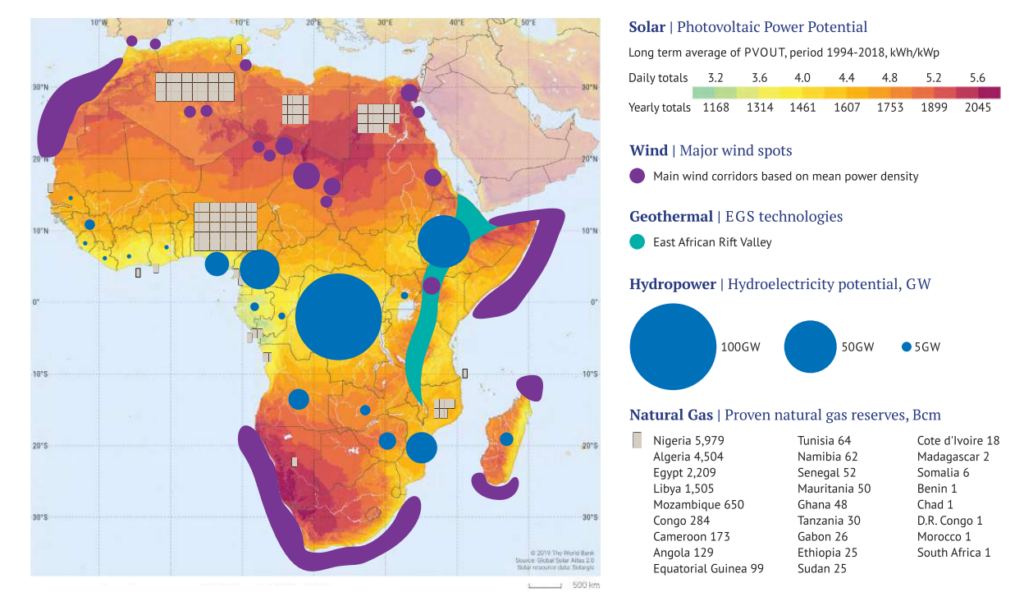
Source: Africa Finance Corporation.[14]
In terms of operational capacities, India and the UAE provide extensive expertise in scaling and infrastructure development through established entities—the Adani Group and Masdar, respectively. Additionally, the two nations have developed growing expertise in value creation across the clean energy supply chain. India now manufactures most of its solar panels domestically, although key upstream inputs—particularly polysilicon and wafers—remain largely imported from China.[15]
The UAE has also gained experience in local value creation through overseas investments. For example, the 500 MW wind project in Morocco, developed by ACWA Power, is expected to supply power to an electric vehicle (EV) battery gigafactory.[16] The learnings gained by both countries in building industrial capacity could prove valuable in partnerships with African countries by supporting local content development, industrial value addition, and reducing overreliance on imported technologies from China—all priorities across the continent.
Each African country would also present strengths that can be harnessed during project execution. For example, South Africa is leading renewable deployment across the continent, courtesy of the enabling regulatory ecosystem created by the Renewable Energy Independent Power Producer Procurement Programme (REIPPPP).[17]
Furthermore, India, the UAE, and African countries comprising the Africa Green Hydrogen Alliance—Egypt, Kenya, Mauritania, Morocco, Namibia, South Africa, Algeria, Angola, Djibouti, Ethiopia, and Nigeria—are positioning themselves as key players in the global green hydrogen economy, presenting an important area for IAU trilateral cooperation.[18]
India has accelerated its green hydrogen ambitions through the National Green Hydrogen Mission, with the Strategic Interventions for Green Hydrogen Transition Scheme providing financial incentives to expand domestic electrolyser manufacturing.[19] Meanwhile, the UAE’s hydrogen strategy aims to position the country as a leading producer and exporter of both green and blue hydrogen by 2031. Egypt and Mauritania have also established relations with UAE developer Masdar for green hydrogen development, with a signed MoU for the development of two green hydrogen production facilities in Egypt[20] and a US$34 billion deal for a green hydrogen project in Mauritania.[21]
Given that the partners are working to build a hydrogen ecosystem focused on domestic and international exports, a clusters-and-corridors approach could help create an integrated system among the IAU countries.[22] Industrial clusters centred on sectors such as fertilisers, chemicals, steel, and refining can help build domestic hydrogen demand while export corridors connecting production centres to partner-country markets can support economies of scale and attract investment, given the presence of off-take agreements. To maximise impact, trilateral cooperation should prioritise technology transfer and co-investment mechanisms that reduce project risks and accelerate deployment.[23]
Table 2: IAU Trilateral Objectives and Outcomes Across Renewable Energy
| Objective | Expected Outcome |
| Jointly develop enabling hydrogen infrastructure, including renewable power generation, electrolysers, storage facilities, and export terminals across India, the UAE, and Africa. | The accelerated deployment of hydrogen production projects through reduced infrastructure bottlenecks and expanded hydrogen production, storage, transport, and export capacity. |
| Stimulate demand through long-term off-take agreements with India, the UAE, and African producers acting as reliable buyers and suppliers for one another. The UAE, in particular, can utilise its strong logistics infrastructure to distribute African and Indian hydrogen to international markets.[24] | The creation of a stable regional market for green hydrogen and its derivatives would help improve project bankability and access to finance, ensuring greater revenue certainty for developers and strengthening trade linkages among the three partners. |
| Establish a technical project preparation facility dedicated to the trilateral’s renewable energy projects. This would aid the scoping, preparation, and tendering of projects, drawing on models such as South Africa’s Joint Project Preparation Facility (JPPF) and India’s Climate Projects Preparation Facility (CPPF). It would provide support throughout the project development cycle from pre-feasibility to financial close, including advisory services, technical assistance, and project developer-financier matchmaking.[25] | An increased pipeline of bankable and investment-ready renewable energy projects by enabling shorter project development timelines and higher rates of project financial close and implementation. |
Source: Author’s own using sources as cited.
Grid and Battery Infrastructure
While renewable energy generation is expanding across the three countries, the reliability and resilience of grid infrastructure remain bottlenecks for power transmission. To illustrate, India curtailed over 2.3 terawatt-hours of solar generation between May and December 2025.[26] In Africa, Nigeria is a prime example, with an installed generation capacity of approximately 13–14 GW. However, its national grid delivers less than half of this, with the remainder lost due to transmission and distribution constraints.[27] Moreover, many African utilities continue to rely on analogue systems that lack real-time data on asset conditions or customer usage.[28] Therefore, efforts by the partners to support renewable energy expansion should be coupled with investments in grid modernisation and transmission infrastructure. This would help reduce inefficiencies across the partnership by limiting the need for investors to hedge against risks associated with curtailment and inadequate grid infrastructure.
In parallel, energy storage systems, especially battery energy storage systems (BESS), are essential to deliver reliable renewable energy power across the grid. India is estimated to require 47.2 GW of battery storage capacity by 2032;[29] Africa is predicted to reach 83 GWh by 2030, with the maximum amount distributed equally between utility-scale and mini grids;[30] and the UAE has expressed its drive to expand BESS through national energy strategies.[31]
Given this momentum in BESS development, the IAU can support deployment across multiple storage applications, including mini-grid systems, which are particularly relevant for the rural and underserved regions in India and Africa,[32] as well as utility-scale storage to support renewable energy integration and grid stability in larger urban centres. In Africa, the trilateral would benefit from aligning battery development with partners established in the renewable energy pillar, recognising the close interdependence between renewable energy deployment and the need for battery storage.
Table 3: Trilateral Objectives and Outcomes for Grid Infrastructure and Storage
| Objective | Potential Outcomes |
| Map grid modernisation strategies and the required enablers. According to a PWC analysis,[33] utilities should focus on three strategies, supported by two key enablers. The strategies are: increase resilience and reliability; accelerate the clean energy transition; and improve operational excellence, enabled by advanced technologies and data systems; as well as adopt talent development initiatives and investments in specialised skills. | Clear roadmaps for grid modernisation, accelerated deployment of advanced grid technologies, and smart-grid training centres leading to operational efficiency and increased preparedness for future electricity demand growth. |
| Implement and expand smart-grid technologies. The partners can work together to strengthen the use of AI-driven analytics for demand-forecasting while focusing on knowledge- and technological-sharing to support strategy development. | Grid Reliability Metrics (GRM)[34] across the three partners indicate improvements in grid reliability and resilience, as reflected in reduced outage frequency and duration, enhanced demand forecasting and grid management, and greater visibility of real-time grid performance for operators and policymakers. |
| Support the development of battery storage value chains through strategic CM-processing hubs, expanding manufacturing capacity, and partnerships with renewable energy companies. Strengthening India’s growing lithium-ion battery recycling industry[35] offers an important area for cooperation as recycled minerals can be reintroduced into battery production. This complements Africa’s mineral resources and reduces external supply-chain dependencies. | Enhanced regional battery supply-chain resilience through greater circularity, reduced dependence on imported raw materials, and stronger integration of CM processing, recycling, and battery manufacturing across the trilateral partnership. |
Source: Author’s own using sources as cited.
Critical Minerals
The energy transition is inherently dependent on CMs and CM-based products. Africa is estimated to hold approximately 30 percent of the world’s CM resources that are essential for renewable energy technologies, and is increasingly prioritising the sector’s contribution to the continent’s economic growth.[36] At the same time, demand for CMs is expected to rise in both India and the UAE as they expand artificial intelligence (AI) and data centre infrastructure, renewable energy capacity, and battery storage systems, among others.[37], [38]
Figure 2: Minerals Used in Selected Clean Energy Technologies
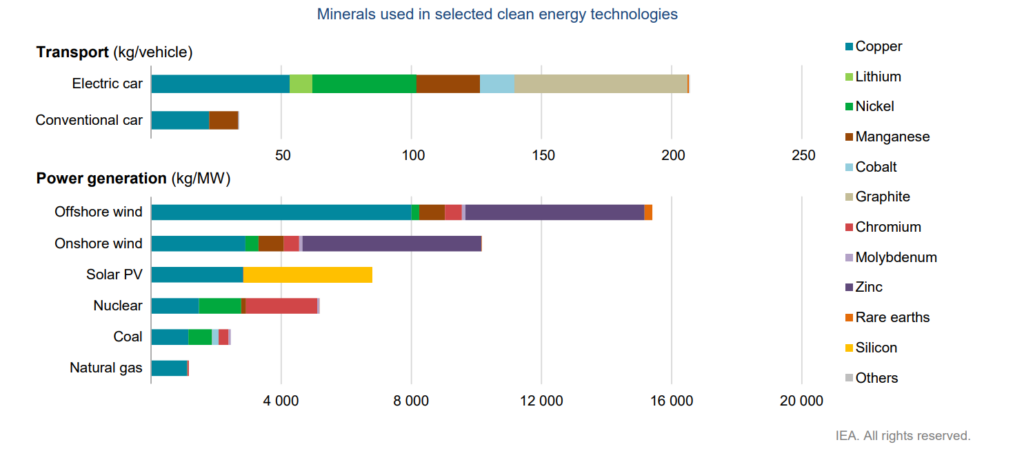
Source: IEA.[39]
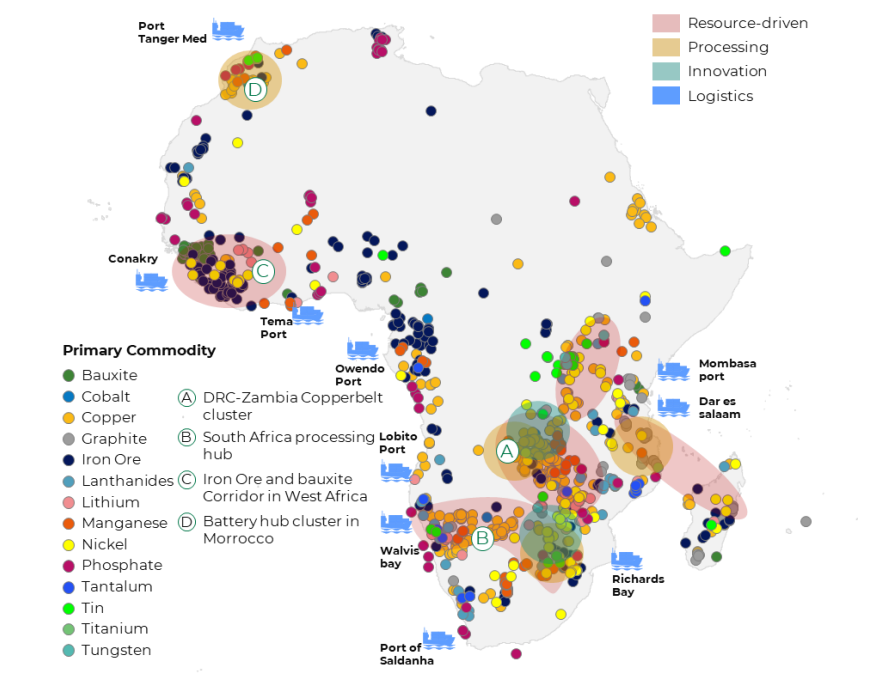
There are several CM clusters within Africa: the Southern African Development Community (SADC) region possesses many valuable energy-transition minerals; West Africa is rich in bauxite and iron ore; and Morocco is rich in manganese, copper, and nickel. Rather than operating in silos, developing regional processing hubs that aggregate mineral inputs from multiple countries can achieve economies of scale and reduce the risk of underutilised capacity.
Each region presents a strategic target for the CM value chain (see Figure 3). Over the years, the UAE has already accelerated its investments in Africa’s mining sector. Examples include the International Holding Company’s acquisition of a 51 percent stake in Zambia’s Mopani Copper Mines,[40] while UAE-based Titan Lithium has invested in lithium-mining projects in Zimbabwe and agreed to export minerals to Khalifa Port and the Khalifa Economic Zones Abu Dhabi (KEZAD) for processing.[41]
Figure 3: Potential CM Clusters in Africa
Source: B20 South Africa.[42]
To avoid the so-called ‘paradox of plenty,’ where resource-rich countries remain economically underdeveloped despite abundant natural wealth,[43] investments should also prioritise value addition over purely extractive models of cooperation. Many African countries are actively seeking to develop mineral industries across the value chain through legislation, domestic refining and smelting capacity, technology transfer, and local industrial development.[44] Consequently, they are likely to favour partnerships that clearly align with these objectives.
Table 4: IAU Objectives and Outcomes for the CM Sector
| Objective | Expected Outcome |
| Build mid- and downstream industries that utilise Africa’s CMs for domestic manufacturing of clean energy technologies, such as batteries, solar panels, and other value-added products. This would support exports to India and the UAE while helping both partners diversify supply chains and reduce dependence on concentrated sources of imports. | Increased regional value addition and manufacturing capacity while supporting the sustainable integration of CM supply chains across IAU countries. In the long term, improved competitiveness through shared infrastructure and lower logistics costs have been envisioned. |
| Support domestic small and medium enterprises (SMEs) and mining suppliers to strengthen local content participation throughout the CM value chain, thereby reducing reliance on imported goods and services and increasing local businesses’ participation in procurement, processing, and service provision. | A stronger domestic industrial ecosystem and improved retention of economic value within local economies, resulting in increased revenues for SMEs and local suppliers as well as enhanced job creation. |
| Focus on enabling drivers for sustainable CM development. This includes workforce skills development (by collaborating with existing regional organisations like the African Minerals and Geosciences Centre),[45] improving transport infrastructure, and strengthening reliable energy infrastructure. | Strengthened human capital and technical capabilities, alongside increased renewable energy deployment and grid modernisation, creating positive feedback loops across the clean energy, electricity infrastructure, and CM sectors. |
Source: Author’s own using sources as cited.
Risks and Barriers
While the trilateral will ultimately provide interconnected benefits for all partners across the discussed sectors, assessing its limitations is essential to maximise the benefits of this cooperation.
Infrastructure and Institutional Constraints
In many African markets, inadequate infrastructure, limited refining and processing capacity, and shortages of skilled labour restrict the ability to scale emerging industries. Social and environmental concerns can also pose important risks; where local communities are not meaningfully engaged, opposition may delay project implementation, generate reputational challenges, and increase the likelihood of costly legal disputes.[46]
In the hydrogen sector, heavy reliance on European export markets across the trilateral exposes projects to external vulnerabilities, including shifts in European policies, fluctuations in hydrogen and ammonia prices, and the implications of mechanisms such as the Carbon Border Adjustment Mechanism (CBAM).[e] This highlights the importance of developing local and regional demand centres, including through greater intra-African trade and industrial integration.
Additionally, investments in Africa may be perceived as extractive or neo-colonial if they fail to generate tangible local benefits.[47] Ensuring durable and mutually beneficial partnerships will require a strong focus on local job creation, skills development, technology transfer, community empowerment, and the strengthening of domestic industrial linkages.
Investment Risks
Investments in infrastructure and energy projects are constrained by regulatory, financial, and institutional challenges. Fragmented regulatory frameworks, inconsistent policy implementation, and prolonged land acquisition procedures increase project uncertainty and delay execution.[48] Investors also face difficulties in assessing opportunities due to limited transparency regarding project pipelines and historical performance, in addition to currency convertibility and exchange-rate volatility.[49]
Geopolitical Pressures and Competition
Current geopolitical tensions in the Middle East have highlighted the fragility of global supply chains and the fiscal pressures countries face during periods of regional instability, leading to inflationary pressures, shifts in economic growth trajectories, and potential credit rating downgrades.[50] These barriers can limit the effective advancement of trilateral projects by delaying pipelines, increasing perceived risks, and ultimately hiking costs.
Additionally, the trilateral will operate within an increasingly competitive global landscape with mature actors such as China, the European Union (EU) and the United States (US), which have already established clean energy industries, extensive supply chains, and strong technological capabilities. Their scale, lower production costs in certain segments, and strong policy support may make it challenging for IAU partners to position themselves competitively and quickly within emerging green technology value chains.
Debt Sustainability and Governance
International infrastructure initiatives have faced criticism regarding debt sustainability concerns and a lack of transparency in financing arrangements.[51] Laos, for example, has frequently been cited as being vulnerable to debt distress, with nearly half of its external debt owed to China.[52] While Gulf investments are often viewed as carrying fewer political and policy conditions than financing from many Western institutions, the scale of capital involved may nevertheless contribute to rising debt burdens,[53] stressing the need for projects to be carefully structured and aligned with countries’ repayment capacities.
Developing the Financial Ecosystem to Scale Trilateral Cooperation
Nurturing a sustainable financial ecosystem across the three partners is essential to translate strategic ambitions into tangible infrastructure and development outcomes. Understanding the existing financial ecosystem of each region will provide a clearer picture of the potential contributions and complementarities within the partnership. Collectively, these hubs are home to a plethora of member companies, including financial institutions, investment funds, holding companies, and wealth management firms that are increasingly interested in clean energy and CM value-chain development.
The United Arab Emirates
Abu Dhabi Global Market (ADGM) and Dubai International Finance Centre (DIFC)
ADGM and DIFC serve as the UAE’s international financial free zones and gateways for trade and investment across the Middle East, Africa, and South Asia (MEASA) region. Firms often benefit from closer engagement with the UAE’s sovereign wealth funds (SWFs),[54] which can serve as anchor investors for large-scale infrastructure and development initiatives. ADGM and DIFC both host several leading investment firms with a strong focus on emerging markets that could support IAU energy cooperation. These include Gemcorp Capital Management, ALTÉRRA, Actis, and LeapFrog Investments, each of which has established investment portfolios in Africa, India, or both.
Sovereign Wealth Funds (SWFs) and State-Owned Investors
The UAE’s SWFs and state-owned enterprises play important roles in international and domestic capital deployment. Investments are increasingly directed towards both India and Africa.[55] For example, the Abu Dhabi Investment Authority (ADIA) recently announced the opening of an office in GIFT City to oversee existing and future investments in India.[56] Beyond traditional hydrocarbons, UAE investment portfolios are increasingly diversified towards low carbon sectors, renewable energy, energy storage, and sustainable infrastructure[57]. Masdar—partially owned by the UAE’s SWF Mubadala—has become the country’s primary vehicle for renewable energy diplomacy and project development across emerging markets. These SWFs could play a pivotal role in financing the trilateral’s large-scale infrastructure projects.
India
Gujarat International Finance Tec-City (GIFT City)
GIFT City, India’s financial free zone, hosts several venture capital, private equity, angel investors, and corporate venture capital funds within its ecosystem.[58] Climate Capital, IREDA Global Green Energy Finance IFSC Limited, and India Exim Bank are among the actors aligned with the trilateral. The fintech sector remains one of the most prominent recipients of investment within the hub.[59] It could play an important role in supporting the trilateral’s financial architecture by improving financial inclusion, reducing transaction frictions, and enabling the efficient movement of capital across borders.
Moreover, growing integration between payment systems in India, the UAE, and several African countries—supported by India’s Unified Payments Interface (UPI) and RuPay network—has the potential to reduce transaction costs, facilitate trade settlements, and improve cross-border financial connectivity.[60] Discussions between the Reserve Bank of India (RBI) and UAE authorities on expanding cross-border payment initiatives further demonstrate this potential.[61]
National Infrastructure Investment Fund (NIIF)
India’s NIIF serves as a mostly government-owned asset manager, with the remaining owned by domestic and foreign investors and multilaterals, including the UAE’s ADIA.[62] Its mandate is to support investment in domestic infrastructure. One of the fund’s key initiatives is the NIIF Sustainable Infrastructure Fund, the country’s largest infrastructure fund, which deploys capital across transport, energy, and digital sectors. Within the IAU, it can serve as an important enabler of connectivity by helping develop and acquire the needed logistics ecosystems. One approach to achieve this is by utilising the existing joint venture between NIIF and DP World, which focuses on expanding facilities such as container freight stations and rail logistics.[63] In addition, the fund can provide financial support for Indian-based renewable energy projects within the trilateral pipeline.
Africa: Morocco, Mauritius, and Kenya
Casablanca Financial City (CFC)
Since its inception, CFC has sought to establish Casablanca as a leading hub for Africa-focused green finance, leveraging its position between Europe and Africa. Beyond attracting foreign capital, Morocco has emerged as one of the continent’s leading investors, with outward investments into Africa increasing from US$100 million in 2014 to US$2.8 billion in 2024.[64] The relevant established players within CFC for the IAU include Africa50, BNP Paribas Regional Investment Company, Private Infrastructure Development Group, Standard Chartered, SouthBridge Investments, and Africa Specialty Risks.
Mauritius
Mauritius’s location between mainland Africa and Asia and its fiscally stable environment have allowed it to function as a bridge into Southeast African countries. Through the years, the island nation shifted from an agriculture-based economy into an expanding financial hub, which now contributes over 13.4 percent of its Gross Domestic Product (GDP) through financial and insurance activities.[65] The country is part of the SADC, Common Market for Eastern and Southern Africa (COMESA), and the AfCFTA (African Continental Free Trade Area). This offers investors favourable access to a combined market of more than 406 million individuals[66] as well as opportunities for Mauritius-based entities to participate in intra-African trade and investment flows. MCB Capital Markets, Adenia, AfriAsia Bank, and Sanlam Investments are some of the relevant entities for the trilateral.
Nairobi International Financial Centre (NIFC)
NIFC, Kenya’s financial free zone, is increasingly shifting from a Kenya-focused approach to a broader pan-African vision, seeking to present Africa as a more unified and coordinated investment destination and expand cross-border capital flows, as expressed by NIFC CEO Daniel Mainda.[67] The growth in accredited firms, from just two or three in 2022 to 41 as of June 2026, highlights the growing international interest in Nairobi as a financial hub.[68],[69] Key actors located within the NIFC that could support the trilateral include Verdant Capital, NovaStar, CrossBoundary Group, and the Catalyst Fund.
Strategies to Mobilise Capital
As demonstrated, there is a strong financial foundation across the IAU to accelerate progress in priority sectors. However, mobilising these resources requires targeted strategies to stimulate both cross-border and domestic capital flows into these investments.
Innovative Financing Models
Financing should adopt a diversified approach rather than relying primarily on government funding. Potential instruments include blended finance, development finance institutions (DFIs), special purpose vehicles (SPVs), sovereign financing, and green bonds. Within the IAU context, the financial entities discussed above could facilitate layered financing structures. For example, UAE sovereign capital, alongside Indian and African public institutions, could absorb higher-risk development and construction-stage financing. As projects mature and begin generating stable cash flows, institutional investors could provide long-term refinancing capital. In terms of geopolitical risks, the inclusion of components such as hedging, insurance products, and risk-sharing structures would also stimulate the needed capital flow.
Trilateral Co-Investment Fund
A dedicated trilateral co-investment fund can be established to pool capital for strategic projects. Such a vehicle could support both pilot initiatives and large-scale infrastructure developments while sharing risks among participating partners. Germany’s Fund for Triangular Cooperation with Asia, which partnered with India and China to incubate smaller-scale triangular pilot projects,[f] is a useful precedent that could be scaled.[70] A similar approach could be adopted within the IAU partnership to support innovative technologies, deep-tech collaborations, renewable energy projects, critical mineral value chains, and broader infrastructure investments.
Standardised ESG and Risk Assessment Frameworks
Environmental, social, and governance (ESG) considerations have increasingly become a source of portfolio value creation and an important mechanism for mobilising private capital. Investors are more willing to deploy capital when risks are transparent, measurable, and mitigated with disclosures aligned with internationally recognised sustainability standards.[71] Using existing ESG-aligned financial frameworks within the IAU partners—such as ADGM’s sustainable finance framework, for example—would serve as useful models for financing projects across the trilateral.[72]
Through partner nations’ expertise, the establishment of interoperable ESG could strengthen investor confidence. Alongside ESG protocols, standardised risk assessment methodologies should be developed to evaluate political, regulatory, currency, sovereign, and project-level risks. Consistent risk assessment frameworks would improve project bankability and facilitate cross-border capital mobilisation.
Local-Currency Bond Pipelines
Issuing bonds for projects in local currency in line with how project revenues are typically earned reduces currency risk. This, therefore, attracts local investors. For example, Nigeria’s InfraCredit helps local investors finance infrastructure projects in their own currency by offering local-currency credit guarantees (i.e., it ensures that losses are covered if the borrower cannot repay),[73] therefore reducing risk and attracting investors. Local debt and equity markets can be better leveraged when large banks or DFIs provide risk guarantees or act as anchor investors, especially in markets with deep reserves of local savings.[74]
Partnerships with Local and International Financial Institutions
The three partners already maintain extensive relationships with international financial institutions, creating opportunities to leverage existing financing channels. India and African countries have long collaborated with institutions such as the New Development Bank, the African Development Bank, and the Asian Infrastructure Investment Bank. These long-standing relationships could support large-scale infrastructure projects by providing de-risking instruments such as guarantees, concessional loans, and project preparation support, helping improve project bankability.[75]
Moreover, the trilateral should leverage existing initiatives between and within financial hubs. The CFC and NIFC signed an MoU in 2026 with a focus on financial services and fintech collaboration to accelerate innovation and broaden the financial sector.[76] Additionally, DIFC’s Sustainable Finance Catalyst aims to mobilise US$100 billion in sustainable finance flows from Dubai by 2030.[77] Aligning such initiatives with trilateral priorities could help channel greater capital towards priority sectors.
Conclusion
The IAU has immense potential to benefit all three partners, as they share complementary sectoral priorities that can further strengthen existing economic and trade ties. It should focus on strengthening priority sectors by effectively utilising existing financial hubs that bring together government, DFIs, banks, institutional investors, private equity, venture capital, and impact funds, creating an enabling environment that can mobilise the required capital. Supporting an innovation-driven ecosystem and deepening collaboration among businesses, startups, researchers, and academic institutions are essential to maintain long-term engagement.
Geopolitical tensions in the region may have created pressures for India, the UAE, and African countries, but they have also highlighted the necessity to strengthen energy security and diversify energy sources. The IAU will accordingly reinforce existing South–South partnerships and drive the ‘regionalisation of globalisation’ to expand energy infrastructure and enhance supply chain resilience. The sustainability of the partnership will essentially depend on its ability to leverage the comparative strengths of each partner while maintaining an equitable and mutually beneficial model of cooperation.
Reem Sagahyroon is Research Assistant, Climate and Energy, ORF Middle East.
The author acknowledges the use of ChatGPT 5.5 for language refinements prior to submission.
All views expressed in this publication are solely those of the author, and do not represent the Observer Research Foundation, either in its entirety or its officials and personnel.
Endnotes
[a] The India–UAE CEPA focuses on reducing trade barriers, enhancing market access, and facilitating investment flows across 11 service sectors including business, telecommunications, transport, and financial and insurance services.
[b] The UAE–Kenya CEPA addresses goods, services, technological innovation, digital trade, and sustainability. It provides opportunities for Kenyan service providers to access the UAE market in sectors such as education, transport, communications, construction, and engineering.
[c] The UAE–Mauritius CEPA focuses on reducing tariffs, providing a platform for small and medium enterprises to expand internationally, creating a framework for digital trade and facilitating investments.
[d] Examples include the India, Brazil, South Africa (IBSA) grouping that involved trilateral collaboration on areas/projects through 14 working groups and by aiding other developing countries through the IBSA Fund; and the Japan, Brazil, and Mozambique Triangular Cooperation Programme for Agricultural Development in African Tropical Savanna.
[e] CBAM is a European Union (EU)-implemented tool that requires EU importers to purchase CBAM certificates reflecting the carbon embedded. This sets a carbon price on carbon-intensive imports. Currently CBAM covers iron, steel, cement, fertilisers, aluminium, electricity, and hydrogen.
[f] A German development initiative commissioned by the Federal Ministry for Economic Cooperation and Development (BMZ) and implemented via Deutsche Gesellschaft für Internationale Zusammenarbeit (GIZ) focused on implementation of triangular cooperation with Asian and German organisations providing technical expertise and/or funding in beneficiary countries.
[1] Cabinet, Government of India, https://www.pib.gov.in/newsite/PrintRelease.aspx?relid=188165®=48&lang=2.
[2] Ministry of Foreign Affairs, United Arab Emirates, https://www.mofa.gov.ae/en/mediahub/news/2025/12/11/uae-africa.
[3] DP World, //www.dpworld.com/en/news/india/dp-world-announces-bharat-africa-setu-with-the-aim-of-doubling-india-africa-trade.
[4] Samir Bhattacharya, “Reviving India-Africa Relations in A Fragmented World,” Hindustan Times, May 16, 2026, https://www.hindustantimes.com/ht-insight/international-affairs/reviving-india-africa-relations-in-a-fragmented-world-101778906079539.html.
[5] OECD and IsDB (2025), Global Perspectives on Triangular Co-operation 2025, Paris, OECD Publishing, 2025, https://doi.org/10.1787/f713f2ce-en.
[6] Africa Renewable Energy Initiative, “Africa Renewable Energy Initiative,” https://www.arei.info/eng.
[7] Embassy of the UAE, Washington DC, “UAE Energy Diversification”, https://www.moei.gov.ae/en/about-ministry/energy-strategies-to-achieve-net-zero.
[8] Viksit India, “Viksit India: Bold Vision. Brighter Future,” https://viksitindia.com/.
[9] “Africa’s Push and Progress in Renewable Energy Scale-up,” Africa Climate Insights, August 26, 2025, https://africaclimateinsights.org/africas-push-and-progress-in-renewable-energy-scale-up/.
[10] Adnan Merhaba et al., Africa’s Green Future, Arthur D Little, 2026, https://www.adlittle.com/en/insights/viewpoints/africa%E2%80%99s-green-future.
[11] International Hydropower Association, “Hydropower in Africa,” International Hydropower Association, https://www.hydropower.org/region-profiles/africa.
[12] International Hydropower Association, “Hydropower in Africa.”
[13] Africa Finance Corporation, State of Africa’s Infrastructure Report 2025, 2025, https://www.africafc.org/our-impact/our-publications/state-of-africa-infrastructure-report-2025.
[14] AFC, State of Africa’s Infrastructure Report 2025.
[15] Fred Pearce, “A First Among Major Nations, India Is Industrializing with Solar, Yale Environment 360,” May 2026, Yale Environment360, https://e360.yale.edu/features/india-solar.
[16] Zawya Projects, “ACWA Power’s Wind Farm to Power Gotion High-Tech’s Morocco Gigafactory – Report,” Zawya, November 4, 2024, https://www.zawya.com/en/projects/industry/acwa-powers-wind-farm-to-power-gotion-high-techs-morocco-gigafactory-report-444328.
[17] Forvis Mazars, Powering Africa’s Future: Energy Trends, Regulatory Framework, and Energy Policies in Africa 2025, Forvis Mazars Group SC, 2025, https://www.forvismazars.com/group/en/content/download/1271525/file/Forvis%20Mazars%20Powering%20Africa%27s%20Future%20Brochure.pdf.
[18] Green Hydrogen Organisation, “The Africa Green Hydrogen Alliance (AGHA),” Green Hydrogen Organisation, https://gh2.org/agha.
[19] Shubhika Rathi, “Strategic Intervention for Green Hydrogen Transition (SIGHT) Programme,” Impact and Policy Research Institute, June 2024, https://www.impriindia.com/insights/strategic-hydrogen-transition-sight/.
[20] Masdar, “Masdar Led Consortium Strengthens Partnership,” https://masdar.ae/en/news/newsroom/masdar-led-consortium-strengthens-partnership.
[21] “Consortium Signs $34 Billion MoU for Hydrogen Project in Mauritania,” Reuters, March 8, 2023, https://www.reuters.com/business/energy/german-uae-egypt-consortium-sign-34-bln-deal-hydrogen-project-mauritania-faz-2023-03-08/.
[22] Parimal Kogekar, Ankur Malyan, and Jagabanta Ningthoujam, “How India Can Enhance Global Energy Security Through Green Hydrogen,” RMI, January 16, 2026, https://rmi.org/resources/how-india-can-enhance-global-energy-security-through-green-hydrogen/.
[23] Kogekar, Malyan, and Ningthoujam, “How India Can Enhance Global Energy Security Through Green Hydrogen.”
[24] Rakshith Shetty, “The India-UAE Partnership in Next-Generation Energy Sectors” ORF Middle East, May 2025, https://orfme.org/research/india-uae-partnership-in-next-generation-energy-sectors/.
[25] Caribbean Centre for Renewable Energy and Energy Efficiency, “Project Preparation Facility,” Caribbean Centre for Renewable Energy and Energy Efficiency,” https://www.ccreee.org/ppf/.
[26] Shreya Mishra, “Why Storage Is the Missing Layer in India’s Clean Energy Story,” World Economic Forum, June 2026, https://www.weforum.org/stories/2026/06/storage-india-clean-energy/.
[27] Dr Lazarus Angbazo, “The Countries That Will Lead the AI Economy Are Being Decided Right Now — by Their Power Grids,” Vanguard, May 23, 2026, https://www.vanguardngr.com/2026/05/the-countries-that-will-lead-the-ai-economy-are-being-decided-right-now-by-their-power-grids/.
[28] Martín Rimblas, “Battery Storage in Africa: From Backup to Backbone,” RatedPower Solar Energy Blog, comment posted February 19, 2026, https://ratedpower.com/blog/battery-storage-africa/.
[29] Mishra, “Why Storage Is the Missing Layer in India’s Clean Energy Story.”
[30] Suzanne Anglivie et al., Closing the Loop in Energy Access in Africa, Geneva, World Economic Forum, 2021, https://www3.weforum.org/docs/WEF_Closing_Loop_Energy_Access_2021.pdf.
[31] Department of Energy, Abu Dhabi Energy Outlook 2050, Department of Energy, 2023, https://www.doe.gov.ae/-/media/Project/DOE/Department-Of-Energy/Media-Center-Publications/1_Abu-Dhabi-Energy-Outlook-2050_En.pdf.
[32] Josh Agenbroad et al., Minigrids in the Money: Six Ways to
Reduce Minigrid Costs by 60% for Rural Electrification, Rocky Mountain Institute, 2018, https://rmi.org/app/uploads/2018/12/rmi-seeds-minigrid-report.pdf.
[33] Biren Gandhi et al., Power Grid Modernization: The Catalyst to Resilience and Energy Transition, New York, Institute of Business Value and AspenTech, 2025, https://www.ibm.com/downloads/documents/us-en/1227c12e6338bedf.
[34] Khalid Zaman and Nazish Bibi, “Efficiency Metrics: Assessing the Impacts of Grid Reliability on Energy Efficiency in Smart Systems,” Energy RESEARCH LETTERS 6, no.1 (2025), https://erl.scholasticahq.com/article/94671-efficiency-metrics-assessing-the-impacts-of-grid-reliability-on-energy-efficiency-in-smart-systems.
[35] Council on Energy, Environment, and Water, “Lithium-ion Battery Waste Recycling,” Council on Energy, Environment, and Water, https://www.ceew.in/lithium-ion-battery-waste-recycling.
[36] Ifeanyi Chukwudi, “3 Ways Africa Can Maximize the Value of Its Critical Minerals and Finance Its Future,” World Economic Forum, April 2026, https://www.weforum.org/stories/2026/04/africa-critical-minerals-energy-transition/.
[37] Press Information Bureau, Government of India, https://www.pib.gov.in/PressNoteDetails.aspx?NoteId=155158&ModuleId=3®=3&lang=2.
[38] Cauvery Ganapathy, “UAE’s Critical Minerals Dilemma,” ORF Middle East, May 2026, https://orfme.org/research/uae-critical-minerals-strategy/.
[39] International Energy Agency, The Role of Critical Minerals in Clean Energy Transitions, Paris, 2021, https://www.oecd.org/content/dam/oecd/en/publications/reports/2021/05/the-role-of-critical-minerals-in-clean-energy-transitions_4ce961a5/f262b91c-en.pdf.
[40] International Resources Holding, “In 2024, IRH Announced the Acquisition of a 51% Interest in Zambia’s Mopani Copper Mines,” International Resources Holding, https://www.irh.ae/assets/
[41] “ UAE’s Titan Lithium to Build $1.4bln Lithium Processing Plant in KEZAD,” Zawya, February 13, 2024, https://www.zawya.com/en/projects/industry/uaes-titan-lithium-to-build-1.4bln-lithium-processing-plant-in-kezad-439061.
[42] B20 South Africa, Africa at the Core of Critical Minerals, 2025, https://www.b20southafrica.org/wp-content/uploads/2025/11/Africa-at-the-Core-of-Critical-Minerals.pdf.
[43] Mannat Jaspal, “Can Energy Transitions Cure the Dutch Disease in Africa?,” ORF Middle East, March 2025, https://orfme.org/expert-speak/can-energy-transitions-cure-the-dutch-disease-in-africa/.
[44] Veda Vaidyanathan, India, Africa and Critical Minerals: Towards a Green Energy Partnership, New Delhi, Centre for Social and Economic Progress, 2025, https://csep.org/wp-content/uploads/2025/03/India-Africa-and-Critical-Minerals-Towards-a-Green-Energy-Partnership.pdf.
[45] Organisation for Economic Co-operation and Development, Regional Note on Critical Minerals in Africa, Paris, OECD, 2026, https://www.oecd.org/content/dam/oecd/en/events/2026/04/critical-minerals-forum/oecd-critical-minerals-regional-note-africa.pdf.
[46] Chigozie Nweke-Eza, The Evolving Role of Gulf States in Africa’s Energy Transition, Anwar Gargash Diplomatic Academy, 2026, https://www.agda.ac.ae/research/publications-multimedia-events/publication-details/the-evolving-role-of-gulf-states-in-africa-s-energy-transition.
[47] Nweke-Eza, The Evolving Role of Gulf States in Africa’s Energy Transition.
[48] Organisation for Economic Co-operation and Development, Addressing Legal and Regulatory Barriers to Quality Infrastructure Investment in India, Indonesia and the Philippines, Paris, OECD Publishing, 2025, https://doi.org/10.1787/fb81e1be-en.
[49] OECD, Addressing Legal and Regulatory Barriers to Quality Infrastructure Investment in India, Indonesia and the Philippines.
[50] David Lubin, “The Hormuz Inflation Shock Is Only Just Beginning,” Chatham House, May 2026, https://www.chathamhouse.org/2026/05/hormuz-inflation-shock-only-just-beginning.
[51] Zaw Oo, Strengthening Trilateral Cooperation on Development Finance in Southeast Asia’s Least Developed Countries, Asia Society Policy Insititute, November 2024, https://asiasociety.org/policy-institute/strengthening-trilateral-cooperation-development-finance-southeast-asias-least-developed-countries
[52] Oo, Strengthening Trilateral Cooperation on Development Finance in Southeast Asia’s Least Developed Countries.
[53] Hakeem Alade Najimdeen, “The GCC’s Strategic Footprint: Gulf Investment as an Emerging Power Bloc in Africa,” AlJazeera Centre for Studies, June 2025, https://studies.aljazeera.net/en/analyses/gccs-strategic-footprint-gulf-investment-emerging-power-bloc-africa.
[54] Daniel Pacic, “An Overview of the DIFC and ADGM,” Ogier, July 1, 2024, https://www.ogier.com/news-and-insights/insights/an-overview-of-the-difc-and-adgm/.
[55] Najimdeen, “The GCC’s Strategic Footprint: Gulf Investment as an Emerging Power Bloc in Africa.”
[56] Julie Kassab, “Expanding Horizons: GCC SWFs at the Forefront of a Strategic Global Expansion,” Deloitte, January 2026, https://www.deloitte.com/middle-east/en/Industries/investment-management/blogs/expanding-horizons.html.
[57] Parul Bakshi, “Mapping Gulf Sovereign Wealth Funds in the Global Energy Transition: Capital, Technology, and Diplomacy,” ORF Middle East, 2026, https://orfme.org/wp-content/uploads/2026/02/ORF-ME_Report_Mapping-Sovereign-Wealth-Funds.pdf.
[58] Garima Mitra, “GIFT City’s Role in Elevating India’s Startup Ecosystem,” Inc42, November 19, 2023, https://inc42.com/resources/gift-citys-role-in-elevating-indias-startup-ecosystem/.
[59]Mitra, “GIFT City’s Role in Elevating India’s Startup Ecosystem.”
[60] Mannat Jaspal, “Countdown to BRICS 2026: The India-Africa-UAE Trilateral,” ORF Middle East, August 2025, https://orfme.org/expert-speak/countdown-to-brics-2026-the-india-africa-uae-trilateral/
[61] Ashwin Manikandan, “India’s RBI Plans Expansion of Digital Rupee through Welfare Schemes, Cross Border Payments,” Reuters, May 29, 2026, https://www.reuters.com/world/india/indias-rbi-plans-expansion-digital-rupee-through-welfare-schemes-cross-border-2026-05-29/.
[62] Sovereign Wealth Fund, “Investor Profile NIIF India,” https://globalswf.com/fund/NIIF.
[63] DP World, “DP World and NIIF Announce Broadening of Partnership in India,” https://www.dpworld.com/en/news/dp-world-niif-announce-partnership-in-india.
[64] Eromo Egbejule, “High-rise, High Expectations: Is Casablanca’s Finance Hub a Model for African Development?” The Guardian, June 3, 2025, https://www.theguardian.com/world/2025/jun/03/casablanca-finance-hub-african-development-morocco.
[65] “Mauritius Reinforces Its Position as Africa’s Preferred Investment Gateway,” CNBC Africa, February 10, 2026, https://www.cnbcafrica.com/2026/mauritius-reinforces-its-position-as-africas-preferred-investment-gateway.
[66] Didier Viney, “How Mauritius’ International Financial Centre compares with the Dubai IFC,” CCI France UAE, September 2021, https://www.ccifranceuae.com/fileadmin/eau-dubai/user_upload/DTOS_Mauritius_Finance_mag_2-Didier_s_article.pdf.
[67] Nairobi International Financial Centre, https://nifca.go.ke/news/4.
[68] Nairobi International Financial Centre.
[69] “Nairobi’s NIFC Secures $200M in Commitments, Testing Kenya’s Hub Ambition,” AUStartups, July 4, 2026, https://au-startups.com/news/nairobi-nifc-200m-investment-influx.
[70] OECD and Islamic Development Bank, Global Perspectives on Triangular Co-operation 2025, Paris, OECD Publishing, 2025, https://doi.org/10.1787/f713f2ce-en.
[71] Jeremy Gorelick, “ESG and Capital Finance Mobilisation from a Private Sector Investment Platform,” Slides, Green Finance Institute, February 2026, https://saiia.org.za/wp-content/uploads/2026/02/ESG-and-Capital-Finance-Mobilisation-from-a-Private-Sector-Investment-Platform.pdf.
[72] ADGM, “Sustainable Finance,” ADGM, https://www.adgm.com/initiatives/sustainable-finance.
[73] Gomez Agou, “Mobilizing Africa’s Capital for African Development,” Project Syndicate, March 2026, https://www.project-syndicate.org/commentary/how-development-banks-can-mobilize-the-capital-africa-needs-by-gomez-agou-2026-03.
[74] Casablance Finance City and Africa50, Developing African Infrastructure in Challenging Times, Casablance Finance City and Africa50, 2025, https://www.casablancafinancecity.com/sites/default/files/2025-02/rapport-developing-african-infrastructure_inside-pages_PRINT-compressed%20%282%29.pdf.
[75] Mannat Jaspal and Anil Kishora, “Greening Half the World: Leveraging the New Development Bank for Green Finance,” ORF Middle East, February 2026, https://orfme.org/research/greening-half-the-world-leveraging-the-new-development-bank-for-green-finance/
[76] Nairobi International Financial Centre.
[77] DIFC, “DIFC Sustainable Finance Catalyst,” https://www.difc.com/ecosystem/sustainability/difc-sustainable-finance-catalyst .