 Global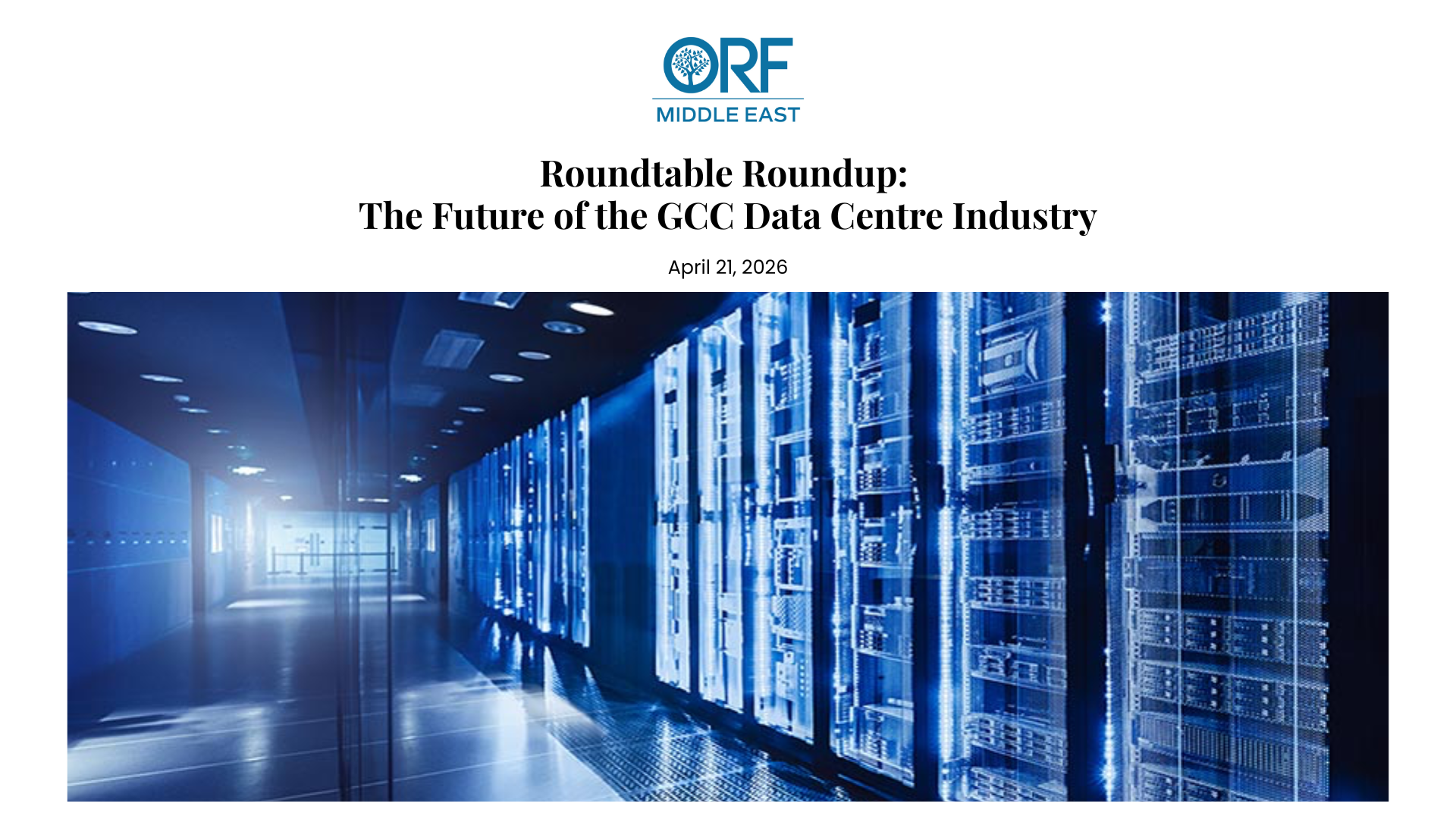
Event Reports | 22 May, 2026
Roundtable Roundup: The Future of the GCC Data Centre Industry
The Gulf’s rapidly expanding data centre sector has become central to the region’s wider ambitions around artificial intelligence (AI), cloud computing, and digital-economic transformation. Across the GCC, governments are positioning digital infrastructure as a strategic pillar of economic diversification, while hyperscale operators and cloud providers increasingly view the region as an attractive destination for investment due to its strategic position in global cable networks, strong state backing, and comparatively fast project approval timelines.
These themes formed the basis of a recent closed-door roundtable convened by the Observer Research Foundation Middle East (ORF ME) as part of its “From Market to Policy” series, examining the future of the GCC data centre industry. Participants with expertise across infrastructure, technology, policy, and energy sectors discussed the opportunities driving the market, as well as the challenges associated with scaling critical digital infrastructure given the current uncertain geopolitical environment.
The discussion took place against the backdrop of surging global demand for compute capacity. According to the International Energy Agency (IEA), global electricity consumption from data centres is projected to more than double by 2030, driven largely by AI workloads and hyperscale expansion. Participants noted that the GCC remains steadfast in pursuing its goal to become a major cloud and AI hub despite regional disruption, particularly as demand for AI infrastructure accelerates.
Strategic Geography and the Race for Digital Infrastructure
Participants emphasised that the GCC’s geographic position between Europe, Asia, and Africa remains one of its strongest structural advantages. Combined with growing subsea cable connectivity and strong government-led digital strategies, this has strengthened the region’s attractiveness as a cloud and AI infrastructure hub. It was highlighted that hyperscale demand across the GCC has increased significantly over the past several years, driven both by domestic digital transformation agendas and by international firms seeking scalable infrastructure markets that are less saturated than other global hubs such as Northern Virginia and Frankfurt. Participants noted that relatively streamlined planning processes in several GCC states have allowed projects to move from approval to construction far more quickly than in North America or Europe.
This speed was widely viewed as a competitive advantage. One participant observed that the region’s ability to mobilise labour and accelerate delivery timelines has made it particularly attractive for hyperscale operators seeking rapid deployment capacity. Saudi Arabia’s plans to significantly expand hyperscale capacity were referenced as evidence that governments remain confident in long-term demand growth with project ambitions becoming increasingly large in scale. Broader market forecasts similarly indicate continued expansion. Recent industry estimates project the GCC data centre market, valued at US$3.48 billion in 2024, is projected to almost triple to reach US$9.49 billion by the end of the decade as AI adoption, cloud localisation requirements, and digital economy initiatives continue to expand.
Participants also discussed the strategic importance of subsea cable infrastructure and connectivity corridors. While Gulf states have historically sought to position much of their submarine cable infrastructure on the Gulf of Oman, beyond the Strait of Hormuz as a safeguard against longstanding geopolitical tensions with Iran. Yet planned expansion of cable landing stations and connectivity corridors remains necessary to improve redundancy, resilience, and the region’s long-term role as a global digital transit hub. However, the growing concentration of strategic digital infrastructure along these routes may itself increase exposure during periods of geopolitical escalation. Cable systems and landing stations remain vulnerable not only to intentional attacks, but also to accidental damage resulting from disruption to commercial shipping routes and maritime incidents in and around Hormuz. As a result, the Arabian Sea cost cable expansion projects outlined in roundtable discussion may require not only greater physical and network redundancy, but also more robust geopolitical risk insurance mechanisms and closer defence and maritime security coordination between cable operators and the Gulf states hosting them.
Despite the geopolitical risks, participants generally remained optimistic about long-term growth. Several, however, noted that the sector’s rapid expansion may also warrant reassessment, particularly around land availability, power supply, and supply chain resilience.
Resilience, Security and the Limits of Speed
A major theme throughout the discussion was the tension between speed and resilience.
Participants noted that while GCC states have been highly successful in accelerating infrastructure deployment, resilience considerations are becoming increasingly important as data centres evolve into strategic national infrastructure assets. The discussion referenced growing concerns around geopolitical risk, particularly in light of the ongoing regional conflict,which has underscored the critical importance of protecting digital infrastructure for sustaining long-term growth. Several participants argued that resilience should not be understood purely in terms of redundancy at the facility level. Instead, resilience was framed as a broader systems-level challenge involving site selection, power access, connectivity, governance structures, and supply chain diversification. Particular concern was raised around the concentration of hyperscale facilities within relatively limited geographic clusters which can create concentration of risks during periods of disruption.
Supply chains were repeatedly identified as a key factor in sustaining the momentum of digital infrastructure projects. Participants stressed that disruptions to semiconductor components, electrical systems, cooling technologies, and other critical inputs could potentially delay projects more significantly than physical infrastructure damage itself. This is because supply chain disruption can create cascading delays across investment cycles, financing, and deployment schedules. South Korean officials warned in March 2026 that the conflict could disrupt supplies of key semiconductor manufacturing materials from the Middle East, including helium, which is essential for chip production and is primarily produced by Qatar. In terms of getting key material into the Gulf too, high shipping fuel prices make logistics more expensive, on top of the operational disruption of having to navigate alternative routes beyond the Strait of Hormuz.
Cybersecurity also emerged as a growing concern, particularly given the increased risk of Iranian cyber operations targeting critical infrastructure amid escalating regional conflict. Gulf data centres and cloud infrastructure were discussed not only as commercial assets, but increasingly as strategic infrastructure vulnerable to both cyber and hybrid attacks. In April 2026, US cybersecurity and intelligence agencies warned that Iranian-linked hackers had intensified attacks against critical infrastructure systems, including operational technology and industrial control systems. As dependence on hyperscale cloud systems grows, the resilience of data centres against cyber disruption is becoming increasingly intertwined with broader national security planning.
Energy, Talent and Long-Term Competitiveness
The roundtable also examined the relationship between data centres, energy systems, and workforce development. Participants noted that power availability is increasingly becoming one of the defining constraints shaping global data centre deployment globally. While the GCC benefits from comparatively strong energy resources, securing reliable grid access for hyperscale projects is becoming more complex as demand intensifies. This is shifting competition away from simply attracting investment toward questions of grid resilience, transmission infrastructure, and long-term generation capacity. As a result, renewable integration, battery storage, district cooling systems, and advanced energy management technologies are increasingly becoming strategic considerations rather than purely sustainability objectives.
Talent development emerged as another key issue. Participants observed that much of the global expertise required to operate advanced data centre infrastructure remains concentrated in more mature markets such as North America and Europe. While GCC universities and institutions are increasingly developing programmes related to AI, semiconductors, and digital infrastructure beyond specialist institutions like MBZUAI and KAUST, participants argued that further investment in local skills ecosystems will be necessary to sustain long-term growth. However, discussion suggested that long-term competitiveness will depend not only on technical education, but also on building deeper operational capability, regulatory maturity, and resilience cultures across both public and private sector institutions. Several participants argued that even highly advanced infrastructure can remain vulnerable without sufficiently trained operators, robust contingency procedures, and regular resilience testing, reinforcing the need for closer collaboration between governments, academia, and hyperscale operators on workforce development and knowledge transfer.
Conclusion
The roundtable highlighted both the scale of the GCC’s digital infrastructure ambitions and the complexity of the challenges accompanying that growth. Participants broadly agreed that the region possesses significant structural advantages, including geographic connectivity, government support, energy availability, and comparatively rapid deployment capacity.
At the same time, discussions reflected a growing recognition that the next phase of growth will require greater emphasis on resilience, governance, and long-term systems planning. As data centres increasingly underpin AI development, cloud services, and wider economic activity, they are also becoming more strategically significant and therefore more exposed to geopolitical, operational, and supply chain risks.
Rather than slowing momentum, participants generally viewed these challenges as part of the natural maturation of the sector. The discussion suggested that the GCC’s long-term competitiveness may ultimately depend not only on how quickly infrastructure can be built, but on how effectively resilience, energy planning, talent development, and policy frameworks can evolve alongside it.
Elizabeth Heyes is a Junior Fellow in Emerging Technologies at ORF Middle East.