 Global
Special Reports | 02 September, 2026 Download Report (PDF)
The Case for BRICS Cooperation: Energy Security and a Managed Energy Transition
Introduction
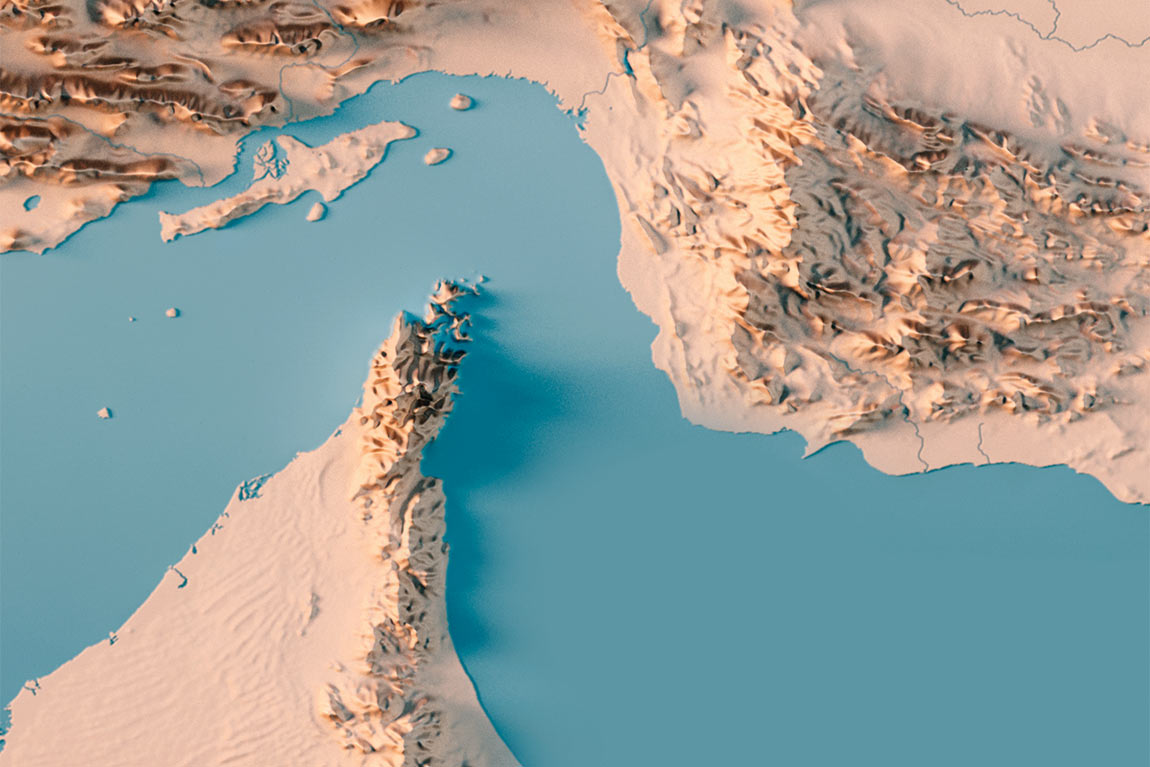
The Strait of Hormuz has historically been the world’s most consequential energy chokepoint. In 2026, it became a stress test, the impact of which was felt globally. With the West Asia conflict threatening maritime security through a corridor handling roughly 25 percent of global oil trade, BRICS—a bloc accounting for nearly half of the world’s population and around 40 percent of global gross domestic product (GDP)—has found itself unable to coordinate a collective response, despite having on its membership roster both major exporters dependent on the Hormuz passage, and major importers acutely exposed to any supply disruption.[1]
The BRICS Energy Cooperation Roadmap 2025–2030, adopted only in 2025 with commendable ambitions around decarbonisation, long-term transition, and green hydrogen, offered limited relief against an immediate supply shock.[2] The gap between BRICS’ declared energy ambitions and its operational energy security capacity has rarely been more visible. Yet this gap is not an argument against BRICS’ energy cooperation, but for rethinking what such cooperation must do and for whom.
This report proceeds from the contention that BRICS’ heterogeneity, routinely treated as the grouping’s primary obstacle to coherent action, is also an underutilised asset. The bloc now has 11 members: Brazil, Russia, India, China, South Africa, Egypt, Ethiopia, Indonesia, Iran, the United Arab Emirates (UAE), and Saudi Arabia. Though Saudi Arabia, having been extended a formal invitation to join at the Johannesburg Summit in August 2023, is yet to formally accept full membership.[3] Unless otherwise specified, references to ‘BRICS’ throughout this report encompass all 11 countries, spanning the full spectrum of the global energy system—major hydrocarbon exporters, coal-dependent industrialisers, advanced clean energy manufacturers, and energy-vulnerable economies with financial constraints. This is not a grouping on the margins of the energy transition or energy security. Together, the BRICS countries account for roughly 40 percent of global crude production, a similar share of global liquids demand, and nearly 50 percent of global energy consumption.[4]
That centrality comes with a stark internal contradiction. According to Global Energy Monitor (GEM), even as BRICS members (excluding Saudi Arabia) commissioned record renewable capacity in recent years, 2025 saw the largest net annual increase in fossil fuel capacity across the grouping, at 115 gigawatts (GW).[5] This was approximately 11 percent above the previous peak with eight of 10 BRICS members commissioning new fossil capacity that year.[6] The split reflects the structural diversity of the grouping, which is precisely what this report argues must be managed, and not wished away.
Coal and gas are therefore treated here not as anomalies but as transition realities to be ‘managed’ in a phased, sequenced, and politically calibrated drawdown rather than an abrupt exit. The question this report poses is whether or not BRICS—precisely because it contains both the world’s largest fossil-fuel producers and consumers and some of its most ambitious clean energy countries—is better positioned to hold the fossil-to-transition continuum together in a way that is geopolitically durable and developmentally just.
Providing the immediate political context for this analysis is India’s 2026 BRICS presidency, organised around the theme of ‘Building for Resilience, Innovation, Cooperation and Sustainability’ and with an energy sub-theme of ‘Sarveṣāṃ Ūrjam’ or Energy for All.[7] Its three energy pillars—energy security and sustainability, energy access and equity, and technology and innovation—map closely onto the analytical terrain covered by this report.
The most recent institutional expression of this agenda came on 25 June 2026, when BRICS Energy Ministers convened in Gurugram, India for their 11th ministerial meeting and adopted a Joint Communiqué affirming that energy security remains a cornerstone of BRICS cooperation. The Communiqué underscored the need for diversified, resilient, and transparent energy systems and supply chains, and reaffirmed that national circumstances, development priorities, and energy pathways must be respected in any cooperative framework.[8]
BRICS and the Global Energy Order: Context and Stakes
Over less than two decades, what began as a dialogue forum among five emerging economies has evolved into an 11-member bloc spanning four continents and representing over one-fourth of global trade. The expansion, bringing in Egypt, Ethiopia, Iran, Saudi Arabia, the UAE, and Indonesia, fundamentally altered BRICS’ energy character.
The grouping now encompasses the world’s largest hydrocarbon exporters alongside its largest importers, its most fossil-dependent industrialisers with the most ambitious clean energy manufacturers. The accession of Iran and the UAE, and the active participation of Saudi Arabia, alongside the presence of the largest importers China and India, make BRICS a structure that now represents the entire global energy sector.[9]
Table 1: BRICS Energy Overview
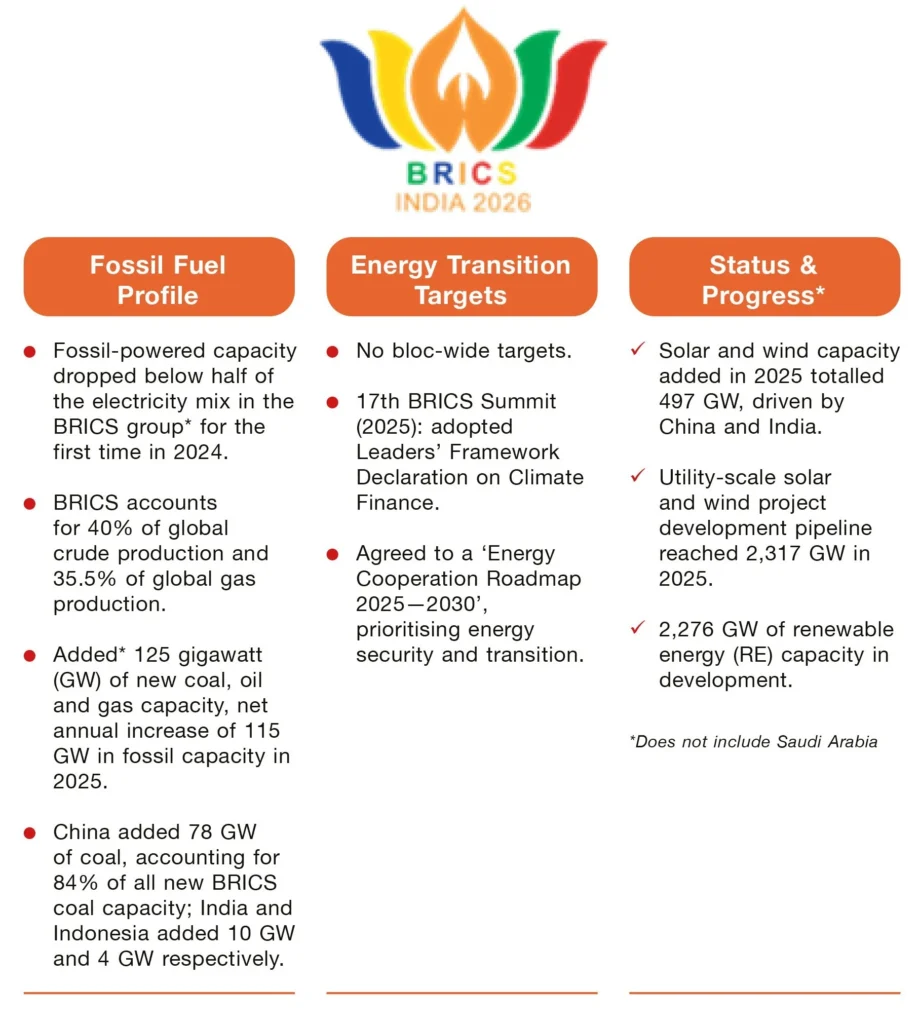
Source: Author’s own, using various sources
The scale of what this grouping now represents in energy terms is difficult to overstate. According to the GEM, BRICS+ nations now account for 38 percent of the global petroleum imports, with an expected increase up to 55 percent in case of further expansions. On the supply side, the group controls approximately 43 percent of the global crude oil output and 32 percent of the natural gas production.[10]
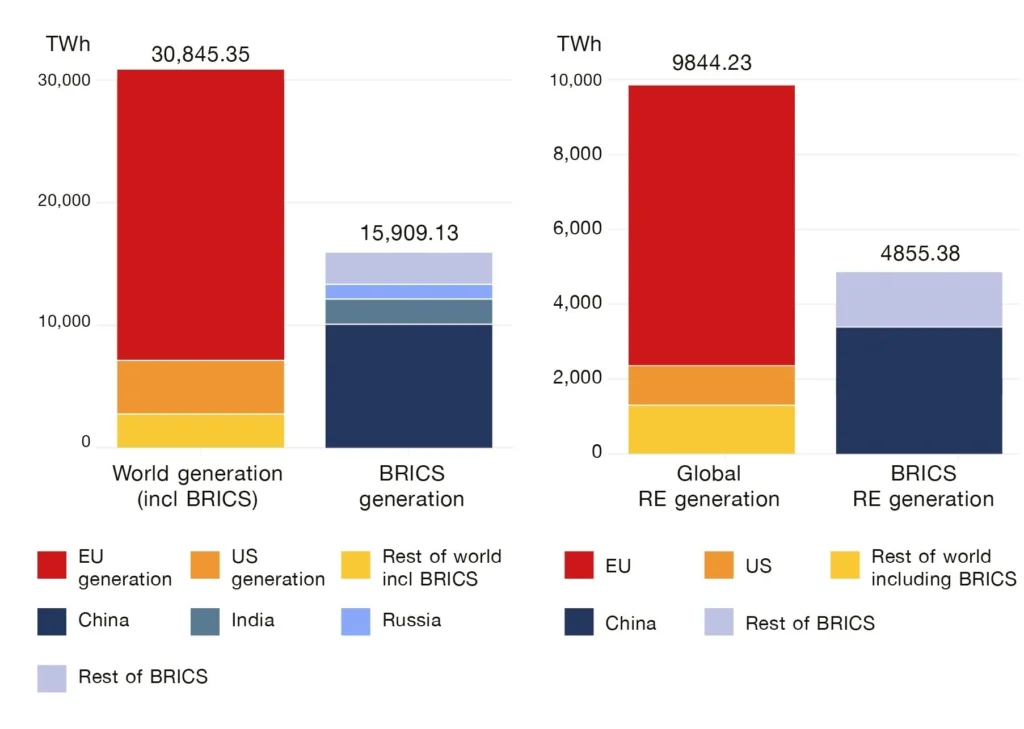
Power demand growth across BRICS (excluding Saudi Arabia) has averaged 5 percent per year over the last decade, roughly double the global average.[11] In 2024, BRICS members generated 15,909 terawatt-hours (TWh) of electricity, just over half of the world’s total, and more than double the combined output of the EU (2,744 TWh) and the United States (4,387 TWh).[12]
Figure 1: Global vs BRICS Total Electricity Generation and RE Generation, 2024 (TWh)
Source: Zero Carbon Analytics[13]
China alone generated more renewable electricity (3,388 TWh) than the US and the European Union (EU) combined, while total BRICS renewable electricity generation was more than double that of the US and EU put together. India (407 TWh) and Brazil (653 TWh), combined, produced renewable electricity equivalent to the entire US renewable output (1,057 TWh).[14] BRICS is therefore not a grouping peripheral to global energy governance, but is increasingly the terrain on which the energy transition can play out.
The analytical framing that dominates mainstream energy governance has struggled to operationalise a transition compact that is simultaneously credible on climate ambition, sensitive to energy security constraints, and legitimate in the eyes of the developing world. The International Energy Agency’s (IEA) membership still excludes most major emerging economies while Conference of the Parties (COP) commitments remain voluntary and unevenly financed. And the geopolitical fracturing, accelerated by the Russia–Ukraine conflict and the ongoing West Asia crisis, has deepened the divide between energy security imperatives and transition timelines in ways that neither institution was designed to bridge.
The limitations of both a pure climate frame and a pure geopolitics frame for understanding BRICS energy cooperation are evident. A climate-first framing, evaluating BRICS solely on decarbonisation ambition, cannot account for the energy security constraints that make managed phase-down a politically viable path for coal-dependent members. A geopolitics-first framing, reading BRICS energy cooperation primarily as a challenge to the existing energy order, overstates the grouping’s coherence and understates the genuine transition ambitions of several members. Securing concrete group-wide cooperation deals has proven difficult due to differences in economic and geopolitical priorities and alliances.[15]
Therefore, an energy transition compact framing holds both dimensions simultaneously. It upholds that energy security and energy transition are not competing priorities, but interdependent ones. Transition pursued without energy security guarantees will be politically reversed, and that energy security maintained through fossil lock-in forecloses the transition window.
The BRICS Foreign Ministers’ May 2026 reaffirmation of, “just, inclusive, orderly and equitable energy transitions, in line with national circumstances and development priorities,” and their underscoring of diversified energy sources and resilient supply chains, gestures toward this managed energy transition framing.[16]
Cluster Framework for BRICS Energy Analysis
Members of BRICS do not share a single energy profile, a common transition timeline, or aligned geopolitical interests. Any analytical framework that assumes otherwise will misread both the grouping’s limitations and its genuine cooperative potential. To navigate this diversity, this report organises BRICS members into four clusters defined by two intersecting variables: their current transition posture—where they sit on the fossil-to-clean energy spectrum and the pace and nature of their transition; and their energy security exposure—whether they are primarily concerned with supply control, import vulnerability, affordability, or access.
This clustering is not a rigid taxonomy but an analytical device to surface the most consequential structural differences across the bloc, and to ask what cooperation across those differences might actually look like.
The first, Fossil-Dependent Industrialisers, encompasses India, South Africa, and Indonesia, relatively large economies where coal and fossil fuels remain central to the energy mix, where renewable buildout is underway but constrained by financing gaps and industrial lock-in, and where transition is inseparable from affordability and employment. The second, Hydrocarbon Exporters in Transition, covers Russia, Saudi Arabia, the UAE, and Iran, members whose energy security interests are organised around supply influence and hydrocarbon revenues, and whose engagement with transition is shaped as much by long-term demand risk as by domestic decarbonisation ambition. The third, Transition Pivots, comprises China and Brazil, economies that carry large fossil footprints but also possess advanced clean energy industrial or resource capacity that gives them influence over what the transition looks like for others across the bloc and beyond. The fourth, Energy-Vulnerable Emerging Members, includes Ethiopia and Egypt, members with low historical emissions and high dependence on external financing and technology transfer to build out energy infrastructure.
India, it should be noted, occupies a bridging position: its domestic energy reality aligns it with the first cluster, while its international posture as a clean energy agenda-setter, a transition voice, and an emerging solar and green hydrogen industrial power, gives it characteristics of the third. This duality is analytically relevant, and it shapes how India can function as an interlocutor across clusters within the BRICS cooperation architecture.
Cluster 1. Fossil-Dependent Industrialisers: India, South Africa, Indonesia
The three economies in this cluster share a defining structural condition: coal and fossil fuels remain central to their energy systems; renewable buildout is underway but constrained by financing gaps and industrial lock-in; and the politics of transition are inseparable from the politics of affordability, employment, and sovereign development trajectories. Energy security for these members is framed primarily around access and affordability rather than supply control, a fundamentally different set of pressures than those facing hydrocarbon exporters.
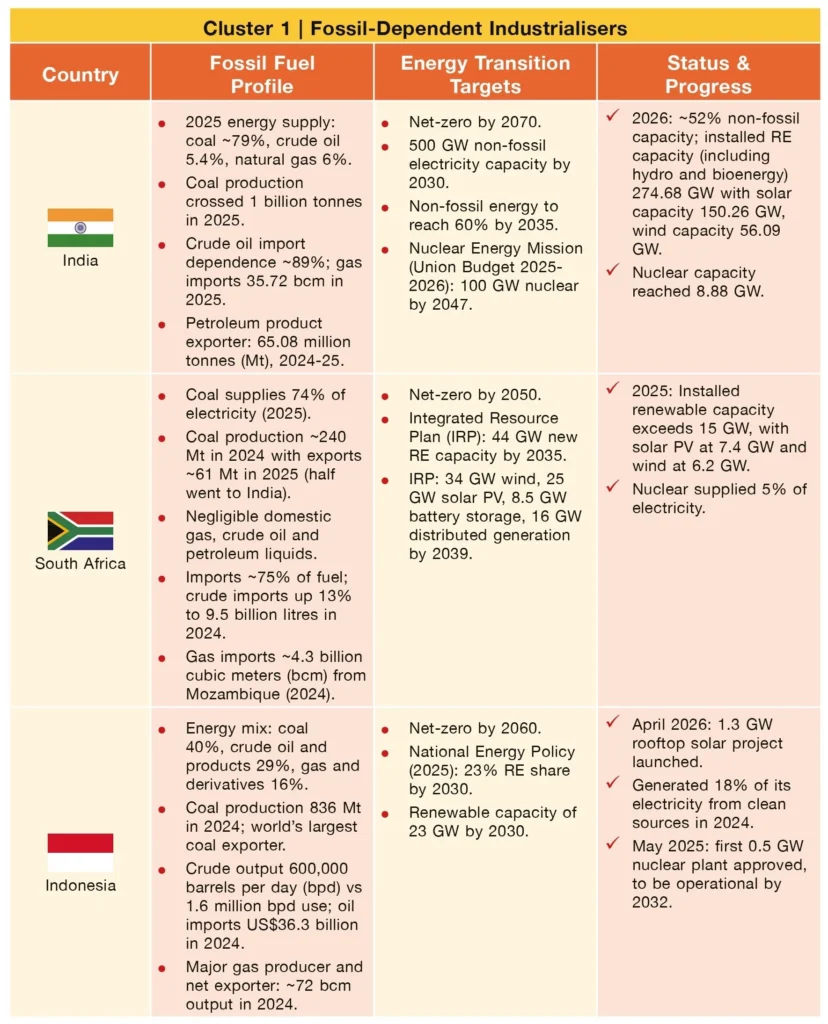
Table 2: Fossil-Dependent Industrialisers
Source: Author’s own, using various sources
India presents the most complex profile in Cluster 1. It is the world’s third-largest producer and consumer of electricity.[17] Coal still accounts for roughly 75 percent of electricity generation even as India has crossed the milestone of 50 percent of installed capacity from non-fossil sources, five years ahead of its target, in June 2025.[18] The distinction between installed capacity and actual generation is analytically important: in a fast-growing system where electricity demand is expected to grow at 6.4 percent annually through 2030, renewables are not displacing coal so much as tempering the rate at which coal demand must grow.[19]
India added a record 55.3 GW of non-fossil capacity in FY 2025–26, the highest annual increase ever recorded, bringing total renewable installed capacity to 274.68 GW and ranking India third globally, surpassing Brazil as per the International Renewable Energy Agency’s (IRENA’s) 2026 statistics.[20] Yet the government intends, simultaneously, to add 100 GW of new coal-based capacity over the next seven years.[21] This dual trajectory of accelerating clean energy deployment alongside continued coal expansion is not a policy contradiction, as much as a reflection of the scale of India’s development imperative. The financial dimension of transition also requires particular attention, as estimates suggest that India needs approximately US$200 billion annually in investments up to 2030; while in 2023 India had clean tech investments of only US$31.4 billion.[22]
Domestically, India’s energy reality aligns it with this cluster. Internationally, its posture is qualitatively different: India holds the third-largest renewable energy installed capacity, leads the International Solar Alliance (ISA), and has deliberately positioned itself as a voice for developing country transition constraints while projecting clean energy industrial ambitions. Its experience in distributed renewables, smart grids, and low-cost deployment gives it a technology-sharing role within BRICS.[23]
For South Africa, coal accounted for approximately 74 percent of electricity generation in January 2025, described as a record low, with renewables including hydro reaching just over 9 percent.[24] Eskom, the state utility responsible for the bulk of generation, plans to build 32 GW of renewables by 2040 and retire 21 GW of coal-fired generation capacity, while grappling with a debt load of approximately US$22 billion and regulated tariffs below cost-recovery thresholds.[25] Eskom celebrated 365 consecutive days without load-shedding in May 2026, an operational milestone after years of rolling blackouts, though structural performance limitations remain, with six coal stations reporting energy availability factors of 50 percent or lower.[26]
The Just Energy Transition Partnership (JETP), originally pledged at US$8.5 billion at COP26 in 2021, has seen around US$2.5 billion disbursed to date, with the US withdrawing its commitments in February 2025, cancelling US$56 million in grants and up to US$1 billion in commercial investment.[27] While European partners have reaffirmed support, with Germany raising its commitment to 2.68 billion euros, the structural gap between pledged and deployed finance remains the primary challenge.[28]
South Africa’s experience with the JETP, its governance architecture, its implementation bottlenecks, and the political consequences of US withdrawal, carry direct lessons for how BRICS might design more resilient, insulated financing mechanisms for transition in fossil-dependent economies.
Indonesia, with coal supplying approximately 68 percent of national electricity, has also added the third-highest volume of new coal capacity in the world in 2024, bringing its fleet to 54.7 GW and another 26.7 GW planned by 2030.[29] Although President Prabowo Subianto pledged to achieve 100 percent renewable electricity by 2035 and to phase-out coal within 15 years, these ambitions are not yet reflected in Indonesia’s current policy framework; instead, the Second Nationally Determined Contribution emphasises on efficiency improvements and clean-coal technologies.[30]
As the world’s largest thermal coal exporter, Indonesia’s transition calculus carries a dual dimension: domestic decarbonisation and the global supply-side consequences of a managed drawdown of its coal export base. Its JETP, signed at the 2022 G20 Bali Summit with a US$20-billion pledge later raised to US$21.4 billion, has approved only approximately US$3.1 billion, roughly 14.5 percent of the total, as of December 2025.[31] The cancellation of the Cirebon-1 early coal plant retirement in late 2025, one of the JETP’s most-watched pilot projects, was a signal of the institutional, legal, and financing barriers that stand between framework and execution.[32]
Indonesia’s industrial base, particularly its nickel processing sector, which feeds directly into global electric vehicle (EV) battery supply chains creates a specific form of fossil lock-in: captive coal plants powering industrial zones that fall outside standard grid decarbonisation frameworks and remain largely unaccounted for in JETP emissions targets.[33] Indonesia’s trajectory illustrates that decarbonising a fossil-dependent industrial economy requires not just financing for renewable power, but a coordinated rethinking of the industrial supply chains.
Cluster 2. Hydrocarbon Exporters in Transition: Russia, Saudi Arabia, UAE, Iran
For the members of this cluster, hydrocarbon exports constitute both their primary revenue base and largely their principal instrument of geopolitical influence. Energy security for these states is framed around supply control, price stability, and the preservation of export relevance in a world where long-term fossil demand faces structural erosion. Yet within this shared posture, the four members are strikingly different in their transition trajectories, their institutional engagement capacity, and their relationship to the rest of the BRICS grouping.
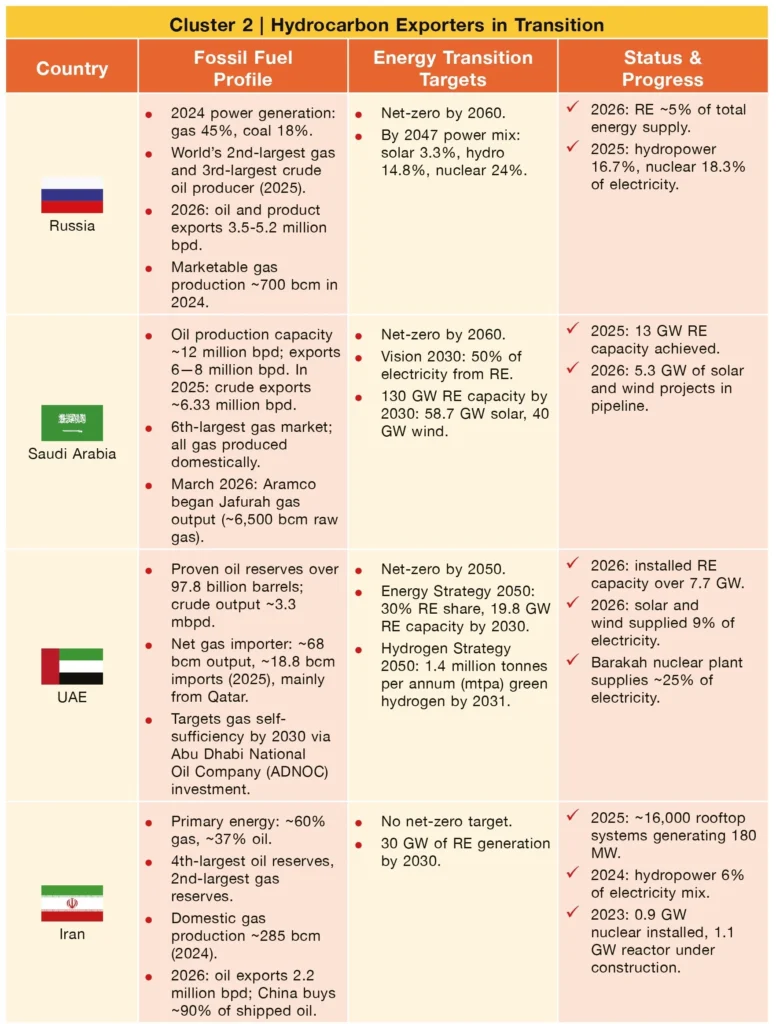
Table 3: Hydrocarbon Exporters in Transition
Source: Author’s own, using various sources
In the case of Russia, the post-2022 Western sanctions effectively redirected its fossil export relationships almost entirely toward Asia. By 2025, China and India together absorbed approximately 80 percent of Russia’s total oil exports, around 190 Mt annually.[34] Russia’s crude exports to India grew from roughly 50,000 bpd in 2020 to over 1.6 mbpd by 2024, while China averaged 2.0–2.2 mbpd across the same period.[35] This concentration has deepened further in 2026, as the Hormuz crisis has driven India to import approximately 2.14 mbpd of Russian crude in March 2026, nearly 47 percent of its total imports that month, as Gulf route disruptions squeezed alternatives.[36]
This reorientation has made Russia the most structurally embedded energy supplier within BRICS, its isolation from Western markets having inadvertently deepened intra-BRICS energy interdependence. Russia’s domestic transition agenda remains minimal—though it holds 9 percent of the world’s hydropower reserves, its domestic policies favour nuclear over hydro in terms of developing low-carbon sources.[37] With installed nuclear capacity of roughly 30 GW, state-owned Rosatom is the largest nuclear enterprise in the world with operations across countries including Egypt, India, Iran and China.[38]
Russia is a fossil exporter managing sanctions and market share, yet its role in BRICS energy cooperation is unavoidable: any meaningful discussion of supply security during managed phase-down must account for the Russian barrels.
Saudi Arabia and the UAE entered BRICS in 2024, while Saudi is not yet a formal member. Saudi Arabia has been the world’s largest annual crude oil exporter since the 1970s, with crude oil exports valued at US$179 billion in 2024, accounting for 59 percent of total merchandise exports.[39] Meanwhile, hydrocarbons remain central to the UAE’s economy, contributing approximately 30 percent of GDP and 13 percent of total exports.[40]
Both are perceived to have been motivated by a calculation that is simultaneously commercial and strategic: hedging against the long-term erosion of hydrocarbon demand, while preserving their centrality to global energy supply during the transition period. They have ambitious domestic clean energy programmes that are as much about economic diversification as decarbonisation commitment. Saudi Arabia committed approximately US$34 billion to clean power in 2025, entering the world’s top 10 renewable energy investors for the first time, a near 70 percent increase on 2024 and has tendered a cumulative 64 GW of renewable capacity under its National Renewable Energy Programme, with approximately 12.3 GW connected to the grid by end-2025.[41]
The UAE targets net zero by 2050, and its energy strategy aims for 32 percent clean energy by 2030, with the Mohammed bin Rashid Al Maktoum Solar Park, targeting 8,000 MW by 2030 and nuclear as its principal vehicles.[42] The UAE’s transition posture is anchored by the Barakah Nuclear Energy Plant, the Arab world’s first operational nuclear facility, which generates approximately 40 TWh of clean electricity annually, meeting around 25 percent of the UAE’s electricity demand and contributing the largest single decarbonisation effort in the country’s history.[43] In both countries, state-owned enterprises are expected to play a central role in advancing clean energy transitions.
Iran in several respects operates semi-outside the multilateral BRICS institutional architecture. Sanctions have not eliminated Iranian production, the country pumps approximately 3.3 mbpd of crude but has narrowed its market almost entirely to China, which absorbed an average of 1.38 mbpd of Iranian crude in 2025.[44] Iran joined BRICS in January 2024 to solidify trade ties within a non-Western bloc and counterbalance Western sanctions.[45] A partial easing of US sanctions on Iranian oil exports, tied to ongoing negotiations in June 2026, has created a conditional opening that could, if sustained, expand Iran’s market reach beyond China and strengthen its engagement with BRICS energy governance mechanisms.
Its domestic transition agenda is progressing slowly, transitioning from early off-grid systems to a rooftop PV programme supported by Feed-in Tariffs and government incentives. As of 2025, more than 16,000 rooftop systems were generating 180 MW, with a national target of 2,750 MW from 550,000 installations.[46] Its engagement with BRICS energy governance mechanisms is limited by the same sanctions architecture that shapes its export relationships.
The ongoing West Asia conflict, with Saudi Arabia and the UAE on opposing sides from Iran within the same BRICS membership, underlines the fundamental tension at the heart of this cluster—that BRICS contains energy suppliers whose geopolitical interests are not merely divergent but adversarial. This does not disqualify the cluster from analytical coherence, but it does set a realistic ceiling on the depth of institutionalised cooperation achievable among its members in the near term.
Cluster 3. Transition Pivots: China, Brazil
China and Brazil are pursuing decarbonisation strategies rooted in national industrial ambition and resource endowment. Both carry significant fossil footprints, but also possess clean energy capacities that give them influence over what the transition looks like for others. It is this combination of weight and agency that makes them pivots rather than simply players. Their nature however differs fundamentally. China’s pivot is anchored in manufacturing scale and technological dominance; it shapes the transition by controlling the supply chains through which it is built, while Brazil’s pivot rests on resource abundance and model maturity of its biofuel programme.
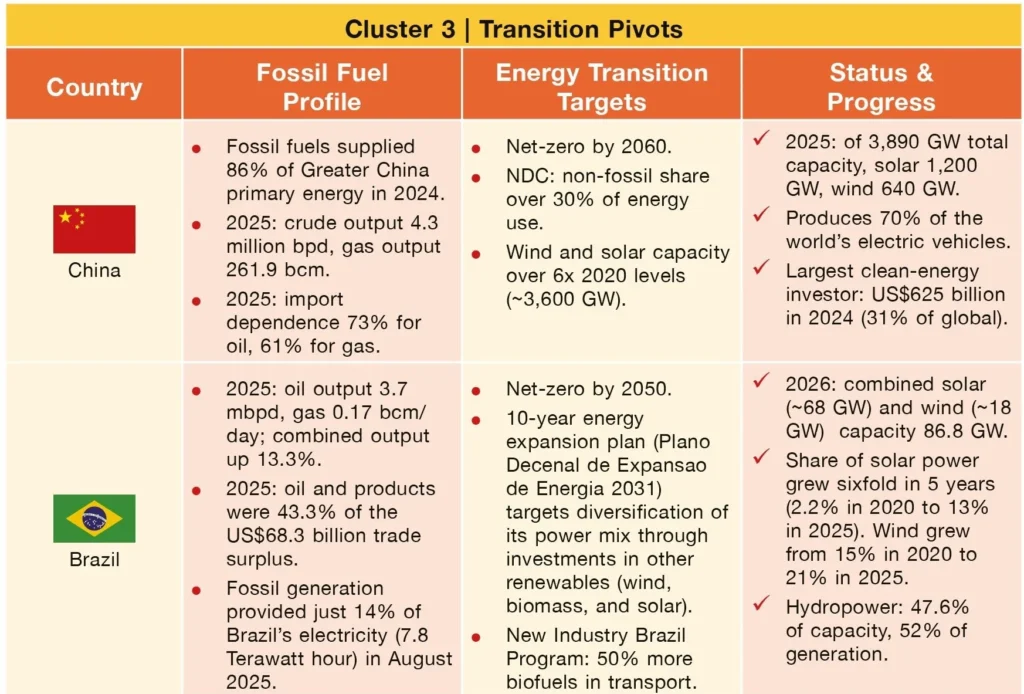
Table 4: Transition Pivots
Source: Author’s own, using various sources
China is simultaneously the world’s largest coal consumer and the world’s most prolific clean energy investor and manufacturer, a duality that is not a contradiction so much as a portrait of a large economy in mid-transition. By end-2025, China’s combined wind and solar installed capacity had surpassed coal-fired capacity for the first time, reaching 1.84 TW, roughly a third of the world’s total installed power capacity while total renewable energy capacity—including hydro, biomass, and storage—reached 2.34 TW, accounting for over 60 percent of national installed capacity.[47] In 2025 alone, China added over 430 GW of new wind and solar capacity and generated approximately 4 trillion kilowatt-hours from renewable sources, exceeding the combined power consumption of all EU member states.[48] Clean energy investment reached approximately 7.2 trillion yuan (US$1 trillion) in 2025, roughly four times the amount invested in fossil fuel extraction and coal power, with clean energy industries growing at 18 percent annually and accounting for more than a third of China’s GDP growth that year.[49]
China’s manufacturing dominance translates this investment scale into systemic global influence. It controls approximately 69 percent of the global EV battery market and 70.3 percent of global new-energy vehicle sales in 2025, with companies like Contemporary Amperex Technology Co. Ltd (CATL) and Build Your Dreams (BYD) setting the pace globally.[50] Between 2018 and 2024, China controlled 80 percent of new solar, wind, battery, and hydrogen facilities worldwide.[51] Some 76 percent of global clean-tech factory investment in 2024 went to China, far surpassing all other markets despite aggressive onshoring efforts elsewhere.[52] China’s clean energy exports are growing rapidly, with emerging markets now claiming 43 percent of Chinese clean-tech exports, up from 24 percent in 2022.[53]
China’s coal-fired grid continues to provide baseload stability for its vast renewable expansion, and despite the clean energy investment surge, new coal capacity continues to be commissioned alongside renewable additions.[54] China commissioned 78 GW of new coal-fired capacity in 2025, the largest annual increase in a decade, and more than India’s net coal additions over the entire preceding 10 years.[55] Coal’s share of total generation did fall to a historic low of 51 percent in June 2025, with clean energy meeting all net growth in electricity demand, but coal power output rose again in early 2026, fuelling concern that 2025’s emissions decline may prove temporary.[56]
Brazil occupies a different but equally distinctive position. Its transition identity rests not on manufacturing scale but on resource abundance and model maturity. Brazil’s energy matrix is already among the most renewable in the world, with renewables accounting for approximately 50 percent of its total energy mix anchored by a world-class hydropower base of 209 GW and the world’s most mature biofuel programme.[57] As the world’s largest exporter of sugarcane ethanol and a pioneer of flex-fuel vehicle technology, Brazil offers a proven, decades-old model of transport decarbonisation.
While solar PV in Brazil only provides around 38 GW of installed capacity, this is a drastic increase from the 0.05 GW of installed capacity in 2015.[58] While China continues to outperform the other BRICS countries, Brazil has almost the same level of renewables capacity because of the size of its hydroelectric sector. However, Brazil’s wind and solar capacity per capita is less than half of that in China.
At the same time, Brazil’s pre-salt oil fields remain a cornerstone of its economy and a central source of investment capital for its own transition. State-owned Petrobras’ 2025–2029 Strategic Plan allocates US$98.2 billion in total investment, with 77.8 percent directed at exploration and production, while increasing its energy transition budget by 42 percent to US$16.3 billion, explicitly framing pre-salt revenues as the financing vehicle for renewable infrastructure buildout.[59] This is the managed fossil-to-transition logic articulated in practice—using hydrocarbon revenues today to finance the clean energy infrastructure of tomorrow. Petrobras is actively expanding offshore wind surveys to underpin its green hydrogen ambitions, merging its world-class deep-water expertise with its decarbonisation pivot.[60]
It is also important to highlight that, as mentioned earlier, there is a case for India as a ‘transition pivot’. It rests on three things: its renewable scale ambition is globally significant; its positioning as a major emerging economy promoting transition is deliberately cultivated and institutionally expressed (G20 presidency, ISA leadership); and its solar and green hydrogen manufacturing push gives it nascent industrial transition capacity. However, India’s transition remains more aspiration than structural reality at the energy-mix level. India becomes the natural interlocutor between clusters, which has real institutional implications for how BRICS energy cooperation gets structured. This also mirrors how India actually behaves in multilateral energy forums, where it speaks as a developing country with fossil constraints, while simultaneously projecting transition ambition and agenda-setting influence.
Cluster 4. Energy-Vulnerable Emerging Members: Ethiopia, Egypt
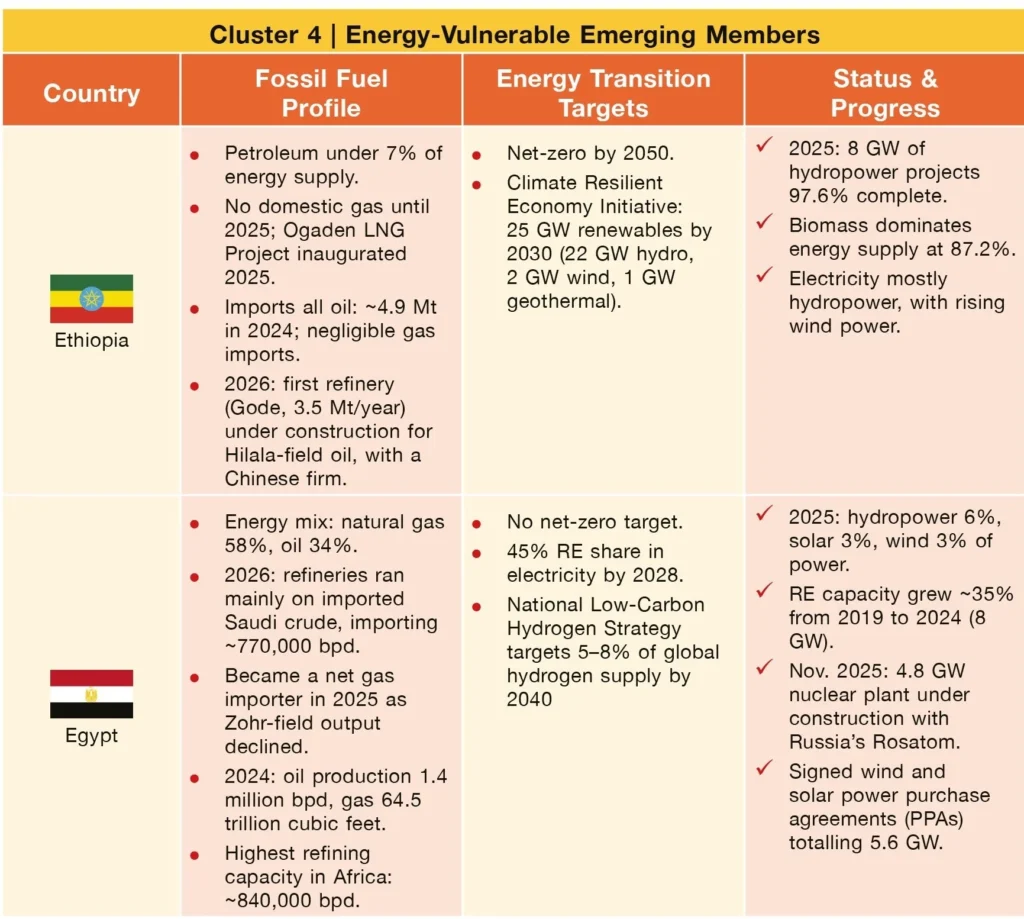
Both Ethiopia and Egypt have low historical emissions, limited domestic transition financing capacity, and dependence on external concessional finance and technology transfer to build out energy infrastructure. For Ethiopia, energy security means access and resilience; for Egypt, it is increasingly about fiscal survival in the face of a collapsing domestic gas base. These can be the most direct test of whether BRICS cooperation can move toward concessional, structurally meaningful support.
Table 5: Energy-Vulnerable Emerging Members
Source: Author’s own, using various sources
Ethiopia’s national grid runs on 100-percent renewable energy, overwhelmingly hydropower, making it one of the greenest energy mixes of any BRICS member by generation share.[61] Yet, approximately 71 million people, close to half the population of Ethiopia, remain without sufficient electricity access, primarily in rural and peri-urban areas.[62] The country’s grid is 90 percent hydropower-dependent, which creates a structural climate-vulnerability paradox: the very resource underpinning its clean energy identity is acutely exposed to drought risk, as evidenced by the experience of comparable African hydropower-dependent systems such as the Kariba Dam on the Zambezi.[63] Ethiopia’s National Drought Plan explicitly acknowledges this, calling for diversification into solar, wind, and geothermal to reduce single-source dependency. However, wind generation declined from 0.76 TWh in 2015 to 0.56 TWh in 2023.[64]
The Grand Ethiopian Renaissance Dam (GERD) was inaugurated in September 2025, after 12 years of construction, at a cost of US$5 billion.[65] With 13 turbines generating up to 2,350 MW, and a planned capacity of 5,150 MW at full operation, GERD represents Africa’s largest hydropower project and a landmark infrastructure achievement for a low-income economy.[66] Ethiopia is already selling surplus power to Kenya, Djibouti, and Sudan, positioning GERD as a regional energy integration asset rather than solely a domestic supply solution.[67] Yet GERD has also been a persistent source of regional dispute: Egypt has accused Ethiopia of violating international law by filling the GERD reservoir without downstream riparian consent.[68] Structural constraints on Ethiopia’s energy system also remain severe: foreign currency shortages have left a quarter of installed generation capacity idle due to lack of spare parts; low electricity tariffs create financial strain; and security concerns in several regions slow infrastructure rollout and cross-border cooperation.[69]
Ethiopia’s energy argument is squarely about access, resilience financing, and concessional technology transfer to diversify beyond hydropower. Its heavy reliance on international public sources exposes its climate agenda to the constraint of external concessional finance.
In 2022–2023, 93 percent of tracked flows originated from international public sources that committed approximately US$2.2 billion annually, primarily through grants (80 percent) and concessional debt (14 percent).[70] Within a BRICS cooperation framework, Ethiopia represents a case for New Development Bank (NDB) concessional lending and technology deployment, particularly in solar and geothermal where its untapped potential is substantial.
Egypt was, until recently, a net liquefied natural gas (LNG) exporter and a significant gas producer whose Zohr field made it briefly one of the Eastern Mediterranean’s most prominent hydrocarbon stories. However, Egypt’s domestic gas production has been declining since 2022, with output at 2.67 million metric tonnes (Mt) in May 2025 compared to 3.8 Mt two years earlier, driven primarily by water infiltration at the Zohr field.[71] Depleting natural gas reserves translated into hiked electricity prices and frequent power cuts in 2024, with some regions in Upper Egypt experiencing load shedding for over 10 hours daily.[72] Imports of LNG surged 188 percent year-on-year in the first 11 months of 2025 to reach 7.8 Mt, placing acute pressure on already strained public finances.[73]
The fiscal dimension compounds the energy dimension: Egypt entered 2025 managing a severe balance of payments crisis, with foreign debt rising close to US$160 billion, high inflation, and energy subsidies that remain politically difficult to reform despite International Monetary Fund (IMF) conditionality.[74] Egypt has accelerated its renewable buildout in response. In early 2026, it commissioned the Amunet and Ras Ghareb wind farms and brought the Obelisk solar facility online, though these additions have not yet offset rising gas consumption.[75] Additionally, Egypt has agreed on a financing package of up to 690 million euros by the EU, to enable the integration of 22 GW of renewable energy capacity by 2030 as well as a US$37-million loan by the OPEC fund for the development of the Abydos II project, featuring a 1,000 MW solar PV plant and 600 MWh battery energy storage system (BESS).[76]
However, Egypt’s energy geography gives it a distinctive strategic value within BRICS that its domestic energy crisis does not diminish. In 2023, approximately 12 percent of global seaborne crude oil trade and 8 percent of global LNG trade passed through the Suez Canal.[77] As a corridor state sitting at the intersection of Gulf hydrocarbon supply chains, European import demand, and African energy infrastructure development, Egypt is critical to any BRICS energy trade architecture. Its green hydrogen ambitions, concentrated in the Suez Canal Economic Zone, are explicitly oriented toward European export markets with approximately 30 memorandums of understanding and 12 binding framework agreements signed with international investors, and a national strategy targeting 5–8 percent of global hydrogen supply by 2040.[78] These ambitions remain externally financed and early-stage, but they position Egypt as a potential energy transition infrastructure node.
While the cluster analysis highlights the diversity of energy systems within BRICS, the grouping’s effectiveness ultimately depends on the institutions through which these differing interests are coordinated.
Institutions and Mechanisms: Enabling BRICS Energy Cooperation
Against this backdrop of growing diversity, the institutional architecture for BRICS energy cooperation has expanded incrementally but remains structurally thin relative to the scale of the grouping’s energy ambitions. The May 2025 BRICS Energy Ministers’ Meeting in Brasília, the first under the expanded 11-member format, produced a jointly adopted Ministerial Communiqué reaffirming commitments to energy security; Sustainable Development Goal (SDG) 7— affordable and clean energy for all; just transitions, acknowledging the continued role of fossil fuels in developing countries; and committing to doubling energy efficiency by 2030. Ministers also advocated for fair, transparent, and consistent guidelines for assessing carbon intensity, energy classification, and mutual recognition of taxonomies and certifications.
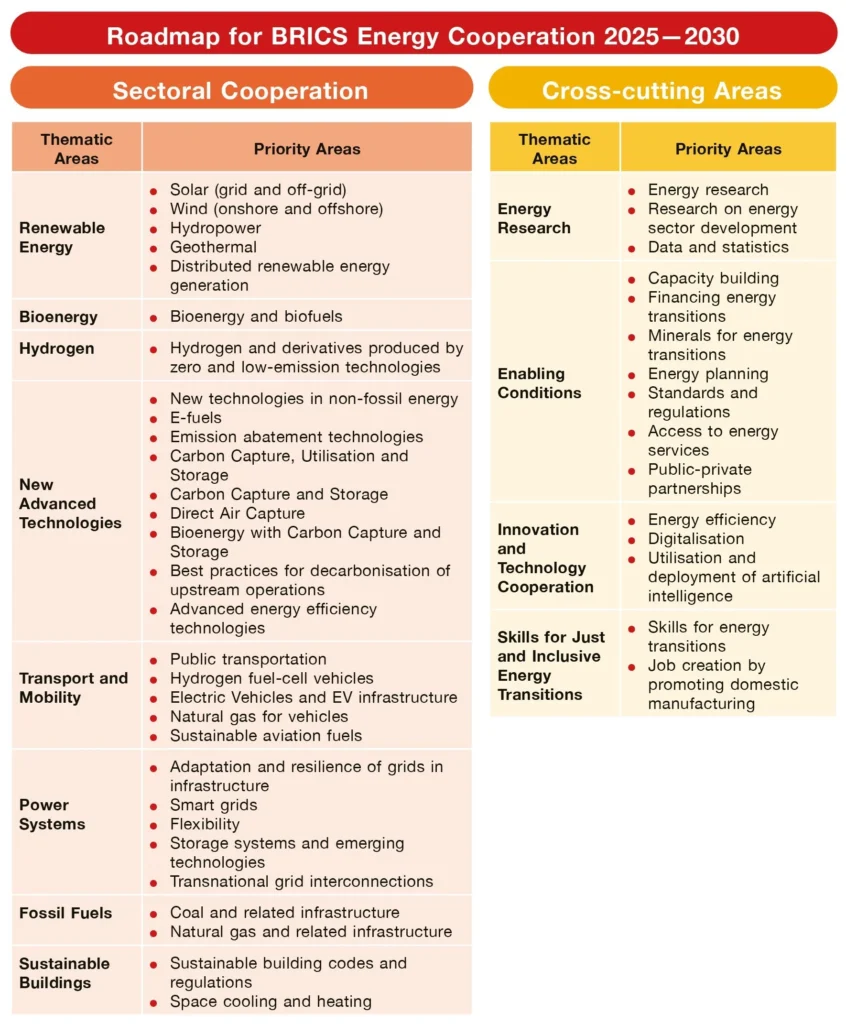
Members of BRICS+ adopted a revised Energy Cooperation Roadmap 2025-2030 at the energy ministers’ meeting in May 2025. The Roadmap outlines a structured plan to enhance energy coordination across member countries through joint research, investment and technology collaboration. The cooperation framework is structured into two branches: Sectoral Cooperation, and Cross-cutting Areas. Under the sectoral cooperation framework, six thematic areas centre around the renewable energy space, while the remaining two focus on fossil fuels and transport and mobility. The cross-cutting areas section identifies key technologies, skills, research and other enabling conditions that can support the deployment of those sectoral cooperation areas.
Table 6: Framework for BRICS Energy Cooperation
Source: Author’s own, using ‘Roadmap for BRICS Energy Cooperation 2025–2030’.[79]
By 2027, the roadmap sets two clear operational targets. First, member countries aim to coordinate the development of energy storage and other emerging technologies to facilitate large-scale renewable integration and reduce grid intermittency. Second, smart grid development is positioned as a strategic priority. A Committee of Senior Energy Officials coordinates the 2025–2030 Roadmap implementation, a BRICS Energy Working Group convenes under each presidency, and the BRICS Energy Research Cooperation Platform (ERCP) provides a mandate for joint research, standards development, and technology exchange.[80] The BRICS Think Tanks Council, Business Council, and Science and Technology Initiative are identified as partners in Roadmap implementation, but these remain coordination mechanisms rather than delivery vehicles.[81]
India’s 2026 presidency has designated the Ministry of Power as the nodal ministry for the energy track in coordination with the Ministry of New and Renewable Energy (MNRE), Ministry of Petroleum and Natural Gas (MoPNG), Ministry of Mines, and Ministry of Coal.[82] The most substantive institutional output from the 11th BRICS Energy Ministers’ Meeting was the formal launch of the BRICS Digital Centre of Excellence for Smart Grids and Energy Storage under the ERCP, a voluntary collaborative platform for knowledge sharing, capacity building, exchange of policy and regulatory best practices, and development of pilot initiatives among member countries. The BRICS ERCP continues to advance SDG 7 implementation while recognising national circumstances and advocating for technically neutral approaches.[83]
Alongside this, BRICS Guiding Principles on Smart Grids and Energy Storage were adopted, recognising the growing importance of modern, resilient, and digitally enabled power systems in supporting reliable and affordable energy access while facilitating renewable integration. Ministers also advanced work on the BRICS Joint Report on Hydrogen Value Chains 2026, which is intended to provide a common foundation for cooperation on hydrogen technologies, standards, industrial applications, and future value chains.[84] Taken together, these outputs mark a modest but real shift toward institutionalised technical collaboration in domains directly relevant to the managed transition argument that this report advances.
At present, there is no binding energy security mechanism, no dedicated transition financing facility, and no collective emergency response framework comparable to the IEA’s strategic reserve architecture. On carbon border measures, BRICS has collectively condemned the EU’s Carbon Border Adjustment Mechanism, which entered into full effect in 2026, as “unilateral, punitive and discriminatory,” yet without a coordinated strategic response this condemnation remains declaratory.[85]
The NDB, the grouping’s most significant financing institution, has approved US$40 billion in total financing across 120 projects since its inception.[86] Energy lending ranks third by sector at US$2.9 billion across the portfolio, behind transport at US$13.1 billion and multisectoral projects at US$3.8 billion, a distribution that reflects the bank’s infrastructure-first origins rather than a deliberate transition strategy.[87] Under its 2022–2026 General Strategy, the bank committed to allocating 40 percent of total financing to climate projects, yet of the 45 projects approved between 2022 and 2025, only seven addressed clean energy and energy efficiency, and a mere 3 covered environmental protection.[88] In South Africa, the bank is supporting Eskom’s transmission infrastructure modernisation programme as part of its broader Just Energy Transition agenda. In Brazil, NDB is co-financing the expansion of São Paulo’s electric bus fleet. In India, NDB has extended financial assistance to Sustainable Alternative Energy Limited’s 300 MW solar PV project in Andhra Pradesh, which includes a 220 kV grid connection under long-term power offtake with the Solar Energy Corporation of India.[89] The Bank’s energy-specific lending remains concentrated in the original five BRICS members, with newer members including Ethiopia and Egypt yet to receive significant energy financing.
The Roadmap invites NDB to support joint energy projects using local currencies, and to join technical discussions under approved workstreams—a normative opening that has not yet been fully operationalised.[90] The 2025 Rio Summit separately proposed a BRICS Multilateral Guarantees Initiative (MGI), modelled on the World Bank’s Multilateral Investment Guarantee Agency (MIGA), aimed at reducing political risk for infrastructure investment across the Global South. If operationalised, the BRICS MGI could provide a complementary instrument to NDB lending for energy transition projects in higher-risk member states.[91]
At the bilateral level, the intra-BRICS energy relationships that already function, such as the Russia–India crude flows, China–South Africa grid infrastructure financing, and China–Brazil clean energy investment, represent the practical substrate of a potential multilateral architecture. The question is whether these can be brought under a common BRICS framework that adds coordination value rather than simply rebranding existing bilateral deals.
The recommendations that follow are not without precedent, proposals for strengthening BRICS energy cooperation architecture have circulated across institutions and platforms, each advancing variants of what is outlined below:
- Establish a differentiated BRICS Transition Finance Facility within or alongside NDB, to operationalise the Roadmap’s invitation for NDB to support joint energy projects, and to directly address the political conditionality gaps exposed by the JETP experience in South Africa and Indonesia.
- Formalise a Technology Transfer Protocol under the BRICS ERCP, moving toward commitments on intellectual property access, joint manufacturing arrangements, and deployment subsidies for clean energy technologies—particularly solar, storage, and grid infrastructure. Utilising the newly launched BRICS Digital Centre of Excellence for Smart Grids and Energy Storage, could mark the first step in this direction.
- Insulate cross-border energy projects from political disruption through project-level legal structures, such as special purpose vehicles, arbitration clauses under neutral BRICS-affiliated jurisdiction, and local currency financing arrangements, that reduce the exposure of long-term infrastructure to member-state diplomatic volatility.
- Develop a BRICS Carbon Intensity and Energy Certification Framework to collectively establish shared trade standards. Without internal alignment on carbon measurement and certification, BRICS members will face asymmetric exposure to European trade barriers individually rather than negotiating from a unified position.
- Develop a coordinated BRICS critical minerals strategy. BRICS members collectively hold 75 percent of the world’s rare earths, 50 percent of graphite, and 28 percent of nickel, and dominate global cobalt, copper, lithium, and nickel refining, yet operate without a shared minerals cooperation framework.[92] At the 2024 Kazan Summit, BRICS states announced their intention to expand minerals sector cooperation. Translating that into a coordinated strategy on extraction, processing, and pricing would reduce individual member dependence on external supply chains and strengthen the bloc’s collective position in clean energy value chains.[93]
- Establish a BRICS Energy Data and Market Observatory under the BRICS ERCP to harmonise data on energy demand, production, trade, investment, critical minerals, and emissions. A shared evidence base would strengthen policy coordination, improve investment planning, and reduce informational asymmetries across members.
- Leverage India’s 2026 presidency to establish a BRICS Energy Security Protocol, modelled loosely on the ASEAN Petroleum Security Agreement, that creates a minimum collective response framework for supply shocks: strategic reserve coordination, emergency supply-sharing arrangements, and price volatility buffers, without requiring the full institutional architecture of the IEA.[94]
These recommendations seek to move BRICS energy cooperation beyond declaratory commitments toward more operational forms of collaboration. Yet institutional design alone cannot overcome the political and economic constraints that continue to shape the grouping. The feasibility of any reform ultimately depends on the members’ willingness to prioritise collective energy interests alongside competing geopolitical and national objectives.
None of these recommendations is without friction. China–India competitive dynamics in clean energy manufacturing—including solar panels, EVs, grid technology—create tensions around technology transfer and India’s own manufacturing ambitions make it a competitor as much as a partner in certain domains. While NDB’s credibility as a politically independent institution remains contested, its energy lending footprint is still heavily weighted toward original members, and its ability to absorb new member states at scale is untested. Iran’s and Russia’s presence creates specific complications: Iran operates semi-outside multilateral financial architecture, and Russia’s sanctions status limits its participation in any mechanism that requires engagement with Western correspondent banking.
The risk of BRICS energy cooperation remaining declaratory is real and should not be understated. Securing concrete group-wide cooperation deals has proven consistently difficult, due to differences in economic and geopolitical priorities.[95] The bloc’s internal divisions, most starkly illustrated by its failure to issue a joint statement on the 2026 Iran war, are a reminder that geopolitical fracture lines run through BRICS as well as around it.
Yet these constraints do not diminish the value of deeper energy cooperation; rather, they underscore why expectations should be calibrated. While BRICS is unlikely to emerge as a highly integrated energy institution, its comparative advantage lies in creating flexible mechanisms through which diverse energy economies can coordinate where interests converge, while accommodating differences where they persist.
Conclusion
In a world of deepening geopolitical fragmentation, where multilateral consensus is harder to achieve, where sanctions architecture divides markets, and where the West Asia conflict has placed BRICS members on opposing sides of an active military confrontation, energy may be the one domain where cooperation remains structurally necessary for all parties. The diversity of energy profiles, transition timelines, and resource endowments that makes BRICS difficult to govern as a unified political actor is also what gives it analytical depth and cooperative potential as an energy compact.
Energy cooperation requires shared stakes more than political unanimity, and those exist across every cluster this report has identified. Fossil-dependent industrialisers need transition finance that is less politically contingent. Hydrocarbon exporters need managed phase-down frameworks that preserve their relevance. Transition pivots need institutional channels through which their technological and resource capacity reaches others on cooperative terms. Emerging economies need concessional architecture that the existing multilateral system has failed to provide at pace and scale.
India’s 2026 presidency, with its three energy pillars and the September summit as a political anchor, is the most immediate window from where to begin. If BRICS can demonstrate that a diverse coalition of developing and emerging economies is capable of advancing practical cooperation on energy security, transition finance, technology, and critical minerals, it could offer an important model for balancing economic development with decarbonisation beyond the traditional multilateral framework.
Parul Bakshi is Fellow, Energy and Climate, Observer Research Foundation Middle East.
All views expressed in this publication are solely those of the author, and do not represent the Observer Research Foundation, either in its entirety or its officials and personnel.
Acknowledgement
The author used Claude Sonnet 4.6 as an editorial support tool during the preparation of this report. The originality, intellectual contribution, analysis, and conclusions of the paper remain the author’s own.
Endnotes
[1] Rosemary Griffin, “BRICS Countries Agree to Broaden Energy Cooperation,” S&P Global Commodity Insights, May 19, 2025, https://www.spglobal.com/energy/en/news-research/latest-news/crude-oil/051925-brics-countries-agree-to-broaden-energy-cooperation.
[2] Amit Bhandari, “A BRICS Energy Stability Framework,” Geopolitical Futures Policy Series, May 2026, https://www.gatewayhouse.in/wp-content/uploads/2026/06/A-BRICS-Energy-Stability-Framework-by-Amit-Bhandari.pdf.
[3] “Saudi Arabia Still Not Formally a BRICS Member, According to Report,” BRICS Connect, May 11, 2025, https://bricsconnect.co/2025/05/11/saudi-arabia-still-not-formally-a-brics-member-according-to-report/.
[4] Griffin, “BRICS Countries Agree to Broaden Energy Cooperation.”
[5] James Norman, Split Transition: BRICS Breaks Renewable Records — And Fossil Records Too, Global Energy Monitor, 2026, https://globalenergymonitor.org/research/split-transition-brics-breaks-renewable-records-and-fossil-records-too.
[6] Norman, “Split Transition: BRICS Breaks Renewable Records — And Fossil Records Too.”
[7] Ministry of Power, Government of India, https://www.pib.gov.in/PressReleasePage.aspx?PRID=2276137®=48&lang=2, 2026.
[8] Ministry of Power, Government of India, https://www.pib.gov.in/PressReleasePage.aspx?PRID=2277751®=3&lang=1, 2026.
[9] “Energy transition in BRICS countries: climate ambitions and hydrocarbon reality,” TV BRICS, February 25, 2026, https://tvbrics.com/en/news/energy-transition-in-brics-countries-climate-ambitions-and-hydrocarbon-reality/.
[10] “Collaborative Framework: BRICS Members Set to Redefine Multilateral Regional Energy Cooperation,” Power Line Magazine, August 11, 2025, https://powerline.net.in/2025/08/11/collaborative-framework-brics-members-set-to-redefine-multilateral-regional-energy-cooperation/ .
[11] James Norman et al., “Energy in the BRICS,” Global Energy Monitor, 2024, https://globalenergymonitor.org/research/energy-brics.
[12] “Renewables Bulletin: BRICS Edition,” Zero Carbon Analytics, 2025, https://zerocarbon-analytics.org/energy/renewables-bulletin-brics-edition/.
[13] “Renewables Bulletin: BRICS edition.”
[14] “Renewables Bulletin: BRICS edition.”
[15] Griffin, “BRICS Countries Agree to Broaden Energy Cooperation.”
[16] Ministry of External Affairs, Government of India, https://www.mea.gov.in/bilateral-documents?dtl/41144/Chairs_Statement_and_Outcome_Document_at_BRICS_Foreign_Ministers_Meeting_May_15_2026, 2026.
[17] Ministry of Power, Government of India, https://www.pib.gov.in/PressReleasePage.aspx?PRID=2277751®=3&lang=1, 2026.
[18] Deepak Khanna and Pritish Raj, “Coal and Renewables: Powering India’s Growth,” S&P Global Energy, April 2026, https://www.spglobal.com/energy/en/news-research/blog/coal/042426-coal-renewables-india-power-generation-economic-growth.
[19] Khanna and Raj, “Coal and Renewables: Powering India’s Growth.”
[20] Ministry of New and Renewable Energy, Government of India, https://www.pib.gov.in/PressReleasePage.aspx?PRID=2250039&lang=1®=3, 2026.
[21] Manojkumar N, Medha Mary Mathew and Lauri Myllyvirta, “India Power Sector Review 2025: Record Clean Energy Deployment Drives Historic Decline in Coal Generation,” Centre for Research on Energy and Clean Air, January 2026, https://energyandcleanair.org/publication/india-power-sector-review-2025/.
[22] Sangeeth Selvaraju, Nick Robins and Suranjali Tandon, Sustainable Finance for a Just Transition in India: The Role Of Investors, Just Transition Finance Lab, July 2024, https://justtransitionfinance.org/wp-content/uploads/2024/07/Sustainable-finance-for-a-just-transition-in-India-Role-of-investors.pdf.
[23] Prachi Priya, “Climate Finance Gap Gives BRICS A Larger Role in 2026,” Policy Circle, May 31, 2026, https://www.policycircle.org/opinion/climate-finance-brics-agenda/.
[24] “South Africa: Minister Welcomes Decline in Coal Share, Growth in Renewables,” All Africa, April 2025, https://allafrica.com/stories/202504020347.html.
[25] Oluwatosin Racheal Alabi, “Eskom Charts Bold Course Away from Coal, Targets 32 GW Renewables by 2040,” Energy News Africa Plus, 2025, https://energynews.africa/2025/07/18/eskom-charts-bold-course-away-from-coal-targets-32-gw-renewables-by-2040/.
[26] Ernest Mabuza, “Beyond Coal: Eskom Begins Rolling Out 6GW Renewable Pipeline,” Times Live, May 27, 2026, https://www.timeslive.co.za/news/south-africa/2026-05-27-beyond-coal-eskom-begins-rolling-out-6gw-renewable-pipeline/.
[27] British Consulate-General Cape Town & British High Commission Pretoria, “12-month Just Energy Transition Partnership leaders’ update 2025,” https://www.gov.uk/government/news/12-month-just-energy-transition-partnership-leaders-update-2025.
[28] “Germany Raises Just Energy Transition Partnership Funding for South Africa to €2.68 Billion,” Ecofin Agency, 2026, https://www.ecofinagency.com/news-industry/2601-52265-germany-raises-just-energy-transition-partnership-funding-for-south-africa-to-2-68-billion.
[29] Alan Munandar, “Indonesia Talks Energy Transition, But Why Does Coal Still Rule?” Modern Diplomacy, April 2026, https://moderndiplomacy.eu/2026/04/21/indonesia-talks-energy-transition-but-why-does-coal-still-rule/.
[30] Hans Nicholas Jong, “Indonesia Pledges Energy Transition — But The Country’s New NDC Says Otherwise,” Mongabay, November 2025, https://news.mongabay.com/2025/11/indonesia-pledges-energy-transition-but-the-countrys-new-ndc-says-otherwise/.
[31] Mutya Yustika and Ramnath N. Iyer, “Building Credibility in Indonesia’s Energy Transition: Insights from The ETM And JETP Indonesia,” Institute for Energy Economics and Financial Analysis, February 2026, https://ieefa.org/resources/building-credibility-indonesias-energy-transition-insights-etm-and-jetp-indonesia.
[32] Munandar, “Indonesia Talks Energy Transition, But Why Does Coal Still Rule?”
[33] Munandar, “Indonesia Talks Energy Transition, But Why Does Coal Still Rule?”
[34] Charles Kennedy, “Russia Shipped 80% of its 2025 Oil Exports to China and India,” OilPrice.com, February 27, 2026, https://oilprice.com/Latest-Energy-News/World-News/Russia-Shipped-80-of-its-2025-Oil-Exports-to-China-and-India.html.
[35] U.S. Energy Information Administration, “Russia’s Oil Exports Have Decreased Modestly Since 2022, Shifting Toward Asia,” August 7, 2025, https://www.eia.gov/todayinenergy/detail.php?id=65885.
[36] Priyanka Salve, “How the Iran War Has Stoked Competition Between India and China for Russian Oil,” CNBC, April 23, 2026, https://www.cnbc.com/2026/04/23/india-china-russian-oil-supply-strait-hormuz-disruption.html.
[37] Climate Action Tracker, “Russian Federation Targets,” 2025, https://climateactiontracker.org/countries/russian-federation/targets/.
[38] Rosatom State Atomiс Energy Corporation, “ROSATOM Power Generation,” https://rosatom.ru/en/rosatom-group/power-generation/.
[39] “From Oil to Chemicals, Electronics and Shipbuilding: Saudi Arabia’s Evolving Export Profile,” Andaman Partners, 2025, https://andamanpartners.com/2025/10/from-oil-to-chemicals-electronics-and-shipbuilding-saudi-arabias-evolving-export-profile/.
[40] International Trade Administration, “United Arab Emirates – Oil and Gas,” 2025, https://www.trade.gov/country-commercial-guides/united-arab-emirates-oil-and-gas.
[41] Giulia Interesse, “Saudi Arabia’s Renewable Energy Investment Opportunities,” Middle East Briefing, March 2026, https://www.middleeastbriefing.com/news/saudi-arabias-renewable-energy-investment-opportunties/.
[42] Parul Bakshi, “Mapping Energy Landscapes in the Gulf: Systems, Policies, and Transition Pathways,” Observer Research Foundation, February 2026, https://www.orfonline.org/research/mapping-energy-landscapes-in-the-gulf-systems-policies-and-transition-pathways.
[43] Batool Ghaith, “Barakah Nuclear Energy Plant Drives UAE’s Clean Energy Progress,” Aletihad Newspaper, October 2025, https://en.aletihad.ae/news/uae/4617919/barakah-nuclear-energy-plant-drives-uae-s-clean-energy-progr.
[44] “Iran’s Main Oil And Gas Production and Infrastructure,” Reuters, January 23, 2026, https://www.reuters.com/world/middle-east/an-overview-irans-energy-industry-infrastructure-2026-02-28/; Dalga Khatinoglu, “Iran’s Energy Trade Defies Year of US Maximum Pressure Sanctions,” January 2026, https://www.iranintl.com/en/202601226536.
[45] “US-Iran Conflict: The Impact On Russia,” Russia’s Pivot to Asia, March 2026, https://russiaspivottoasia.com/us-iran-conflict-the-impact-on-russia/.
[46] Brics Brasil 2025, Report on Access to Energy Services.
[47] The State Council, People’s Republic of China, “China’s Newly Installed Wind, Solar Power Capacity Up 22 Pct In 2025,” February 2026, https://english.www.gov.cn/archive/statistics/202602/12/content_WS698d93cbc6d00ca5f9a091bb.html; The State Council, People’s Republic of China, “Renewables account for over 60 pct of China’s power capacity in 2025,” January 2026, https://english.www.gov.cn/archive/statistics/202601/30/content_WS697cb463c6d00ca5f9a08da7.html.
[48] “Renewables Account for Over 60 Pct of China’s Power Capacity in 2025.”
[49] Lauri Myllyvirta and Belinda Schaepe, “Analysis: Clean Energy Drove More Than A Third Of China’s GDP Growth In 2025,” Carbon Brief, May 2026, https://www.carbonbrief.org/analysis-clean-energy-drove-more-than-a-third-of-chinas-gdp-growth-in-2025/.
[50] Jeff Pao, “Chinese EVs, Batteries Gain World Market Share as Trump Backs Oil,” Asia Times, January 2026, https://asiatimes.com/2026/01/chinese-evs-batteries-gain-world-market-share-as-trump-backs-oil/.
[51] Jennifer L, “How China’s $180B Clean-Tech Investments Transform the Global South,” Carbon Credits, December 11, 2025, https://carboncredits.com/how-chinas-180b-clean-tech-investments-transform-the-global-south/.
[52] “China Dominates Clean Technology Manufacturing Investment as Tariffs Begin to Reshape Trade,” BloombergNEF, April 28, 2025, https://about.bnef.com/insights/clean-energy/china-dominates-clean-technology-manufacturing-investment-as-tariffs-begin-to-reshape-trade-flows-bloombergnef/.
[53] “China Dominates Clean Technology Manufacturing Investment as Tariffs Begin to Reshape Trade.”
[54] Andrew Liu, “Despite Record Renewable Growth, China Is Still Betting on Coal,” Inside Climate News, June 12, 2026, https://insideclimatenews.org/news/12062026/china-coal-power-generation-grows/.
[55] “Coal is Losing Ground but Not Letting Go: Structural Inertia and the Struggle to Shift Coal’s Role in China’s Power System,” Centre for Research on Energy and Clean Air, 2025, https://energyandcleanair.org/publication/chinas-coal-is-losing-ground-but-not-letting-go/.
[56] Andrew Liu, “Despite Record Renewable Growth, China Is Still Betting on Coal;” “Coal is losing ground but not letting go: Structural inertia and the struggle to shift coal’s role in China’s power system.”
[57] Anoushka Singh, “Fractured Climate Multilateralism and the BRICS Pathways to Energy Transition,” Indian Council of World Affairs, January 2026, https://www.icwa.in/show_content.php?lang=1&level=1&ls_id=14133&lid=8574.
[58] “Renewables Bulletin: BRICS edition.”
[59] International Trade Administration, “Brazil – Oil and Gas,” 2025, https://www.trade.gov/country-commercial-guides/brazil-oil-and-gas.
[60] Erhan Eren, “Petrobras Hydrogen Strategy 2026: Why Delay Is a Bold Move,” Enki, 2026, https://enkiai.com/petrobras-hydrogen-initiatives-for-2025-key-projects-strategies-and-partnerships/.
[61] Ministry of Water and Energy, Federal Democratic Republic of Ethiopia, Ethiopian Energy Outlook 2025, https://powerlibrary.theelectricityhub.com/2025/11/25/ethiopian-energy-outlook-2025/.
[62] “New World Bank Program to Expand Electricity Access to Six Million People Across Ethiopia,” World Bank Group, July 2025, https://www.worldbank.org/en/news/press-release/2025/08/04/new-world-bank-program-to-expand-electricity-access-to-six-million-people-across-ethiopia.
[63] “As the Grand Ethiopian Renaissance Dam Opens, Benefits Are Weighed Against Concerns,” In On Africa, October 15, 2025, https://www.inonafrica.com/2025/10/15/as-the-grand-ethiopian-renaissance-dam-opens-benefits-are-weighed-against-concerns/.
[64] “Renewables Bulletin: BRICS edition.”
[65] “As the Grand Ethiopian Renaissance Dam Opens, Benefits Are Weighed Against Concerns.”
[66] “Ethiopian Energy Outlook 2025”
[67] Paul Burkhardt, Nduka Orjinmo, Michael J Kavanagh et al., “Africa’s Energy Shortage Is Stalling Its Industrial Revolution,” Bloomberg, November 14, 2025, https://www.bloomberg.com/graphics/2025-africa-power-shortage-industrialization/.
[68] Thomas Rijntalder, “The GERD Dispute: Lessons for Water Governance and the Future of the Nile Basin,” October 2025, https://www.fpri.org/article/2025/10/the-gerd-dispute-lessons-for-water-governance-and-the-future-of-the-nile-basin/.
[69] “Ethiopian Energy Outlook 2025”
[70] Matthew Hurworth, Varun Shankar, et al., “Landscape of Climate Finance in Ethiopia,” Climate Policy Initiative, April 7, 2026, https://www.climatepolicyinitiative.org/publication/landscape-of-climate-finance-in-ethiopia-2/.
[71] Sarah Samir, “Gas Supply Challenges: Egypt’s Path to Energy Stability,” Egypt Oil & Gas, August 2025, https://egyptoil-gas.com/features/gas-supply-challenges-egypts-path-to-energy-stability/.
[72] “Electricity Crisis: Shed the Load by Harnessing the Sun,” Alternative Policy Solutions, July 2024, https://aps.aucegypt.edu/en/articles/1407/electricity-crisis-shed-the-load-by-harnessing-the-sun.
[73] Sherine Abdel-Razek, “2025 Yearender: Bridging the energy gap,” Ahram Online, December 26, 2025, https://english.ahram.org.eg/UI/Front/Inner.aspx?NewsContentID=559119.
[74] Selma Khalil and Amr Hamzawy, “Egypt’s Challenges and Opportunities in Climate-Related Finance and Governance,” Carnegie, March 2025, https://carnegieendowment.org/research/2025/03/egypts-challenges-and-opportunities-in-climate-related-finance-and-governance.
[75] James Norman, “Split transition: BRICS breaks renewable records — and fossil records too.”
[76] Kavitha, “OPEC Fund Supports Egypt’s Clean Energy Push with $37 Million Loan for Abydos II Solar Project,” SolarQuarter, January 2026, https://solarquarter.com/2026/01/19/opec-fund-supports-egypts-clean-energy-push-with-37-million-loan-for-abydos-ii-solar-project/; Pie Kamau, “Egypt and EU launch €690m renewable energy grid investment,” Africa Business Communities, June 16, 2026, https://africabusinesscommunities.com/sustainable-energy/egypt-and-eu-launch-690m-renewable-energy-grid-investment/.
[77] American Chamber of Commerce in Egypt, “Energy infrastructure upgrades,” 2024, https://www.amcham.org.eg/publications/industry-insight/issue/81.
[78] “New Legislative Landscape as Egypt set to become a serious global contender in Green Hydrogen production,” Clyde & Co., January 2024, https://www.clydeco.com:443/insights/2024/01/new-legislative-landscape-as-egypt-set-to-become-a.
[79] BRICS Committee of Senior Energy Officials, Roadmap for BRICS Energy Cooperation 2025-2030, BRICS Brasil 2025, https://www.gov.br/mme/pt-br/atos-internacionais/organismos-internacionais/brics/RoadmapforBRICSEnergyCooperation20252030Final22.pdf.
[80] “Roadmap for BRICS Energy Cooperation 2025-2030.”
[81] “Roadmap for BRICS Energy Cooperation 2025-2030.”
[82] “India To Host 11th BRICS Energy Ministers’ Meeting In Gurugram As 11-Nation Bloc Focuses On Energy Security, Sustainability And Innovation,” Swarajyamag, June 21, 2026, https://swarajyamag.com/world/india-to-host-11th-brics-energy-ministers-meeting-in-gurugram-as-11-nation-bloc-focuses-on-energy-security-sustainability-and-innovation.
[83] “BRICS launches digital platform for cooperation on smart grids and energy storage,” TV Brics, March 2026, https://tvbrics.com/en/news/brics-launches-digital-platform-for-cooperation-on-smart-grids-and-energy-storage/.
[84] Ministry of Power, Government of India, https://www.pib.gov.in/PressReleasePage.aspx?PRID=2277751®=3&lang=1, 2026.
[85] Arzoo Yadav, “‘Unilateral, Punitive And Discriminatory Protectionist Measures’: BRICS Rejects European Union’s Carbon Border Taxes,” Swarajyamag, July 2025, https://swarajyamag.com/news-brief/unilateral-punitive-and-discriminatory-protectionist-measures-brics-rejects-european-unions-carbon-border-taxes.
[86] “New Development Bank Seminar Discusses Ways to Finance India’s Sustainable Energy Transition,” New Development Bank, November 2025, https://www.ndb.int/news/new-development-bank-seminar-discusses-ways-to-finance-indias-sustainable-energy-transition/.
[87] Miguel Antonio Tamonan, “How the New Development Bank built a multibillion-dollar portfolio,” Devex, September 2025, https://www.devex.com/news/sponsored/how-the-new-development-bank-built-a-multibillion-dollar-portfolio-110742.
[88] Himanshu Jaiswal and Rajesh Chadha, “India’s 2026 BRICS Presidency: Key Priorities for a Multipolar World,” Centre for Social and Economic Progress, April 2026, https://csep.org/blog/indias-2026-brics-presidency-key-priorities-for-a-multipolar-world/.
[89] “Collaborative Framework: BRICS Members Set to Redefine Multilateral Regional Energy Cooperation.”
[90] “Roadmap for BRICS Energy Cooperation 2025-2030.”
[91] Valentina Sader and Ignacio Albe, “What Really Came Out of This Year’s BRICS Summit?” Atlantic Council, July 8, 2025, https://www.atlanticcouncil.org/blogs/new-atlanticist/what-really-came-out-of-this-years-brics-summit/.
[92] Wen Hui Lee et al., “The Role of Critical Mineral Prices And Geopolitical Risk In Shaping Renewable Energy Poverty,” Discover Sustainability 6, 623 (2025), https://link.springer.com/article/10.1007/s43621-025-01429-w.
[93] Melanie Müller, “Between Global Geopolitics and National Interests: BRICS Cooperation in the Mineral Sector,” South African Journal of International Affairs 32, 215–241 (2025).
[94] Bhandari, “A BRICS Energy Stability Framework.”
[95] Griffin, “BRICS Countries Agree to Broaden Energy Cooperation.”