 Global
Occasional Paper | 13 March, 2026 Download Report (PDF)
Building A Heat Resilience Roadmap for the Gulf Region
The escalating heat challenge facing the Gulf Cooperation Council (GCC) countries will only worsen in the coming years. As they rapidly urbanise and diversify their economies towards non-oil activities, the urban heat island effect intensifies too, increasing demand for cooling. All these will continue to strain electricity grids and increase carbon emissions, propelling the region into a dangerous cycle of rising temperatures. Addressing the mounting risks of extreme heat is therefore an imperative for the Gulf’s long-term economic prosperity. This paper explores the impacts of extreme heat across the region’s health, labour, supply chains, and infrastructure; analyses the GCC’s anticipatory heat policies and responsive sustainable cooling and climate-resilient adaptation policies; identifies key policy gaps; and offers feasible pathways to build a strategic heat resilience roadmap.
Attribution: Leigh Mante, “Building A Heat Resilience Roadmap for the Gulf Region,” ORF Occasional Paper No. 529, Observer Research Foundation, March 2026.
Introduction
The Gulf Cooperation Council (GCC) countries have been experiencing record-breaking warm temperatures, with Dubai, Doha, and Riyadh, in 2024, ranked among the top cities with the most dangerous summer heat globally.[1] Projections indicate that maximum temperatures in GCC cities during the summer are likely to increase by approximately 0.6°C per decade through the end of the century, potentially exceeding 55°C under a business-as-usual scenario.[2] Although the Middle East and North Africa (MENA) region, more broadly, is projected to experience temperatures warming at twice the global average, the Gulf region is particularly expected to experience exacerbated thermal discomfort.[3] In Gulf cities, humidity from coastal areas combined with heat absorption from urban materials and fewer green landscapes contribute to the urban heat island (UHI) effect, raising temperatures to uncomfortably high levels.[4] Prolonged “heat waves” strain urban systems, leading to health crises, compromised infrastructure, and supply chain vulnerabilities.[5],[6] In parallel, the Gulf’s urban population is projected to increase by 90 percent in 2050.[7] The subsequent increase in cooling demand will not only add pressure to the electricity grid and finite resources but also exacerbate greenhouse gas emissions and the perilous cycle of escalating heat.[8],[9]
Currently, the Gulf lacks a unified heat resilience and sustainable cooling agenda which may undermine national development objectives. The region is actively pivoting to non-oil sector activities, encoding such reforms in national development plans. These measures range from a “golden license” scheme to attract investments and industrial manufacturing in Bahrain, developing renewable-powered cities in Saudi Arabia, strengthening logistics and supply chain facilities in the United Arab Emirates, transforming Kuwait into a financial hub, bolstering tourism through large-scale infrastructure in Qatar, and investing in digital infrastructure in Oman.[10] Solidifying a proactive approach to prepare for and cope with extreme heat is crucial to safeguard economic prosperity, protect public health, strengthen infrastructure resilience, and achieve net-zero objectives.
‘Heat resilience’ refers to the capacity of urban systems to absorb and resist high-temperature events and maintain a city’s coping capacity through adaptive measures.[11] Protecting an urban population from chronic heat requires a structured heat governance framework comprising immediate emergency responses and medium- to long-term efforts to mitigate risks and promote sustainable adaptation.[12] This paper compares the progress and gaps in GCC countries’ existing extreme-heat, sustainable cooling and climate-resilient urban adaptation policies. It argues for the development of a regional GCC strategy that integrates anticipatory early warning systems, occupational safety measures, health system preparedness measures, and long-term urban planning with sustainable cooling. The subsequent recommendations aim to reinforce each country’s respective development goals, coinciding with thematic areas for capital inflows such as digital transformation and climate technology integration into existing and forthcoming infrastructure.[13]
The Impacts of Extreme Heat in the Gulf
Extreme heat paralyses progress towards the objectives set out by the GCC countries as part of their development goals. The negative impacts are seen in various domains, discussed in turn in the following paragraphs.
Health: Heat stimulates the ozone and air pollutants, exacerbating respiratory illnesses, inducing heat stress, and raising respiratory mortality rates.[14] Across the GCC countries, labourers in outdoor construction, oil-fields, and agriculture, for example, are at greater risk of heat illness and injury, with low-income families experiencing a double burden of occupational heat and indoor chronic exposure.[15] Without climate action, the death rates from non-optimal temperatures are projected to reach up to 65.79 per 100,000 people in the Gulf region by 2090.[16] Opportunities lie in implementing heat-health early warning systems and spreading awareness of preventive heat protocols to reduce pressure on medical services.
Figure 1. Projected Death Rates from Non-Optimal Temperatures (Gulf, 2030-2090)
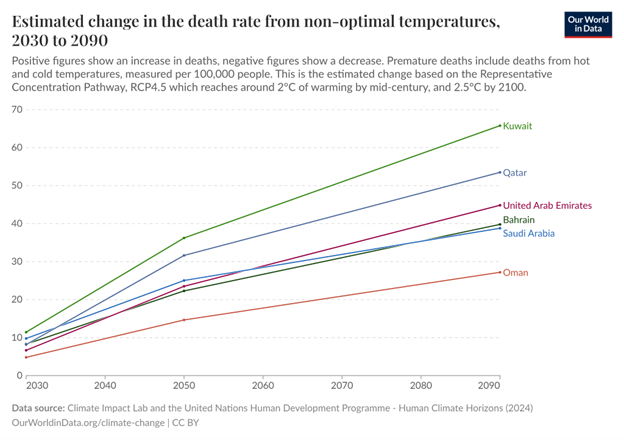
Source: Climate Impact Lab and the United Nations “Our World in Data”[17]
Labour and Economy: Extreme heat undermines labour productivity and the Gulf’s economic output. By 2030, the UAE is predicted to experience the largest heat stress-induced job losses and a 2.6-percent reduction in total working hours. Qatar is expected to be the most negatively impacted, losing 5.3 percent of its total working hours from heat stress, followed by Bahrain at 4.1 percent.[18] As tourism becomes integral to the GCC’s diversification trajectory, hotter temperatures may impede tourism and compromise job security for service industries. For instance, Mecca will experience 182 days of dangerous heat by 2050, exposing millions of tourists to health risks.[19] Opportunities exist in revamping fixed worker bans to adhere to changing temperatures and mandating protective cooling gears during peak heat.
Supply Chains: Extreme heat destabilises global supply chains, transport infrastructure, and local production. Many GCC countries rely on food and manufactured imports while striving to become global trade hubs. Analysts suggest a linkage between heat and reduced operating incomes of suppliers in global supply chain networks, resulting in customers severing relationships with suppliers exposed to heat levels above historical expectations.[20] Extreme heat also threatens domestic food production, exacerbating water insecurity, reducing crop yields, and degrading soil quality.[21] Opportunities lie in exploring sustainable cooling alternatives for logistics and supporting research and development for drought-resistant seed varieties.
Rising Energy Demand and Infrastructure Strain: Without improvements in energy efficiency, cooling demand in the GCC is expected to nearly triple by 2030.[22] A rise in cooling demand has historically led to power outages in Kuwait, and increased temperatures will increase cooling load demand in the UAE by 40 percent in 2080.[23],[24] The GCC has the highest level of AC ownership within MENA (80 percent of household owners).[25] At present, there are limited incentives from GCC governments to reduce electricity demand, due to an abundance of fossil fuel resources heightening accessibility to on-demand cooling.[26] However, there are opportunities in mandating energy-efficient measures for old and new buildings and regulating demand-side energy consumption.
Heat Resilience and Sustainable Cooling Measures in the GCC
This section evaluates progress and gaps in the development of national policies that acknowledge heat as a mounting risk, and the corresponding anticipatory measures such as heat action plans, warning systems, and worker protection efforts. The Global Heat Health Information Network (GHHIN), World Meteorological Organization (WMO), and UN Office for Disaster Risk Reduction (UNDRR) developed global standards and best practices for national heat action plans (HAPs).[27] Also, National Heat-Health Action Plans (HHAPs) coordinate multi-sectoral responses to extreme heat impacts on health, while Heat-Health Warning Systems (HHWS) integrate climate forecasts and predetermined levels of heat stress to inform public health interventions.[28]
Anticipatory Heat Policies
As part of UNFCCC reporting guidelines and the Cancun Adaptation Framework, many GCC countries have started developing National Adaptation Plans (NAPs) that urge countries to outline climate risks and coping strategies, laying the foundation for coordination and climate finance.[29] However, only Kuwait’s NAP acknowledges heat stress risk. Although Oman, Qatar, Saudi Arabia, and the UAE are actively developing NAPs, they have separately developed national strategy plans acknowledging extreme heat risk.
Yet, there is no formal HHAP at the national level though Qatar, Saudi Arabia, and the UAE have enacted labour-specific heat action policies, complementing peak summer outdoor working bands initiated by all GCC member states.[30] These bans are defined by fixed hours, with the exception of Qatar which mandated the use of Wet-Bulb Globe Temperature (WBGT) index instruments that adjust banned work hours based on variable heat exposure.[31] Although these measures are useful, research suggests that working bans are highly insufficient despite high compliance levels. For instance, a study in Kuwait demonstrated “substantial increases in the risk of occupational injury from extremely hot temperatures” even with the midday work ban policy.[32] Existing heat awareness policies also exclude other vulnerable populations such as the youth and elderly.[33],[34]
There is also an increasing regional commitment to strengthen heat resilience efforts, as evidenced by the Sixth Arab Regional Platform for Disaster Risk Reduction in February 2025.[35] However, progress in establishing predictive warning systems remains limited. While each GCC country disseminates extreme heat alerts through their respective meteorological departments, only Saudi Arabia has developed a Heat-Health Warning System, with its application limited to the Hajj.[36] This research is supplemented by external literature claiming that only 5 percent of Arab countries have comprehensive multi-hazard early warning systems (MHEWS) despite increased MHEWS reporting.[37]
Table 1. Heat Resilience Policies and Initiatives in the GCC
| Country | National Adaptation Plan (NAP) Status[38] | National Climate Plan that Considers Heat as Risk | Heat Action Plan (HAP) | Heat Warnings and Thermal Stress Indicator[39] | Heat-Health Warning System (HHWS) | Worker Protection Bans and Campaigns[40] |
| Bahrain | No information | No information | No information |
Yes |
No | Yes
Ring the Safety Bell Campaign[41] |
| Kuwait | Yes[42] | Yes[43] | No (adhoc basis)[44] | Yes | No | Yes
Ministry of Interior Delivery Bike Ban[45] |
| Oman | In development [46] | Yes [47] | No information | Yes | No | Yes |
| Qatar | In development [48] | Yes[49] | Limited
Heat Stress Legislation by Ministry of Labour [50] |
Yes – WGBT | No | Yes
SafeSummer Campaign (cooling suits)[51] Ministry of Public Health Workplace Wellness Support Project[52] |
| Saudi Arabia | In development | No information | Partly
Preventing Effects of Working in High-Temperatures – Saudi Arabia[53] Heat Protection Plan during Hajj[54] |
Yes –
Heat Index |
Yes[55]
Hajj Heat-Health Warning System |
Yes |
| The United Arab Emirates | In development | Yes [56] | Partly
Dubai Technical Guidelines for Heat Stress Management Abu Dhabi – National Centre of Meteorology Action Plan Against Extreme Weather[57] |
Yes | No | Yes
Smart-Tech (heat sensors)[58] Cooling Vests[59] |
Source: Author’s own, using various open sources. The list of worker protection campaigns is indicative.
Sustainable Cooling Initiatives and Policies
Cooling demand in the GCC is expected to triple by 2030, with air-conditioning projected to account for 60 percent of additional power generation required in the region and 1.5 million barrels of oil per day needed to meet fuel demands.[60] Based on an analysis of historical ‘cooling degree days’ (CDD)[a] in GCC capital cities, Doha experiences the highest CDDs, while Riyadh, the lowest. Furthermore, Abu Dhabi experiences the highest cooling costs due to high tariffs, while Muscat experiences the lowest.[61]
Although ACs are a critical life-saving measure, the persistence of potent hydrofluorocarbons (HFCs) in Heating, Ventilation and Air Conditioning (HVAC) and refrigeration systems creates environmental challenges that are difficult to mitigate.[62] The heavy subsidisation of oil and gas has enabled wide accessibility to AC systems and consumer perception of cooling abundance, resulting in a lack of urgency among both public and private sectors to pursue energy-efficient measures. This has also led to limited education and sustainability training in critical industries like construction in countries like Oman and Saudi Arabia.[63] Coping with extreme heat in the built environment requires instituting energy-efficient cooling measures, passive urban designs, district cooling in new developments, and retrofitting older buildings.
To be sure, political commitment to sustainable cooling is gradually gaining momentum. The Kigali Amendment to the Montreal Protocol aims to accelerate HFC phase-down through passive cooling measures, energy-efficient cooling appliances, and natural refrigerants. As of December 2025, five out of six GCC countries have either accepted or ratified the Kigali Amendment, signifying collective will to shift towards sustainable cooling.[64] The UAE helped reinforce sustainable cooling at COP28 by leading the Global Cooling Pledge, an initiative to reduce cooling-related emissions by 68 percent from 2030 to 2050; urge development of National Cooling Action Plans (NCAPs) that advise cooling strategies tailored to national contexts, and establish minimum energy performance standards.[65],[66]
Nevertheless, the UAE is the only GCC country to sign the Global Cooling Pledge and no country has instituted NCAPs. Across the region, the enforcement of energy efficiency and sustainable design solutions remains uneven. The UAE leads in the integration of its National Green Building Codes and mandatory Pearl and Al Sa’fat rating systems that holistically evaluate buildings on energy efficiency, water conservation, materials selection, and site sustainability.[67],[68],[69] Bahrain and Qatar also have comprehensive energy efficiency mandates. Bahrain’s National Energy Efficiency Action Plan (NEEAP) mandates thermal insulation and energy demand reduction initiatives, and Qatar’s Global Sustainability Assessment System (GSAS) represents the first performance-based system in MENA.[70],[71]
For their part, Kuwait and Saudi Arabia have instituted building standards but face implementation challenges, while Oman’s regulations have only recently been inaugurated. Kuwait has deployed minimum energy performance requirements for new and regulated buildings but struggles to regulate cooling due to low electricity costs.[72] The Saudi Energy Efficiency Program (SEEP) updates regulations for new buildings but faces challenges due to a lack of skilled personnel and unaligned government regulations.[73] Oman’s Building Code, which seeks to enhance resilience to extreme heat and flooding, is still new.[74]
Retrofitting is one urban adaptation strategy for existing buildings. It modernises standing HVAC systems, with an energy reduction potential of more than 20 percent and significant cost savings.[75] The International Energy Agency (IEA) also notes that health benefits gleaned from energy efficiency retrofits could exceed their implementation costs by up to three times.[76] However, retrofitting remains largely underutilised in Bahrain, Kuwait, and Oman due to a lack of financing incentives for the high installation costs.[77],[78] Saudi Arabia and the UAE, meanwhile, have successfully encouraged retrofitting through incentives and specific policy objectives, with Dubai hoping to retrofit 30,000 buildings by 2030.[79],[80]
District Cooling (DC) systems distribute centralised cooling to a select number of buildings, providing energy efficiency and cost savings of at least 40 percent.[81] An emerging market for DC exists in Bahrain, Kuwait, and Oman, but has yet to be scaled due to high initial installation and operational costs.[82],[83],[84] Qatar, Saudi Arabia, and the UAE, on the other hand, have well-established DC plants.[85]
Table 2: Sustainable Cooling Policies and Initiatives in the GCC
| Country | Kigali Amendment to the Montreal Protocol[86] | Global Cooling Pledge[87] | National Cooling Action Plan[88] | Policy on Energy Building Performance Standards[89] | Policies Incentivising Retrofitting | District Cooling Market[90] |
| Bahrain | Ratification | No | No | Yes (National Energy Efficiency Action Plan – NEEAP) | Limited (National Energy Efficiency Action Plan – NEEAP) | Growing Market |
| Kuwait | Approval | No | No | Yes (Building Energy Conservation Code) | Limited (Kuwait Energy Efficiency Technologies Program) | Growing Market |
| Oman | Ratification | No | No | Yes (Oman Building Code) | Limited (Oman Net Zero Report 2022) | Growing Market |
| Qatar | No Information | No | No | Yes (Global Sustainability Assessment System – GSAS) | Limited (Qatar National Development Strategy) | Well-established |
| Saudi Arabia | Acceptance | No | No | Yes (Saudi Arabia Energy Efficiency Program – SEEP) | Advanced (Saudi Arabia Royal Decree for Energy Efficiency) | Well-established |
| The United Arab Emirates | Acceptance | Yes | No | Yes (National Green Building Codes) | Advanced (Dubai’s Demand Side Management Strategy) | Well-established |
Source: Author’s own, using various open sources.
Sectoral Strategies to Strengthen Heat Resilience
Despite growing concern for extreme heat in the Gulf region, policies remain largely reactive. Formal HHAP, HHWS, and NCAPs have yet to be instituted, and legislation remains constrained to a few sectors like labour or tourism. The implementation of energy efficiency and urban planning measures also varies by country due to high upfront costs of solutions and heavily subsidised electricity that curtails urgent policy enforcement. This evaluation thus underscores the need for a unified GCC heat resilience policy framework to facilitate the development of national HHAPs, HHWS, and CAPs, refine sector-specific heat-health integration policies, and foster scaling and adoption of private-led adaptive measures across labour, tourism, and urban planning. Heat surveillance and sustainable cooling offer strong entry points for private financing but necessitate favourable policy frameworks and public-private cooperation to scale.
The following paragraphs outline sector-specific recommendations to inform a regional heat resilience agenda for the Gulf:
Health: Leverage artificial intelligence (AI) and data analytics to enhance heat surveillance and inform rapid emergency responses, embed heat surveillance indicators in national electronic health records, and improve communication of heat-health risks to the public. Saudi Arabia has already deployed thermal imaging technology and AI-powered drones to monitor heat waves during the Hajj.[91] There are opportunities to pilot dynamic mapping tools to detect UHI.[92] Strengthening AI and data analytics aligns with national objectives to advance digital transformation and climate technology, enabling engagement with the private sector and startups in the Gulf.[93] This also breeds opportunities for public-private partnerships (PPPs) to enhance the implementation and financing of heat action plans.
The GCC can learn from Cairo, where PPPs between the local government and companies like IBM and Vodafone Egypt have led to the deployment of smart city technologies to monitor heat.[94] Deploying heat-health alerts and implementing education programmes for schools and vulnerable outdoor workers would also help improve adoption of preventive measures.
Labour: Enforce flexible midday work bans that align with heat index alerts and urge adoption of cooling uniforms. Learning from Qatar, other GCC countries can adopt globally recognised heat indicators such as Wet-Bulb Globe Temperature (WBGT) in addition to other predictive measures such as heat mapping. Given that peak heat hours tend to precede worker ban hours, countries can use these measures to encourage adjustable work bans in lieu of pre-fixed hours. Moreover, the labour industry can mandate companies to adopt smart-tech cooling vests for outdoor workers in the summer.
Urban Planning: Update, streamline, and develop regional green building code guidelines for new buildings; harmonise retrofitting standards across the GCC countries; and promote research and development (R&D) for sustainable cooling innovations.[95] For new buildings, improve public procurement standards to incentivise reflective materials and shade structures. National governments should mandate that construction practices adhere to building designs that naturally reduce energy consumption and high indoor temperatures. After construction, governments must monitor compliance through recurring energy audits.
Roadmap for Implementation and Financing
Short-Term Heat Preparation and Early Response
The GCC should establish a regional heat task force chaired by Chief Heat Officers appointed by respective national climate change agencies to lead the heat resilience mandate and urge large-scale adoption of these sector-specific interventions. These officers will coordinate responsibilities among labour, health, meteorological, and energy agencies and oversee public-private partnerships.[96] This would help overcome challenges of fragmented governance and limited financing and increase data transparency regarding extreme heat impacts.
The regional task force should first adapt GHHIN-WMO-UNDRR guidelines to the region in order to facilitate country development of comprehensive HHWS contextualised to unique urban municipalities and HHAPs that bridge efforts between the municipal and national level.[97],[98] Regional guidelines can also recommend heat stress indicators, demonstrate multifaceted uses of smart sensors and UHI-detection tools, and outline strategies for heat-health integration. When developing HHAPs, the GCC should leverage its regional platform to establish a forum for cross-sharing lessons and liaise with other heat-affected regions.
The GCC can learn from cities that have developed clear adaptation frameworks that facilitate vertical coordination between the municipal and national government and horizontal coordination between health, labour, and meteorological departments.[99] For instance, Saudi Arabia is collaborating with Singapore to develop occupational heat exposure interventions.[100] Another lesson can be learned from Ahmedabad, India which developed a comprehensive Heat Action Plan in 2013 to help reduce heatwave mortality and set precedence for replication across the region.[101] Europe and North America also have well-established HHAP and HHWS, with HHAPs helping to avert up to 23 percent of expected deaths in Europe.[102]
Long-Term Adaptation and Sustainable Cooling
To minimise each country’s carbon footprint, the regional heat task force must also guide the development of NCAPs involving energy and urban planning ministries to bolster effective energy-efficient measures in the short-term and develop a long-term roadmap for developing sustainable cooling technologies.
As scientists continue to test emerging sustainable cooling technologies, the Gulf should institute financing incentives and policy reforms to expand upon historically effective passive cooling, retrofitting, and DC initiatives in the short to medium-term. The Gulf Organisation for Research and Development’s Sustainable Construction Code offers new opportunities to prioritise consistent standards for passive cooling techniques for energy and water efficiency at a regional level.[103] The regional task force can also lead fundraising efforts by piloting a “Heat Resilience Fund”, leveraging a combination of sovereign wealth funds, rebates, tax credits, and incentive programmes to help enhance the financial viability of retrofitting.[104]
Pairing green bonds or green sukuk[b] with tax incentives can also help finance energy retrofitting in the Gulf.[105] Bahrain, Oman, and Kuwait can overcome previous challenges that inhibit DC adoption by integrating regional technical expertise and prioritising DC construction in upcoming large-scale infrastructure projects as part of national development plans.[106] Increasing consumer awareness of energy-saving practices and energy-efficient buildings is equally crucial and can be achieved through informational workshops and media advertising. Expanding local cooling industries would also help foster the green job market and attract talent in line with national objectives to develop sustainable infrastructure.
Moving forward, the Gulf regional countries should capitalise on emerging technologies in sustainable cooling such as refrigerator compressors, thermoelectric cooling, solar-driven cooling, and indirect evaporative cooling. Refrigerator compressors specifically designed for propane (R-290) offer up to 15 percent more energy-efficient compared to conventional products. These have been piloted in UAE, Kuwait, and Qatar.[107] Thermoelectric cooling presents a potential green alternative to HFC refrigerants and has been piloted in niche settings like solar-powered car cooling and supply chain refrigeration but has yet to be scaled for large-scale air-conditioning purposes.[108],[109]
A solar hybrid cooling system integrates photovoltaic technology with vapour compression or uses solar thermal energy to drive absorption cooling systems, converting the sun’s heat into cooling. A study comparing compression systems and absorption cooling systems in the Gulf reveals that solar-driven compressor systems can achieve up to 99.1 percent GHG emissions reductions in Dubai, while solar absorption cooling systems may be the most financially viable with an internal rate of return of 38.8 percent in the same location.[110] Researchers in Saudi Arabia are piloting indirect evaporative cooling systems enhanced with nanotechnology that operate like passive cooling processes and provide cooling relief by absorbing water from the air.[111] Early studies in a King Abdullah University of Science and Technology (KAUST) villa village in Saudi Arabia have noted that IEC-mechanical vapour compression hybrids can reduce annual electricity consumption by up to 33 percent.[112]
Although these are nascent technologies, the GCC countries should continue investing in R&D since it coincides with Gulf national plans on climate technology and development.[113] Encouraging digital ministries to cultivate proper policy frameworks to guide development of these technologies will help meet challenges associated with cooling AI data centres and building resilient cold storage supply chains. To harmonise policies with rapid technological growth, GCC states should continue to lead innovation workshops, convening public and private actors.[114] Scaling emerging technologies like thermoelectric cooling would require confronting high costs and supply chain vulnerabilities of critical minerals.[115] The GCC countries should thus continue to strengthen domestic mineral capabilities and forge trade partnerships to overcome this issue.[116]
Conclusion
Building a unified GCC heat resilience framework and regional platform is crucial to safeguarding progress towards diversification and sustainability objectives outlined in national development plans. As climate change and urbanisation intensifies heat, existing policy and programmatic responses across the GCC remain fragmented, targeted to a few sectors, and insufficiently scaled.
To sustain the region’s visions for the future, GCC countries must immediately strengthen anticipatory planning through integrated HHWS and HHAPs; harmonise heat detection, heat-health integration and energy-efficient design standards and policies; deploy financing incentives to advance retrofitting and district cooling in the short to medium-term; and invest in R&D and policy development to cultivate emerging sustainable cooling technologies in the long term. Inter- and intra-regional collaboration, public-private partnerships, and alignment of regional guidelines with global best practices will help catalyse progress and cement the Gulf’s visibility as a champion of heat resilience and sustainable cooling innovation.
Leigh Mante is Junior Fellow, Energy and Climate Change Programme, ORF Middle East.
All views expressed in this publication are solely those of the author, and do not represent the Observer Research Foundation, either in its entirety or its officials and personnel.
Endnotes
[a] The metric of ‘cooling degree days’ (CDD) measures energy cooling demand for buildings.
[b] Refers to Sharia-compliant certificates that operate like green bonds without charging interest.
[1] John Calabrese, “From Floods to Heatwaves: Navigating the Gulf’s New Climate Reality,” Gulf International Forum, April 2024, https://gulfif.org/from-floods-to-heatwaves-navigating-the-gulfs-new-climate-reality/.
[2] Mansour Almazroui, “Summer Maximum Temperature over the Gulf Cooperation Council States in the Twenty-First Century: Multimodel Simulations Overview,” Arabian Journal of Geosciences 13, no. 477 (2020), https://doi.org/10.1007/s12517-020-05537-x.
[3] Kathryn A. Miller, et al., Living on the Edge: The Implications of Climate Change for Six Countries in the Middle East North Africa Region, Greenpeace Research Laboratories Technical Report (Review) 02-2022, (2022), https://www.greenpeace.org/static/planet4-mena-stateless/2022/11/b57fcf2f-greenpeace-living-on-the-edge-full-english.pdf.
[4] U.S. Environmental Protection Agency, “What are Heat Islands?,” 2025, https://www.epa.gov/heatislands/what-are-heat-islands.
[5]World Meteorological Organization, “Heatwave,” https://wmo.int/topics/heatwave.
[6] Mohammed Raouf, “Climate Change in the GCC: Security Threats and Opportunities in International Cooperation,” Gulf Research Center, 2024, https://www.grc.net/single-commentary/142.
[7] Mohamed Abdelraouf, “Sustainable Cities in the Gulf: The Case of the GCC Countries,” Gulf Research Center, 2025, https://www.grc.net/single-commentary/236.
[8] Nada AlSaeed, “How Gulf Countries’ Golden Schemes are Paving the Way to a Sustainable Future,” World Economic Forum, 2025, https://www.weforum.org/stories/2025/04/gulf-countries-golden-schemes/.
[9] Calabrese, “From Floods to Heatwaves: Navigating the Gulf’s New Climate Reality.”
[10] AlSaeed, “How Gulf Countries’ Golden Schemes Are Paving the Way to a Sustainable Future.”
[11] Sustainability Directory, “Heat Resilience,” December 2025, https://energy.sustainability-directory.com/term/heat-resilience/.
[12] World Meteorological Organization, Extreme Heat Risk Reduction: Towards a Common Global Framework, Report of the Expert Consultation, December 2024, https://www.undrr.org/media/107175/download?startDownload=20251021.
[13] KPMG, Unlocking Diversification in the GCC States, World Governments Summit 2024 (August 2024), https://assets.kpmg.com/content/dam/kpmg/ae/pdf-2024/08/unlocking-diversification-en.pdf.
[14] Al Hurini et al., “The Impact of Increased Heat on the Physical, Mental, and Social Health Domains of Adults in the United Arab Emirates in 2024,” Cureus, December 2024, https://doi.org/10.7759/cureus.74951.
[15] Ali Raza, “Heatwaves and Public Health: Understanding the Rising Threat of Extreme Heat Events,” Journal of Environmental Science and Health, 1, no. 1 (2025), https://www.imdpi.com/index.php/jesh/article/view/43.
[16] Climate Impact Lab and UNDP, “Estimated Change in the Death Rate from Non-Optimal Temperatures,” Our World in Data, 2024, https://ourworldindata.org/grapher/change-heat-death-rate?time=earliest.2090&country=ARE~QAT~KWT~OMN~SAU~BHR.
[17] Climate Impact Lab and UNDP, “Estimated Change in the Death Rate from Non-Optimal Temperatures.”
[18] Jamila El Mir, “Heat Resilience: A Matter of Both Adaptation and Mitigation for the GCC,” in Climate-Resilient Cities, ed. Anvita Arora et al. (Springer Cham, 2024), 47-61, https://doi.org/10.1007/978-3-031-73090-0_3.
[19] Calabrese, “From Floods to Heatwaves: Navigating the Gulf’s New Climate Reality.”
[20] Raouf, “Climate Change in the GCC: Security Threats and Opportunities in International Cooperation.”
[21] Yasmeen Yaqoobi, “Climate Change and Human Security in the GCC,” TRENDS Research & Advisory, 2022, https://trendsresearch.org/insight/climate-change-and-human-security-in-the-gcc/.
[22] PwC, Unlocking the Potential of District Cooling | Strategy& Middle East (2012), https://www.strategyand.pwc.com/m1/en/reports/unlocking-the-potential-of-district-cooling.pdf.
[23] Zhang Zhuoya, “Middle East Insights: Countries take Active Measures to Combat Climate Change as Extreme Heat Sweeps Across the Gulf,” CGTN, July 8, 2024, https://news.cgtn.com/news/2024-07-08/Gulf-countries-take-active-measures-to-combat-climate-change-1v4GNKPBCEM/p.html.
[24] Afifa Mohammed et al., “On the Cooling Energy Impacts of Combined Urban Heat Mitigation Strategies in Subtropical Urban Building Environment,” Energy and Buildings 309 (2024), https://doi.org/10.1016/j.enbuild.2024.113918.
[25] International Energy Agency, The Future of Electricity in the Middle East and North Africa (Paris, September 2025), https://www.iea.org/reports/the-future-of-electricity-in-the-middle-east-and-north-africa
[26] Lena Gurriaran et al., “Warming-Induced Increase in Power Demand and CO2 Emissions in Qatar and the Middle East,” Journal of Cleaner Production 382 (2023), https://doi.org/10.1016/j.jclepro.2022.135359.
[27] Global Heat Health Information Network, An Assessment of Heat Action Plans: Global Standards, Good Practices, and Partnerships, 2025, https://www.undrr.org/media/108606/download?startDownload=20251021.
[28] G7 Germany, From the G7 Health Communique to Action: Health and Climate – Heat Preparedness through Early Warning Systems, November 2022, https://heathealth.info/wp-content/uploads/G7-report-heat-EWS.pdf.
[29] UNDP Climate Promise, “What are National Adaptation Plans and Why Do They Matter?,” 2025, https://climatepromise.undp.org/news-and-stories/what-are-national-adaptation-plans-and-why-do-they-matter.
[30] International Labour Organization, Heat and OSH Policy Brief, June 2024, https://doi.org/10.54394/FCLI7133.
[31] Sarah Mostafa-Kamel, “Understanding GCC Labour Laws. Part One: Heat Stress,” 2024, https://gulfsustain.org/insights/understanding-gcc-laws-heat-stress-recruitment-fees-and-migration-agreements.
[32] Barrak Alahmad et al., “Extreme Heat and Work Injuries in Kuwait’s Hot Summers,” Occupational and Environmental Medicine 90, no. 6 (2023), http://dx.doi.org/10.1136/oemed-2022-108697.
[33] SM Ayaz Zakir, “UAE: Kids at Greater Risk of Heat Stroke than Adults, Doctors Warn after 7-yr-Old Dies in Car,” Khaleej Times, May 2024, https://www.khaleejtimes.com/uae/uae-kids-at-greater-risk-of-heat-stroke-than-adults-doctors-warn-after-7-yr-old-dies-in-car.
[34] Mohammed Mahmoud, Building a More Resilient Bahrain: An Integrated Approach to Climate Change, Socioeconomic, and Governance Challenges, Middle East Institute, 2024, https://www.mei.edu/sites/default/files/2024-05/Building%20a%20More%20Resilient%20Bahrain%20-%20An%20Integrated%20Approach%20to%20Climate%20Change%2C%20Socioeconomic%2C%20and%20Governance%20Challenges_0.pdf.
[35] United Nations Office for Disaster Risk Reduction, “Facing the Heat: How the Arab Region is Tackling Rising Temperatures,” 2025, https://www.undrr.org/news/facing-heat-how-arab-region-tackling-rising-temperatures.
[36] Ministry of Health, Kingdom of Saudi Arabia (KSA), Guidelines for Management of Heat Illnesses During Hajj, n.d., https://gcmgm.moh.gov.sa/en/HajjUmrah/Pages/003.pdf.
[37] United Nations Office for Disaster Risk Reduction and World Meteorological Organization, Global Status of Multi-Hazard Early Warning Systems, Geneva, 2024, https://library.wmo.int/idurl/4/69085
[38] UNFCCC, “NAP Tracking Tool,” 2024, https://napcentral.org/nap-tracking-tool.
[39] Mostafa-Kamel, “Understanding GCC Labour Laws: Part One – Heat Stress.”
[40] International Labour Organization, Heat and OSH Policy Brief.
[41] Elise D. Solberg, “ ‘Ring the Safety Bell’ Campaign Targets Heat Risks at Bahraini Company,” 2024, https://www.healthandsafetyinternational.com/article/1925680/ring-safety-bell-campaign-targets-heat-risks-bahraini-company.
[42] Government of Kuwait, Kuwait National Adaptation Plan (2019-2030), 2021, https://unfccc.int/sites/default/files/resource/NAP_Kuwait_2021.pdf.
[43] Sara Mehryar and Mohammad Alsahli, “From Reaction to Resilience: Preparing for Climate Multi-Hazards in Kuwait,” LSE Middle East Centre, April 2025, https://eprints.lse.ac.uk/128255/1/mec_2025_4_3_from-reaction-to-resilience-preparing-for-climate-multi-hazards-in-kuwait.pdf.
[44] Mehryar and Alsahli, “From Reaction to Resilience: Preparing for Climate Multi-Hazards in Kuwait.”
[45] Ramadan Al Sherbini, “Kuwait Enforces 11am-4pm Delivery Bike Ban to Shield Workers from Heat Risks,” Gulf News, 2025, https://gulfnews.com/world/gulf/kuwait/kuwait-enforces-11am4pm-delivery-bike-ban-to-shield-workers-from-heat-risks-1.500139361.
[46] Joy Arkeh and Nourane Awadallah, “Reforming for Resilience in Oman: Environmental Risk and Policy Capacity,” Carnegie Endowment for International Peace, 2025, https://carnegieendowment.org/research/2025/09/reforming-for-resilience-in-oman-environmental-risk-and-policy-capacity?lang=en.
[47] Sultanate of Oman, National Strategy for Adaptation and Mitigation to Climate Change for the Sultanate of Oman (2020-2040), 2019, https://cdn.climatepolicyradar.org/navigator/OMN/2019/national-strategy-to-mitigate-impacts-of-climate-change_ee3fc6a5855c0215b881ebe7494d260e.pdf.
[48] Global Green Growth Institute, “QA06 National Climate Adaptation Planning for Qatar”, n.d., https://gggi.org/project/qa06-support-to-national-adaptation-planning/.
[49] Ministry of Environment and Climate Change, Qatar National Climate Change Action Plan 2030, https://www.mecc.gov.qa/Publications/NCCAP-Consolidated_digital-en_new.pdf.
[50] Ministry of Labour, Heat Stress Legislation in Qatar, April 2023, https://www.mol.gov.qa/admin/LawsDocuments/2020%20Heat%20Stress%20Guidance-r15.pdf
[51] “Oman Launches SafeSummer Campaign to Combat Heat Stress,” HSE Review, 2025, https://hsereview.com/industry-insights/oman-launches-safesummer-campaign-to-combat-heat-stress?nominify=1.
[52] “Health Ministry Concludes Training on Heat Stress Prevention During Summer,” The Peninsula, https://s.thepeninsula.qa/nblims.
[53] “Preventing Effects of Working in High-Temperature – Saudi Arabia,” National Council for Occupational Safety and Health & Saudi NCOSH, 2024, https://heathealth.info/resources/preventing-effects-of-working-in-high-temperature-saudi-arabia/.
[54] “Hajj 2025: Saudi Arabia Unveils Heat Protection Plan,” The Express Tribune, 2025, https://tribune.com.pk/story/2541726/hajj-2025-saudi-arabia-unveils-heat-protection-plan.
[55] Waad Hussain, “Saudi Ministers Announce Full Hajj Readiness with 1.07 million Pilgrims Already in Kingdom,” Arab News, 2025, https://www.arabnews.com/node/2602262/saudi-arabia.
[56] UAE, Ministry of Climate Change and Environment, National Climate Change Plan of the UAE 2017-2050, https://u.ae/en/about-the-uae/strategies-initiatives-and-awards/strategies-plans-and-visions/environment-and-energy/national-climate-change-plan-of-the-uae.
[57] Dubai Municipality, Technical Guidelines for Management of Heat Stress at Work, 2019, https://www.dm.gov.ae/wp-content/uploads/2022/08/DM-HSD-GU38-MHSW2_Technical-Guidelines-for-Management-of-Heat-Stress-at-….pdf.
[58] EGA, “EGA Extends Use of Wearable Technology to ‘Beat the Heat’ in UAE Summer,” 2023, https://media.ega.ae/ega-extends-use-of-wearable-technology-to-beat-the-heat-in-the-uae-summer/#:~:text=07:56-,EGA%20extends%20use%20of%20wearable%20technology%20to%20’Beat%20the%20Heat,illnesses%20in%202019%20and%202022.
[59] “How Cooling Vests are Helping Outdoor Workers Beat the Heat,” Gulf News, July 2025, https://gulfnews.com/technology/how-cooling-vests-are-helping-outdoor-workers-beat-the-heatwave-1.500190692.
[60] PwC, Unlocking the Potential of District Cooling.
[61] Hayder Salem, Khalil Khanafer, “Cooling Degree Days for Quick Energy Consumption Estimation in GCC Countries.” Sustainability 14, no. 21 (2022), https://doi.org/10.3390/su142113885.
[62] Climate & Clean Air Coalition, “Hydrofluorocarbons (HFCs),” https://www.ccacoalition.org/short-lived-climate-pollutants/hydrofluorocarbons-hfcs.
[63] Salvatore Carlucci et al., “Characteristics of the Built Environment in the Eastern Mediterranean and Middle East and Related Energy and Climate Policies,” Energy Efficiency 17, (2024), https://doi.org/10.1007/s12053-024-10217-w.
[64] Ozone Secretariat, “All ratifications,” UN Environment Programme, 2025, https://ozone.unep.org/all-ratifications.
[65] Cool Coalition, “Global Cooling Pledge,” https://coolcoalition.org/global-cooling-pledge/.
[66] Cool Coalition, “NCAPs in Middle East and Africa,” https://coolcoalition.org/projects/ncaps-middle-east-and-africa.
[67]UAE, Ministry of Energy and Infrastructure, “Ministry of Energy and Infrastructure Launches National Green Certificates Program,” 2024, https://www.moei.gov.ae/en/media-center/news/10/7/2024/ministry-of-energy-and-infrastructure-launches-national-green-certificates-program#:~:text=Ministry%20of%20Energy%20and%20Infrastructure%20Launches%20National%20Green%20Certificates%20Program,friendly%.
[68]Abu Dhabi Urban Planning Council, The Pearl Rating System for Estidama Public Realm Rating System Design & Construction, 2016, https://www.dmt.gov.ae/-/media/Project/DMT/DMT/E-Library/0001-Manuals/PRRS/PRRS-Version-10.pdf.
[69] Dubai Municipality, Government of United Arab Emirates, “Al Sa’fat – Dubai Green Building System,” 2020, https://www.dm.gov.ae/municipality-business/al-safat-dubai-green-building-system/.
[70] UNDP, The Kingdom of Bahrain National Energy Efficiency Action Plan, 2017, https://www.undp.org/sites/g/files/zskgke326/files/2022-09/seu_neeap_report_2017.pdf.
[71] GSAS Trust, “Middle East’s Leading Rating System for Sustainability & Green Buildings,” 2025, https://gsas.gord.qa/.
[72] Kuwait Ministry of Electricity and Water, Energy Conservation Code for Buildings, 2018, https://www.mew.gov.kw/media/f5eezszd/new-r6-2018%D8%A7%D9%84%D8%AA%D9%83%D9%8A%D9%8A%D9%81.pdf.
[73] Carlucci et al., “Characteristics of the Built Environment in the Eastern Mediterranean and Middle East.”
[74] MoHUP, “MoHUP Unveils Oman Building Code,” 2025, https://mohup.gov.om/en/media/news/ptwze3npscd05jp37ifuwcmk.
[75] Eiman M. Al Mulla, “Modeling and Retrofit for Energy Conservation: A Case Study of the Incubator Building,” 2016, https://khazna.ku.ac.ae/ws/portalfiles/portal/6811948/file.
[76] KAPSARC, Unlocking Energy Efficiency in the GCC Built Environment, 2025, https://www.unescwa.org/sites/default/files/inline-files/Unlocking%20EE%20in%20GCC%20Built%20Environement_KAPSARC%20ESCWA%202024.pdf.
[77] UNDP, The Kingdom of Bahrain National Energy Efficiency Action Plan.
[78] Carlucci et al., “Characteristics of the Built Environment in the Eastern Mediterranean and Middle East.”
[79] InvestSaudi, “Why Invest in Energy Savings”
[80] “Retrofitting Existing Buildings: A Crucial Step to Net Zero,” Masdar, 2019, https://masdar.ae/en/news/newsroom/retrofitting-existing-buildings.
[81] “Is District Cooling the Answer to the Gulf’s Power Demand?,” Meed, 2008, https://www.meed.com/is-district-cooling-the-answer-to-the-gulfs-power-demand-3/#:~:text=There%20are%20resource%20issues%2C%20ranging,can%20affect%20the%20financing%20arrangements.
[82] MarkNtel Advisors, “Bahrain District Cooling Market Research Report: Forecast (2023-2028),” 2023, https://www.marknteladvisors.com/research-library/bahrain-district-cooling-market.
[83] MarkNtel Advisors, “Kuwait District Cooling Market Share, Size, Share, & Industry Trends | 2028,” 2023, https://www.marknteladvisors.com/research-library/kuwait-district-cooling-market.html.
[84]MarkNtel Advisors, “Oman District Cooling Market Research Report: Forecast (2023-2028),” 2023, https://www.marknteladvisors.com/research-library/oman-district-cooling-market.html.
[85] Zhang Zhaohui and Wang Ruonan, “Climate-Safe Refrigerants,” in Sustainable Cooling: How to Cool the World Without Warming the Planet,” ed. Bo Shen et al., ADB Institute, 2024, https://doi.org/10.56506/MAGR4101.
[86] UN Environment Programme, “Country Data”, https://ozone.unep.org/all-ratifications.
[87] COP28 UAE, “Global Cooling Pledge for COP28,” https://www.cop28.com/en/global-cooling-pledge-for-cop28.
[88] UNDP, “Summary of National Cooling Action Plans (NCAPs),” November 2023, https://www.undp.org/publications/summary-national-cooling-action-plans-ncaps#:~:text=November%2021%2C%202023,to%20overcome%20pre%2Dinvestment%20challenges.
[89] Carlucci et al., “Characteristics of the Built Environment in the Eastern Mediterranean and Middle East.”
[90] Mark Ntel Advisors, “Oman District Cooling Market Research Report.”
[91] Juwayriah Wright, “Hajj Begins with Sweeping New Changes” Time Magazine, June 4, 2025, https://time.com/7291105/hajj-2025-saudi-arabia-new-rules/.
[92] MBUZAI, “MBZUAI Looks to AI-Powered Solutions for Extreme Weather Events Following Recent Flooding in Gulf Region,” May 13, 2024, https://mbzuai.ac.ae/news/mbzuai-looks-to-ai-powered-solutions-for-extreme-weather-events-following-recent-flooding-in-gulf-region/.
[93] KPMG, “Unlocking Diversification in the GCC States.”
[94] UNDRR, “Narrative Analysis: Case Studies in Heat Resilience,” 2025, https://www.undrr.org/quick/95888.
[95] KAPSARC, “Unlocking Energy Efficiency in the GCC Built Environment”
[96] Atlantic Council, “Chief Heat Officers,” https://onebillionresilient.org/project/chief-heat-officers/.
[97] Shilpa Rao and Prayash Chaudhary, “Evaluating the Socioeconomic Benefits of Heat-Health Warning Systems.” European Journal of Public Health 35, no. 1 (February 2025), https://academic.oup.com/eurpub/article/35/1/178/8005969.
[98] Gerardo Sanchez Martinez and Vladimir Kendrovski, “Heat-Health Action Planning in the WHO European Region: Status and Policy Implications,” Environmental Research 214, no. 1 (November 2022), https://doi.org/10.1016/j.envres.2022.113709.
[99] Madhurima Sarkar-Swaisgood and Aparna Roy, “Policy Pathways for Urban Heat Resilience: Leveraging Digital Tools for Risk-Informed Adaptation” in Surviving the Anthropocene: Urban Climate Resilience and Disaster Management, ed. Dhaval Desai and Nandan Dawda (Durham University, 2025), pp. 14.
[100] Natalia Laskowska, “Saudi Regulator Teams with Singapore Scientists for Heat-Resilient Workplaces,” Arab News, May, 2025, https://arab.news/mxd35.
[101] NRDC, “Ahmedabad Heat Action Plan,” 2019, https://www.nrdc.org/sites/default/files/ahmedabad-heat-action-plan-2018.pdf.
[102] Rajashree Kotharkar and Aveek Ghosh, “Progress in Extreme Heat Management and Warning Systems: A Systematic Review of Heat-Health Action Plans (1995-2020),” Sustainable Cities and Society 76 (January 2022), https://www.sciencedirect.com/science/article/abs/pii/S2210670721007538#:~:text=In%20response%20to%20the%20rapidly,health%20action%20plans%20(HHAPs).
[103] “GORD to Integrate Green Code into Gulf Standards,” Gulf Construction Online, March 2025, https://gulfconstructiononline.com/Article/1628882/GORD_to_integrate_green_code_into_Gulf_Standards.
[104] “Building Retrofitting: Paving the Way to a Sustainable Future,” PlanRadar, 2024, https://www.planradar.com/ae-en/building-retrofitting-for-sustainable-future/.
[105] Yue Li et al., “Policy Solutions to Enable Climate-Friendly Cooling,” in Sustainable Cooling: How to Cool the World Without Warming the Planet,” ed. Bo Shen, Dina Azhgaliyeva, and Alfredo Bano Leal, ADB Institute, 2024.
[106] MOFA (Kuwait), “Kuwait Vision 2035 “New Kuwait,” https://www.mofa.gov.kw/en/pages/kuwait-vision-2035.
[107] Cool Up Programme, MENA Region Cooling Status Report, no. 3, December 2024, https://www.coolupprogramme.org/wp-content/uploads/2024/12/Cool-Up_MENA-Region-Cooling-Status-Report_Issue-3.pdf.
[108] Mehwish Khan Mahek and Mohamad Ramadan, “A Comprehensive Review of Thermoelectric Cooling Technologies for Enhanced Thermal Management in Lithium-Ion Battery Systems.” Heliyon 10, no. 24 (December 2024), https://doi.org/10.1016/j.heliyon.2024.e40649.
[109] Sergiy Filin and Ludmila Filina-Dawidowicz, “Improvement of Criteria for Assessing the Energy Efficiency of Thermoelectric Refrigerators Used in Supply Chains.” Energies 14, no. 6 (2021), https://doi.org/10.3390/en14061620?urlappend=%3Futm_source%3Dresearchgate.net%26utm_medium%3Darticle.
[110] Bassam Hasanain, “Fostering Solar Hybrid Cooling Systems in MENA Region: A Techno-Economic and Emission Reduction Assessment,” AIP Advances 14, no. 4 (April 2024), https://doi.org/10.1063/5.0197158.
[111] King Abdullah University of Science and Technology, “The Future of Sustainable Cooling Is Being Built in the Saudi Desert,” 2025, https://www.kaust.edu.sa/en/news/the-future-of-sustainable-cooling-is-being-built-in-the-saudi-desert.
[112] Moncef Krarti et al., “Energy Benefits of Retrofitting Residential Communities: Case Study of KAUST Villa Housing Community,” Journal of Engineering for Sustainable Buildings and Cities 6, no. 4 (November 2025), https://doi.org/10.1115/1.4069135.
[113] KPMG, “Unlocking Diversification in the GCC States.”
[114] UAE Ministry of Climate Change and Environment, “Ministry of Climate Change and Environment Hosts Innovative ‘Clean Cold’ Workshop in Dubai,” 2018, https://www.moccae.gov.ae/en/media-center/news/9/4/2018/ministry-of-climate-change-and-environment-hosts-innovative-clean-cold-workshop-in-dubai.aspx?disableresponsive=1#:~:text=While%20the%20UAE%20is%20leading,demonstrate%20and%20disseminate%20these%20tec.
[115] Krishna Vohra, “Heat Adaptation through Sustainable Cooling and Design”, in Surviving the Anthropocene: Urban Climate Resilience and Disaster Management, ed. Dhaval Desai and Nandan Dawda (Durham University, 2025), pp. 73.
[116] John Calabrese, “The Gulf’s Mineral Gambit: Shaping the Global Race for Critical Resources,” Gulf International Forum, August 25, 2025, https://gulfif.org/the-gulfs-mineral-gambit-shaping-the-global-race-for-critical-resources/.