 Global
Expert Speak | 28 May, 2026
Russia-China Defence and Security Partnership: Intensification Amid Constraints
The following excerpt is from Chapter 5 — ORF Global Quarterly: Disruption and Recalibration.
Never against each other, but not always together”[1]—this is the formulaic expression often used in discussions among Russian officials and experts to describe Russia-China relations. Such characterisation captures the nuances of bilateral engagement more accurately than the widely publicised “no-limits partnership”, which has become a cliché in global expert analysis since February 2022.
Despite the formal projection of a “comprehensive strategic partnership”,[2] neither side is willing to shoulder the burden of protecting the other during conflicts. China is carefully balancing its position on the war in Ukraine, offering Russia targeted support while avoiding direct military involvement in the form of supplying lethal weapons or deploying troops. Similarly, Moscow would like to avoid getting entangled in China’s conflicting relations with India, Japan, Vietnam, or the United States (US). This cautious approach on both sides imposes a clear ceiling on their engagement and leaves limited prospects for an alliance-like partnership in the future.
Over the past several years, Russia and China have strengthened their political dialogue, reinforcing their affinity in defence and security. Much of this strategic alignment derives from both Moscow’s and Beijing’s efforts to act in concert to counterbalance the US. Their shared opposition to US hegemony has accelerated the evolution of their bilateral ties, most evident in defence cooperation. At an unprecedented level of bilateral engagement, defence relations have expanded to encompass extensive transfers of technology from Russia,[3] the intensification and broadening of bilateral exercises, and closer coordination between the militaries, including the exchange of battlefield experience.[4]
In the military-technical domain, Russia has long supplied China with advanced weaponry and equipment, ranging from fighter jets and jet engines to air defence systems and assistance in developing a ballistic missile early warning system (BMEWS) (see Table 1). The latter is particularly noteworthy from a political perspective: first, because such systems represent rare and sophisticated technology previously developed and maintained only by the US and Russia;[5] and second, because it directly enhances China’s strategic capabilities vis-à-vis the US. Whether the Russian and Chinese systems exchange data automatically—a development that would effectively amount to the creation of a joint global missile defence network and reveal the depth of their military cooperation— remains an open question.[6]
Table 1. Russian Military Supplies to China (2016-2025)
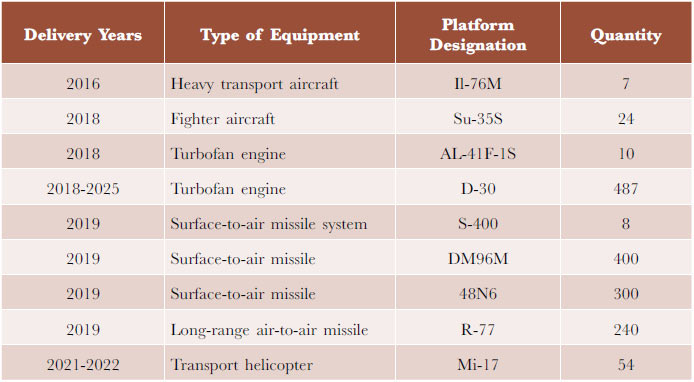
Source: SIPRI Arms transfers database[7]
Russian arms imports were particularly instrumental during the 1990s and 2000s, enabling the Chinese military-industrial complex to develop expertise in producing its own military platforms and emerge as a self-reliant arms manufacturer. Conversely, Russia has more recently experienced a shortage of certain types of military platforms, a challenge that has become evident during the war in Ukraine. As a result, it may even need to consider acquiring defence systems such as military transport aircraft or AWACS planes from China, which developed them using Soviet technology.
Moscow is also becoming increasingly eager to pursue joint cooperation, including research and development (R&D) in the high-technology production of military equipment such as air and missile defence systems, fifth- and sixthgeneration fighter aircrafts, submarines, and spacecraft.[8] From Moscow’s perspective, codevelopment and co-production are intended to shift the balance from China’s unilateral procurement of Russian weapons systems to a more collaborative mode of cooperation, although this remains largely aspirational and has yet to yield tangible progress.[9]
In recent years, amid the war in Ukraine, Russia has sourced from China various dual-use items, including microelectronics and critical components necessary for defence production. These supplies are believed to have assisted Russia in overcoming a critical juncture in the war in 2023 and in sustaining the production of advanced equipment and missiles.[10] However, China has refrained from exporting heavy weapons or fully assembled arms to Russia, with the exception of a limited number of Shaanxi Baoji Tiger armoured vehicles supplied to Russian paramilitary forces.[11] This ambiguity has enabled China to portray itself as a proponent of peace and deflecting accusations of direct involvement in the war alongside Russia. A notable asset that Russia contributes to the partnership is battlefield experience, which the Chinese Army lacks. This issue has been highlighted during multiple exchanges between military delegations from Moscow and Beijing.[12]
Engagement between military officials has increased markedly in the recent years, with a growing number of meetings and dialogues. Russian Defence Minister Andrey Belousov, for example, since assuming office in May 2024, has conducted four rounds of talks with the Chinese military-political leadership, including Vice Chairman of the Central Military Commission Zhang Youxia[13] and Defence Minister Dong Jun. During their most recent video call in January 2026, Belousov and Jun discussed developments concerning Venezuela and Iran.[14] This was followed by an official visit to China in February 2026 by the Secretary of the Russian Security Council, Sergey Shoigu, who held talks with Wang Yi, Member of the Political Bureau of the CPC Central Committee and Foreign Minister. According to the Chinese readout, the discussions addressed several flashpoints in the Indo-Pacific, including “stability in the Taiwan Strait” and “Japan’s attempts to accelerate remilitarisation.”[15]
From Moscow’s perspective, co-development and coproduction are intended to shift the balance from China’s unilateral procurement of Russian weapons systems to a more collaborative mode of cooperation.
The Indo-Pacific is a key geography where Russia and China have reinforced one another politically and militarily. Their converging regional outlooks are shaped by a shared perception of threat, articulated by officials from both sides, arising from so-called “closed military-political alliances.” This affinity in geopolitical approaches has contributed to the increasing frequency and complexity of bilateral exercises, indicating a gradual shift toward deeper coordination between their armed forces.
Since 2022, Russia and China have intensified their annual joint air and naval patrols in the Indo-Pacific.[16] The locations of these manoeuvres indicate that Moscow and Beijing are signalling coordinated efforts directed against the US and its regional allies. In addition to regular air patrols near Japanese and South Korean airspace, the Russian and Chinese strategic bombers TU-95MS and Xian H-6K conducted a patrol near Alaska in July 2024, where they were intercepted by the US and Canadian fighter aircrafts.[17] Expanding their bilateral military activities in the region, Russia and China carried out a joint submarine patrol in August 2025, which included the exchange of sonar data and rescue exercises, in both the Sea of Japan (the East Sea) and the East China Sea.[18] Another notable development was the resumption of joint anti-missile drills after an eight-year hiatus, with the third round held “within Russian territory” in December 2025.[19]
Beyond bilateral drills, Russia and China regularly conduct maritime exercises in the Indian Ocean, including with South Africa and with Iran (see Table 2). The nine-day BRICS-Plus naval exercise, ‘Will for Peace’, off South Africa’s Western Cape, marked the first occasion on which all four powers participated (alongside the UAE).[20] Although the military dimension is not formally part of the BRICS agenda, framing the drills as a ‘BRICS Plus naval exercise’[21] suggests an intention by some countries to introduce this aspect into the group’s activities. However, two founding BRICS members—Brazil and India—chose not to participate, underscoring the limited scope of the group’s military engagement. The most recent ‘Maritime Security Belt’ drills with Iran were held in the Gulf of Oman in February 2026, coinciding with a build-up of US naval forces in the region.[22]
Table 2. Russia-China Military Drills (May 2022-February 2026)
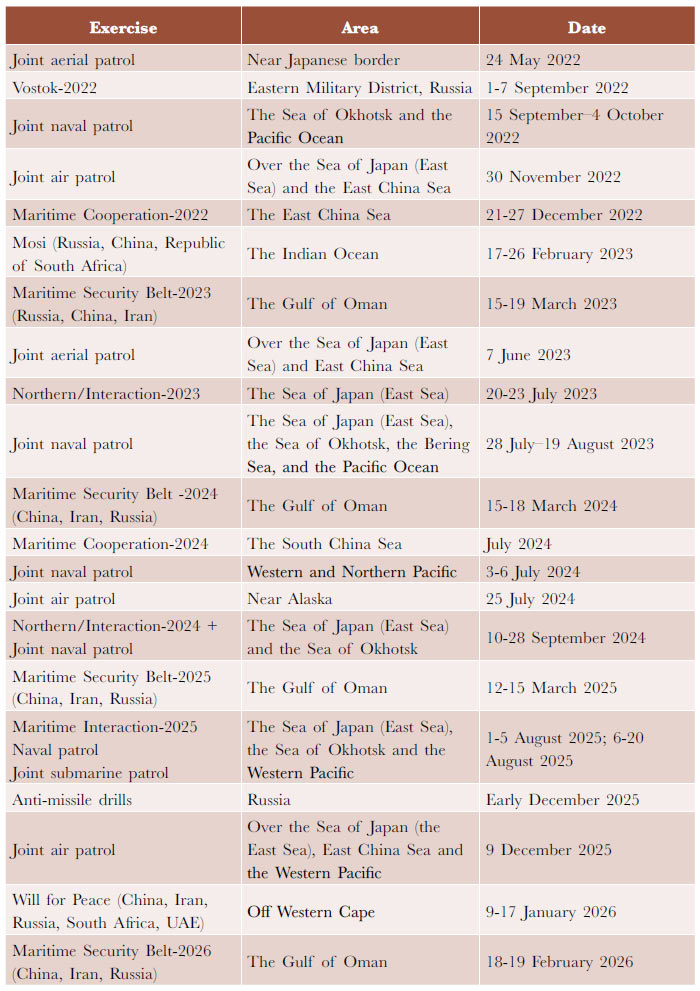
Source: Author’s own, using data from various open sources.
Although there is a significant gap, and room for mistrust remains between the Russian and Chinese militaries, their engagement in recent years indicates deeper coordination and operational integration. Efforts by US President Donald Trump to drive a wedge between Beijing and Moscow have thus far not altered the trajectory of their defence partnership, which continues to be sustained by their shared perception of the US and the US-led alliances as a common security threat.
Aleksei Zakharov is Fellow, Russia & Eurasia, Strategic Studies Programme, Observer Research Foundation.
[1] “The Head of IMEMO RAS: The Confrontation Between the US and China Will Be the Main Issue in the Post- Pandemic World,” TASS, July 10, 2020, https://tass.ru/interviews/8936527; Andrei V. Kortunov et al., Russia-China Dialogue: The 2022 Model: Report No. 78, Moscow, Russian International Affairs Council, 2022, https://russiancouncil.ru/ papers/Russia-China-2022-Report78.pdf.
[2] “Joint Communique Following the 30th Regular Meeting of the Heads of Government of Russia and China,” Government of Russia, November 4, 2025, http://government.ru/news/56833/.
[3] Russia has been willing to supply China with a range of state-of-the-art platforms, including air defence systems and fighter jets. However, Moscow has been reluctant to share the most advanced technologies for producing jet engines or stealth propulsion systems for the latest nuclear-powered submarines, which China has been seeking to acquire.
[4] Claus Soong, “China–Russia Military Cooperation Targeting Taiwan Could Link the European and Asia–Pacific Theaters,” MERICS, November 6, 2025, https://merics.org/en/comment/china-russia-military-cooperation-targetingtaiwan- could-link-european-and-asia-pacific.
[5] Vasily Kashin, “Chinese–Russian Ballistic Missile Cooperation Signals Deepening Trust,” East Asia Forum, February 20, 2021, https://eastasiaforum.org/2021/02/20/chinese-russian-ballistic-missile-cooperation-signals-deepening-trust/.
[6] Vasily Ivanov, “Maximum Rapprochement Without Strategic Alliance,” Nezavisimaya Gazeta, December 21, 2023, https://nvo.ng.ru/gpolit/2023-12-21/1_10_11_1237_china.html; Kashin, “Chinese–Russian Ballistic Missile Cooperation Signals Deepening Trust.”
[7] “Arms Transfers Database,” SIPRI, https://armstransfers.sipri.org.
[8] This is not a China-specific policy, since Russia has put forward similar proposals to its other strategic partners, including India.
[9] “Russia Has Expressed Its Readiness to Offer China Joint Weapons Production,” RIA Novosti, November 13, 2024, https://www.gazeta.ru/army/news/2024/11/13/24372031.shtml.
[10] Aamer Madhani, “US Intelligence Finding Shows China Surging Equipment Sales to Russia to Help War Effort In Ukraine,” The Associated Press, April 19, 2024, https://apnews.com/article/united-states-china-russia-ukraine-war-265df8 43be030b7183c95b6f3afca8ec.
[11] “Arms Transfers Database.”
[12] “A Delegation from the Chinese Armed Forces Arrived in Moscow,” Izvestiya, August 22, 2024, https://iz.ru/1747021/2024- 08-22/v-moskvu-pribyla-delegatciia-sukhoputnykh-voisk-vs-kitaia.
[13] In January 2026, Zhang Youxia was removed from his position and placed under investigation for “violation of discipline and law.”
[14] “Belousov Discussed Developments in Venezuela and Iran with the Head of China’s Ministry of Defense,” Vedomosti, January 27, 2026, https://www.vedomosti.ru/politics/news/2026/01/27/1172095-belousov-obsudil.
[15] “Wang Yi and Secretary of the Russian Federation Security Council Sergei Shoigu Hold Strategic Communication,” Ministry of Foreign Affairs of People’s Republic of China, 2026, https://www.fmprc.gov.cn/eng/xw/zyxw/202602/ t20260202_11849138.html.
[16] The CSIS database shows the evolution of China-Russia military exercises from 2003 to 2025. See: “China-Russia Joint Military Exercises,” China Power Project, CSIS, https://chinapower.csis.org/data/china-russia-joint-militaryexercises/.
[17] Paul Sonne, “Russia and China Carry Out First Joint Bomber Patrol Near Alaska,” The New York Times, July 25, 2024, https://www.nytimes.com/2024/07/25/world/asia/russia-and-china-carry-out-first-joint-bomber-patrolnear- alaska.html.
[18] Liu Zhen, “Russia and China ‘Shared Sonar Data’ In Submarine Exercise ‘That Sent Message to US’,” South China Morning Post, November 1, 2025, https://www.scmp.com/news/china/military/article/3331124/details-russian-chinesejoint- submarine-exercise-sent-message-us-released.
[19] Guo Yuandan and Xu Yelu, “Chinese, Russian Militaries Hold 3rd Joint Anti-Missile Exercise, Working Together to Jointly Reinforce Post-World War II Order: Expert,” Global Times, December 7, 2025, https://www.globaltimes.cn/ page/202512/1349933.shtml.
[20] Paul Nantulya, “China’s Military Footprint in Africa Deepens with PLA-led BRICS Naval Drills,” Africa Center for Strategic Studies, January 30, 2026, https://africacenter.org/spotlight/china-pla-military-africa-brics-naval-drills/.
[21] See “‘Will for Peace 2026’ Exercise Shows a New Model of Security Co-Op Among ‘BRICS Plus’ Nations,” China Military, January 6, 2026, http://eng.chinamil.com.cn/2025xb/O_251451/16435863.html.
[22] Jay Hilotin, “Russian, Chinese, Iran Warships Conduct ‘Surprise’ Hormuz Strait Exercises, Amid Massive US Military Mideast Buildup,” Gulf News, February 19, 2026, https://gulfnews.com/world/mena/russian-chinese-iran-warshipsconduct- surprise-hormuz-strait-exercises-amid-massive-us-military-mideast-buildup-1.500448199.