 Global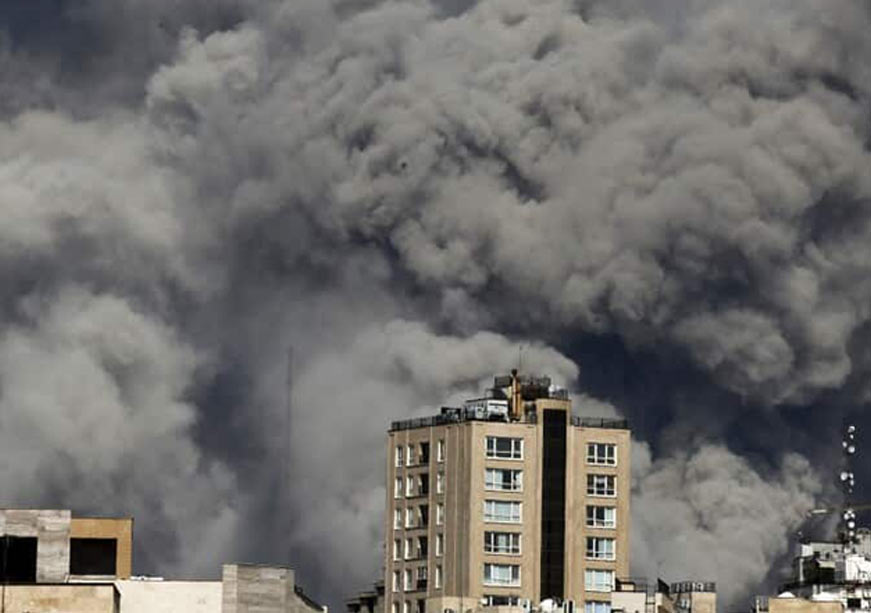
Expert Speak | 03 March, 2026
US-Israel Strikes on Iran: Experts React to the Fallout
Four days after the US-Israel strikes on Iran, the region is being drawn into a wider, prolonged conflict. The operation has already killed 49 of what the White House describes as Iran’s most “senior regime leaders” — a figure cited by press secretary Karoline Leavitt and President Trump. Iranian retaliation has expanded beyond US military bases to civilian infrastructure, with energy and oil installations now also coming under threat.
Aviation across the Gulf has ground to a halt, with major Middle East carriers suspending flights. The Strait of Hormuz presents another flashpoint: Iran’s Islamic Revolutionary Guard Corps has broadcast radio warnings prohibiting all vessel passage.
A further front has opened with Hezbollah launching attacks on Israel. At a press conference alongside General Dan Caine, Chairman of the Joint Chiefs of Staff, US Defense Secretary Pete Hegseth offered no exit strategy — a signal that the region should brace for more. The Observer Research Foundation (ORF) Middle East experts offer their concise analysis on the widening repercussions.
A Post-Khamenei Era for Iran
Since the 1979 revolution, Iran has seen only two transfers of supreme power. Ayatollah Ruhollah Khomeini took charge after the Shah’s fall, his support base ultimately consuming the student-led protest movement that initiated it. Following Khomeini’s death in 1989, Ali Hosseini Khamenei assumed leadership — holding it for 37 years until his assassination on 28 February 2026, killed in a US-Israel airstrike at the age of 86.
Khamenei had long framed the prospect of his own death as martyrdom and not as loss but as theological inevitability. The religious cohort around him shares these credentials and remains committed to the ideological positioning the state has maintained for decades. Internal coercion and external expansionism were twin pillars of his rule — and the resilience of the system in the wake of his death is, in part, testament to how deeply both were institutionalised.
Khamenei had long framed the prospect of his own death as martyrdom and not as loss but as theological inevitability.
External pressures will shape who that candidate can be. The US and Israel have struck targets across Iran but have conspicuously avoided Qom and Mashhad — the ideological heartlands of the revolution—calculating that alienating Iran’s Shia majority would be counterproductive. The attempt to drive a wedge between the Iranian people and the regime is deliberate, but the system’s entrenchment since 1979 is both deep and multifaceted.
If a successor is swiftly selected and consolidated in the coming days, the regime’s long-term stability could yet be reaffirmed — as it was in 1989.
Kabir Taneja, Executive Director, ORF Middle East.
Oil on the Boil: Hormuz, LNG, and the $100 Barrel Question
Global energy markets have reacted sharply to the US-Israel strikes on Iran. Oil prices jumped above US$80 a barrel — a rise of more than 10 percent — while the threat to the Strait of Hormuz has sent war risk insurance premiums soaring, with shipping companies rerouting via the Cape of Good Hope, adding freight costs and delivery delays.
Tehran’s warning that it would “burn any ship” attempting to transit the Strait of Hormuz — through which nearly 20 percent of the world’s oil exports pass — has rattled markets. Saudi Aramco confirmed it will temporarily shut its Ras Tanura refinery, which processes around 550,000 barrels per day, following a drone attack. A port facility in Oman and a vessel northwest of Muscat were also struck, compounding regional instability.
With nearly 70 percent of Hormuz crude destined for China, India, Japan, and South Korea, these economies will bear the brunt of any sustained disruption. Some analysts are already predicting Brent crude could reach US$100 a barrel — a price shock that would feed through to transport, manufacturing, and agricultural commodities globally.
QatarEnergy, one of the world’s largest LNG suppliers, has suspended production following attacks on its facilities in Ras Laffan and Mesaieed Industrial City. European gas prices have reportedly risen 45 percent in response — a severe blow to a continent still navigating its transition away from Russian energy, with 30 percent of Europe’s jet fuel originating from or passing through the Strait.
With nearly 70 percent of Hormuz crude destined for China, India, Japan, and South Korea, these economies will bear the brunt of any sustained disruption.
Saudi Aramco confirmed it will temporarily shut its Ras Tanura refinery, which processes around 550,000 barrels per day, following a drone attack. Gulf states are moving to mitigate disruption through Saudi Arabia’s East-West pipeline and expanded capacity at UAE’s Fujairah Port. Demand for Russian crude and gas may surge as markets scramble to fill supply gaps.
The timing invites scrutiny: coming on the heels of America’s seizure of Venezuelan energy assets, the strikes may position Trump to flood global markets with American and American-controlled oil and LNG.
Mannat Jaspal, Director and Fellow, Climate and Energy, ORF Middle East.
Choking the Arteries: Iran’s Assault on Gulf Infrastructure
The war in the Middle East has severely tested the containment-of-conflict rationale that long allowed Gulf states to flourish amid regional disruption. Iran’s assault on regional connectivity infrastructure is, at its core, an act of desperation.
Targeting the Gulf’s critical commercial infrastructure strikes at the heart of three nodes of global connectivity — aviation, maritime trade, and digital infrastructure — while directly undermining these states’ economic diversification agendas. Choking these arteries injects the conflict into international supply chains, with material consequences for global inflation.
The most immediate impact has been on aviation. The deliberate targeting of the Middle East 3 (ME3) carriers has stressed a sector already constrained by overflight restrictions from the Russia-Ukraine, Israel-Gaza, and Pakistan-Afghanistan conflicts. Detour options are scarce and prohibitively costly. The logistics of stranded aircraft and crew are creating global congestion bottlenecks that will outlast the physical impact of the strikes themselves. Prolonged disruption carries knock-on effects for ancillary sectors that lack the fiscal resilience of the Gulf carriers — costly risk assessments and elevated insurance premiums will persist long after immediate volatility subsides, becoming structurally embedded in the system.
The logistics of stranded aircraft and crew are creating global congestion bottlenecks that will outlast the physical impact of the strikes themselves.
That Gulf carriers are already working to restore a modicum of normalcy speaks to the embedded resilience of the ME3 ecosystem. Recovery, when it comes, can be expected to consolidate quickly.
It is in Tehran, where tactical capability and strategic foresight do not appear to coincide. By unilaterally targeting the fundamental value proposition of Gulf states as safe havens for global capital, commerce, and connectivity, Iran has bargained for an unquiet peace in a neighbourhood where memories are long — and where the goodwill it once enjoyed may prove far harder to rebuild than the infrastructure it has targeted.
Cauvery Ganapathy, Fellow, ORF Middle East.
The Algorithm Went to War: What the Iran Strikes Reveal About AI and Accountability
The US military used Anthropic’s Claude to support strikes on Iran hours after President Trump ordered every federal agency to stop using the company’s technology. Claude had been the only frontier AI model on the Pentagon’s classified networks, integrated through Palantir since 2024 under a US$,200 million contract for intelligence analysis, target identification, and operational simulations. It could not be extracted even after its maker was declared a national security threat.
This episode raises three questions demanding urgent attention from any government integrating US-built AI into defense and intelligence systems. First, if the guardrails of a frontier model can be overridden by the ideological leanings of developer nations, what does AI sovereignty mean for importing nations? Second, as the Iran strikes demonstrated, once AI is embedded in operational military systems it becomes inseparable from the mission — who truly controls it? Third, if companies building these systems cannot agree on what constitutes safe use, on what basis should any government or public trust them?
AI safety guarantees are only as durable as the laws underpinning them, and the governments’ and developers’ willingness to honour them.
The rupture between Anthropic and the Pentagon centred on two restrictions CEO Dario Amodei refused to drop: no mass domestic surveillance, and no fully autonomous weapons without human oversight. When Anthropic held firm, Secretary of War Pete Hegseth designated it a “supply chain risk,” a classification never before applied to an American company.
Within hours, OpenAI signed a classified network deal with the Pentagon, announcing it included the same two red lines, plus a third. The Pentagon accepted from OpenAI what it punished Anthropic for requesting. Yet the deals differ critically: Anthropic sought explicit contractual prohibitions, while OpenAI relied on references to existing laws that critics argue are insufficient to prevent the very abuses both companies claim to oppose.
In the fog of war, the distinction may matter less than the precedent: AI safety guarantees are only as durable as the laws underpinning them, and the governments’ and developers’ willingness to honour them.
Siddharth Yadav, Fellow, ORF Middle East.