 Global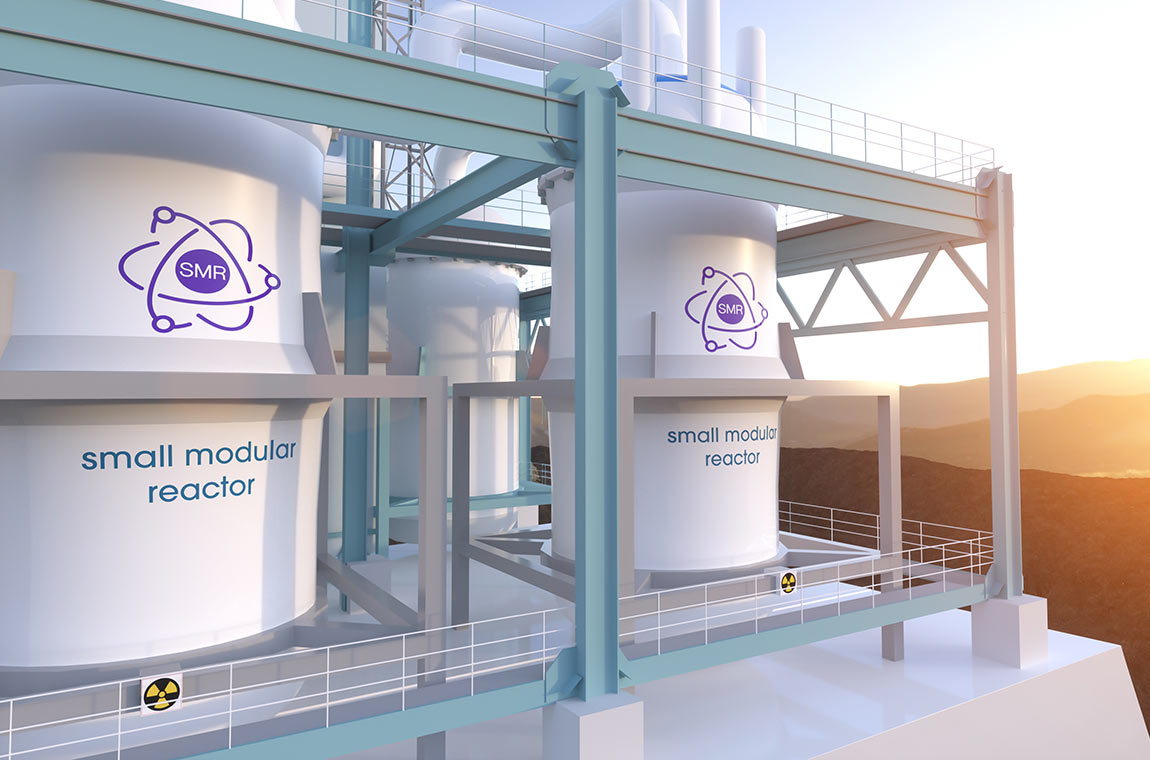
Policy Briefs | 24 April, 2026 Download Report (PDF)
Big Aspirations for Small Modular Reactors: Understanding India’s Strategy on SMRs
In India’s Union Budget 2025, a Nuclear Energy Mission was launched with an allocation of INR 20,000 crore for research and development (R&D) in small modular reactors (SMRs) that would be capable of resolving many of India’s energy dilemmas and contributing to its energy transition. However, general comprehension of India’s strategy regarding the development and deployment of SMRs is limited. This brief identifies India’s needs for SMRs, analyses the challenges associated with their deployment in the country, and explores prospects for international collaboration.
Attribution: Leyla Turayanova, “Big Aspirations for Small Modular Reactors: Understanding India’s Strategy on SMRs,” ORF Issue Brief No. 870, Observer Research Foundation, April 2026.
SMRs: An Overview
In the global nuclear energy sector, small modular reactors (SMRs) are seen as one of the most promising technologies, for many reasons. They have a power capacity of up to 300 megawatts electrical (MWe) per unit, approximately one-third of the generating capacity of conventional reactors.[1] Owing to their modular design, they can be assembled in factories and then transported to installation sites, ensuring reduced construction times and costs. In the long term, this modularity will allow for economies of serial production and scaled deployment as energy demand increases.[2]
SMRs occupy less space, resulting in a smaller exclusion zone of approximately 0.5 kilometres around each, compared to the 1–1.5-kilometre zones required for traditional nuclear power plants.[3] This increases flexibility in site selection and reduces land procurement issues and associated social costs.
SMRs can be used to supply power to remote locations, as well as to areas with small-scale grids that are unable to accommodate excess capacity. They provide a reliable and continuous supply of power, unlike renewable energy sources, such as wind or solar. Therefore, they can be integrated with renewable energy to provide a base-load capacity for industrial decarbonisation. While traditional reactors require refuelling every one to two years, SMRs are refuelled after three to seven years.[4]
SMRs possess inherent passive safety systems that do not require human intervention or external power to shut them down in the event of an accident.[1] This feature is particularly important for countries with limited experience in handling nuclear energy.[5]
According to the International Energy Agency’s (IEA) projections, SMRs may begin to play a significant role in decarbonisation from the mid-2030s, provided that regulatory and investment decisions concerning their deployment are made within this decade.[6] Some estimates suggest that the global market size for SMRs will reach US$300 billion by 2040.[7] An International Atomic Energy Agency (IAEA) report states that there are at least 68 active SMR designs at various stages of development worldwide.[8] However, only two SMR nuclear power plants (NPPs) are currently operational: the world’s first floating power unit[2] in Russia, Akademik Lomonosov, which has two KLT-40S reactors[3] of 35 MWe each; and the first land-based High-Temperature gas-cooled Reactor Pebble-bed Module (HTR-PM) demonstration plant[4] in China, comprising two reactors with a combined installed capacity of 210 MWe. Several SMRs are in advanced stages of construction in Argentina, China, Russia, and the United States (US).[9]
India’s SMR Push
The Nuclear Power Corporation of India Ltd (NPCIL), a public sector undertaking under the Department of Atomic Energy (DAE), operates 24 reactors across seven nuclear power plants, with eight more reactors under construction.[10] Currently, India’s nuclear power capacity stands at 8.78 gigawatts (GW), representing only 1.74 percent of the country’s total installed generation capacity.[11] Nuclear energy accounts for 3.1 percent of its overall electricity generation.[12]
By 2040, India is projected to drive nearly 25 percent of the growth in global energy demand.[13] New Delhi hopes that accelerated increase in nuclear capacity will help meet this demand as well as achieve net-zero carbon emissions by 2070.
Despite the slow expansion of nuclear power in previous decades, the Indian government has set an ambitious target of 100 GW of nuclear power capacity by 2047. By 2031–32, the capacity is expected to increase to 22.38 GW.[14] SMRs have an important role in these plans. During the Budget 2025 announcement, a Nuclear Energy Mission was launched with an outlay of INR 20,000 crore for research and development of SMRs.[15]
This push for SMRs is driven by several imperatives. Rapid growth in renewable energy, coupled with a lack of adequate storage facilities, has led to increasing instability in the country’s power grid.[16] SMEs are intended to provide base-load capacity in the hybrid energy systems.
SMRs can also be a viable solution for repurposing retired coal-based power plants while taking advantage of the existing infrastructure, such as transmission networks, rail connectivity, and water availability. Thus, they will avoid the need for scouting new areas and displacing people from their homes. The Indian government has identified ten decommissioned thermal power plants as potential sites for conversion into nuclear power units.[17]
Another potential application for SMRs as a captive generation source would be in data centres, which are among the most energy-intensive facilities. In 2024, data centres accounted for approximately 1.5 percent of global electricity consumption.[18] India’s data-centre capacity is expected to increase fivefold by 2030, from the current 1.7 GW to 8 GW.[19] As External Affairs Minister S. Jaishankar put it, “If data is the new oil, then data centres are the new refineries that will need to be powered.”[20]
Challenges and Prospects
In its quest for SMRs, India faces a number of hurdles. The first challenge is technological. The country’s indigenous small reactors are based on Pressurised Heavy Water Reactor (PHWR) technology. However, as they are not modular, it leads to scalability issues. Currently, 15 PHWRs with capacities ranging from 200 to 220 MWe are operational in India.[21] The government plans to deploy additional PHWRs of 220 MW, known as Bharat Small Reactors (BSR). They are being upgraded to reduce their carbon footprint and make them suitable for industrial decarbonisation.[22]
Under the Nuclear Energy Mission, the Bhabha Atomic Research Centre (BARC) is developing three new types of SMRs: the 200 MWe Bharat Small Modular Reactor (BSMR-200), the 55 MWe Small Modular Reactor (SMR-55), and a high-temperature gas-cooled reactor of up to 5 megawatts thermal (MWth) intended for hydrogen production.[23] At least five indigenously developed SMRs are expected to be operational by 2033.[24]
Both the BSMR-200 and SMR-55 will be based on pressurised light water reactor technology.[5] The BSMR-200 is meant for captive power generation in energy-intensive industries (steel, aluminium, cement), to repurpose decommissioned fossil fuel-based power plants, and for off-grid applications in remote areas.[25] It is at an advanced stage of obtaining financial and administrative sanction.[26] A demonstration unit will be commissioned six years after project approval.[27] According to media reports, no foreign collaboration is being considered at this point.[28] The Road Map for Achieving the Goal of 100 GW of Nuclear Capacity by 2047, published by the Central Electricity Authority, estimates that the installed capacity of BSMRs will reach 5 GW by 2047.[29]
The SMR-55 will provide energy to remote off-grid locations.[30] The lead twin units of these reactors are expected to be operational at a DAE site by 2033.[31]
The high-temperature gas-cooled reactor being developed for hydrogen generation aims to decarbonise the transport sector and process industries. Lead units of this reactor will be deployed at DAE sites, while subsequent units will be set up at end-user industries or decommissioned thermal power plants.[32]
The second challenge is the constraint of public funding. Nuclear energy projects are extremely capital-intensive. However, since its inception, India’s nuclear energy sector has been state-owned and controlled, which has led to the slow expansion.
The global nuclear energy economy landscape is diverse. Among the top five nuclear energy producers, the US is dominated by private companies, whereas in China, France, Russia, and South Korea, atomic energy is state-owned and controlled. According to IEA estimates, private financing will be critical for the future of nuclear energy in many parts of the world.[33]
The incremental investment required to achieve a capacity of 100 GW in India by 2047 is estimated to be approximately INR 19 lakh crore. The prevailing view is that reaching this target is hardly possible without private financing from both domestic and foreign investors.[34] On 18 December 2025, in a major development, the Indian Parliament passed the Sustainable Harnessing and Advancement of Nuclear Energy for Transforming India (SHANTI) Bill, 2025. This repeals the Atomic Energy Act, 1962, and the Civil Liability for Nuclear Damage Act, 2010, providing a unified legal framework for the nuclear energy sector.[35]
The Atomic Energy Act, 1962, restricted nuclear power generation and related activities to the central government or government companies.[36] The NPCIL was the sole entity operating nuclear power plants. The SHANTI Act will permit any government or private company, as well as joint ventures, to obtain licences for building, owning, operating, or decommissioning nuclear power plants or reactors; for nuclear fuel fabrication; for transportation or storage of nuclear fuel; for the import, export, or acquisition of nuclear fuel, prescribed substances, or equipment; and for the import or export of any technology or software that may be used for the development, production, or use of prescribed substances or equipment. However, it restricts eligibility to entities incorporated in India. Sensitive activities, such as enrichment or isotopic separation of prescribed or radioactive substances, management of spent fuel, production and upgradation of heavy water, and mining in onshore or offshore areas containing uranium and thorium, are reserved exclusively for the central government or its wholly owned institutions.[37]
The SHANTI Act also revises the nuclear liability regime, addressing the primary concern associated with India’s Civil Liability for Nuclear Damage Act (CLNDA). The CLNDA granted Indian nuclear operators a right of recourse whenever “the nuclear incident has resulted as a consequence of an act of supplier or his employee, which includes supply of equipment or material with patent or latent defects or sub-standard services.”[38] This provision was inconsistent with the existing international nuclear liability regime, which is based on the principle of exclusive liability of the operator of the nuclear installation.[39] Consequently, both foreign and domestic suppliers of nuclear equipment refrained from investing in nuclear projects in India. Under the SHANTI Act, the operator’s right of recourse applies only if it is explicitly included in the contract between the parties or in cases of deliberate acts causing nuclear damage. However, the rules and regulations for implementation of the Act are yet to be finalised.[40]
India’s decision to open up its nuclear energy sector mirrors the government’s previous move to liberalise the space industry, which, like atomic energy, used to be under the exclusive control of the state. As a result, the number of space start-ups increased from one in 2022 to nearly 200 in 2024.[41]
It is likely that the next step following the adoption of the SHANTI Act will be the introduction of a revised Foreign Direct Investment (FDI) policy for the nuclear energy sector. According to India’s consolidated FDI policy, the nuclear energy industry is listed among the prohibited sectors. However, there are no restrictions on FDI in the manufacturing of equipment and other supplies for nuclear power plants.[42] According to media reports, the government is considering allowing FDI of up to 49 percent in the nuclear sector. An initial cap may be set at 26 percent and later relaxed. Majority ownership in any joint venture would remain with an Indian entity.[43]
In addition to legal reforms, financial incentives aimed at engaging the private sector, such as the inclusion of nuclear energy in green taxonomy, are in the pipeline.[44] Nuclear energy has already been recognised as green in the European Union, China, Russia,[45] and South Korea.[46] The Government of India is currently developing a climate finance taxonomy, under which, in line with recommendations from the NITI Aayog,[47] investors in SMR projects may be granted access to green bonds, concessional financing, and climate-linked incentives. The draft framework was released in May 2025.[48]
Many public and private companies have already expressed interest in SMR projects. The Indian Railways has identified sites to set up small nuclear power plants to meet its energy requirements.[49] The Adani Group is in talks for the construction of eight BSMR-200 units in Uttar Pradesh. Other Indian conglomerates, such as the Tata Group, Reliance Industries Ltd, and the JSW Group, are also considering expanding into the nuclear sector.[50]
The IEA estimates that shorter construction and payback periods make SMRs more attractive to private investors.[51] However, the design approaches and norms currently applied to SMRs are the same as those used for large nuclear power plants. As a result, initial SMR projects have inherited the problems of conventional reactors, such as high costs, complexity, and lengthy construction times. SMR technologies can realise their full potential through a ‘paradigm shift’ in these areas.
Another potential obstacle is societal acceptance of nuclear energy projects. Public perceptions of nuclear energy remain mixed due to safety and displacement concerns. Historically, the construction of nuclear power plants has faced strong resistance politically and from local communities. Therefore, large-scale deployment of SMRs in India would require well-designed awareness campaigns focusing on safety, development, and job opportunities. Outreach strategies could emphasise their advantages over conventional nuclear power plants, such as more efficient land use, enhanced security features, and no need for local displacement.[52]
Another challenge lies in ensuring a sustainable fuel supply chain. Many SMR designs require high-assay low-enriched uranium (HALEU), enriched between 5 percent and 20 percent U-235. Currently, only Russia manufactures HALEU on a commercial scale. [53]
Other difficulties in the large-scale deployment of SMRs, and therefore in achieving the target of 100 GW of nuclear capacity by 2047, include accelerating land acquisition (which typically takes more than four years) and obtaining other necessary clearances; increasing uranium supplies as well as processing and fabrication capabilities; managing spent fuel due to the increased demand for nuclear fuel; recruiting and training a qualified workforce; and ensuring effective security management.[54]
Scope for Foreign Collaborations
To accelerate the SMR development in the country using advanced imported technology, foreign collaborations would be necessary. According to media reports, the state-run power generator National Thermal Power Corporation Ltd (NTPC) is in discussions with Électricité de France (EDF) of France, Rosatom State Corporation of Russia, and Westinghouse Electric Corp. of the US to build SMRs in India.[55] Negotiations are also underway with Korea Hydro & Nuclear Power, as well as the US firms GE Vernova Inc. and Holtec International Corp.[56] But no binding agreements have been signed so far.
Moscow appears to be a natural choice for collaboration, given the two countries’ positive history of cooperation in nuclear energy. To date, Russia remains India’s sole on-ground partner in this field and is currently constructing the country’s largest nuclear power plant at Kudankulam, Tamil Nadu.
Apart from the Akademik Lomonosov, Rosatom State Corporation is constructing the world’s first onshore small nuclear power plant (SNPP) based on the RITM-200N reactor in Yakutia, Russia.[57] Since 2012, 10 RITM-200 reactors have been manufactured for five Russian Project 22220 multi-purpose nuclear icebreakers. The demonstration lead-cooled fast reactor BREST-OD-300, which falls under the energy output criteria for SMRs, is also under construction.[58] Several other SMR designs are at various stages of development.
Currently, for export markets, Rosatom State Corporation offers floating power units based on the KLT-40S and RITM-200M reactors, designed for coastal areas, islands, or archipelagos, and an onshore small nuclear power plant (SNPP) for continental data centres or industrial clusters.[59] The state corporation has signed agreements to build SMRs with Uzbekistan and Myanmar.[60]
Russia has offered to cooperate with India in building SNPPs, with the possibility of their deep localisation, including transfer of the construction work to New Delhi.[61] Rosatom State Corporation and India’s Ministry of Ports, Shipping and Waterways have established a working group to explore the potential for floating nuclear power plants in India.[62] Moscow’s proposal on SMRs was discussed during the Russia–India summit in New Delhi on 4–5 December 2025.[63]
Parallel negotiations are taking place with other entities too. Rosatom and the Maharashtra State Power Generation Company (MAHAGENCO) have discussed the development of an SVBR-100 SMR that would be capable of utilising thorium-based fuel in Maharashtra.[64] Rail Vikas Nigam Ltd (RVNL), a public sector unit of the Ministry of Railways, is in talks with Rosatom to build SMRs to meet its energy requirements as well.[65]
Other prospective partners for India include the US and France. Although Washington’s and Paris’s nuclear power plant projects in India did not reach the implementation stage in the past, due to suppliers’ concerns about exposure to unlimited liability, the adoption of the SHANTI Act could potentially open the way.
In the US, several SMR designs are currently under development. Kairos Power is constructing a Hermes low-power demonstration reactor, based on fluoride salt-cooled, high-temperature reactor (KP-FHR) technology, in Tennessee.[66] NuScale’s VOYGR SMR design has been certified by the US Nuclear Regulatory Commission.[67] Other mature designs include the BWRX-300 by GE Hitachi Nuclear Energy (GEH), the AP300 SMR by Westinghouse, and the SMR-300 by Holtec International.
Last year, the US took several steps to facilitate collaboration with India. In January 2025, three Indian nuclear entities—the Indira Gandhi Centre for Atomic Research, the Bhabha Atomic Research Centre, and Indian Rare Earths—were removed from the US export control list, which restricts the export of certain goods from US companies.[68] During Indian Prime Minister Narendra Modi’s visit to the US in February 2025, the two sides agreed to pursue private sector collaboration, particularly in advanced SMRs, involving large-scale localisation and technology transfer.[69]
In March 2025, in a breakthrough, the US Department of Energy granted authorisation to the American company Holtec International to sell the SMR-300 for deployment in India. Larsen & Toubro, Tata Consulting Engineers, and the company’s subsidiary, Holtec Asia, were named as eligible entities with whom it could share the necessary technical information.[70] Previously, under the India–US civil nuclear deal, American entities were permitted to export nuclear reactors and equipment to India, but were prohibited from engaging in design or manufacturing within the country.[71]
When it comes to France, the French Alternative Energies and Atomic Energy Commission (CEA), the EDF, Naval Group, and TechnicAtome are jointly developing the NUWARD SMR, based on pressurised water reactor technology, which will be capable of delivering 400 MWe of power. The conceptual design is scheduled to be finalised by mid-2026, while commercialisation of the project is planned for the 2030s.[72]
In November 2023, France’s EDF signed a Memorandum of Cooperation with Bharat Heavy Electricals Limited (BHEL), under which both parties will also explore collaboration on a NUWARD SMR.[73] During PM Modi’s visit to France in February 2025, the two sides adopted a Declaration of Intent on collaboration in co-designing, co-developing, and co-producing SMRs and advanced modular reactors.[74]
Collaboration on SMRs has also been identified as a promising area in bilateral visionary documents between India and a number of countries. In the India–Japan Joint Vision for the Next Decade, a ten-year strategic prioritisation for economic and functional cooperation adopted in August 2025 during Prime Minister Modi’s visit to Japan, joint research on SMRs and advanced reactors is highlighted as a promising avenue to advance next-generation technology and innovation partnership.[75] Under the “India–UK Vision 2035”, endorsed by the prime ministers of India and the United Kingdom (UK) during their meeting in July 2025, both called for engagement on next-generation nuclear technologies, such as SMRs, within the framework of the India–UK Nuclear Cooperation Agreement.[76] India has also agreed to explore collaboration on SMRs with Singapore,[77] the United Arab Emirates (UAE),[78] and Canada.[79]
Rosatom is likely to become New Delhi’s first foreign partner in SMR deployment, considering that only Russia’s small-capacity nuclear power plant has reached the stage of commercial operation. In India’s Road Map for Achieving the Goal of 100 GW of Nuclear Capacity by 2047, only Russian SMRs (marine or land-based) are mentioned as potentially available for import.[80]
At the same time, in the long run, India will seek to diversify its SMR collaborations, as adoption of multiple technologies will allow it to hedge against geopolitical uncertainties. For instance, the US has imposed sanctions on nearly 70 Rosatom’s subsidiaries and related individuals,[81] including JSC Rusatom Overseas, which is responsible for SMR development as the sectoral integrator.[82] So far, these restrictions have not significantly affected Rosatom’s projects abroad, but the risk cannot be ruled out.
India could also explore collaboration on the deployment of SMRs in countries of the Global South. It already has positive experiences of cooperating with Russia in third countries, such as the Rooppur NPP in Bangladesh, where Indian companies participate in construction and installation work, and supply of non-critical materials and equipment.[83] India has also discussed collaboration with the US on developing next-generation SMR technologies for export.[84]
Conclusion
India has set an ambitious goal to achieve 100 GW of nuclear power capacity by 2047. Given the country’s growing energy demand, flexible and scalable SMRs can help it meet its net-zero target by complementing conventional nuclear reactors and renewable energy sources. By integrating SMRs into its energy mix, India can address land constraints, repurpose retiring coal-fired thermal power plants, supply energy to data centres, and contribute to industrial decarbonisation.
The large-scale deployment of SMRs in India requires legal reforms and huge investment. A significant step was taken with the adoption of the SHANTI Act, which removed suppliers’ liability and established a legal framework for private participation in nuclear energy. Further reforms in FDI policy and green taxonomy are also anticipated.
However, there are several challenges. These include high capital intensity, negative public perceptions, lengthy construction timelines for nuclear projects, the need to establish a conducive regulatory framework, and geopolitical risks. The future development of small-scale nuclear power in India will depend on the ability to attract private investment into the sector, address public concerns, introduce indigenous technology, and secure favourable agreements with foreign vendors.
When it comes to international cooperation in nuclear energy, India regards the diversification of foreign partnerships as key to ensuring energy security and mitigating geopolitical risks. Among its potential partners in SMR development, Russia is India’s first choice, given Moscow’s leadership in SMR technologies and the history of mutually beneficial cooperation in nuclear energy, though it is also in discussions with several other countries for potential collaboration.
Leyla Turayanova is Visiting Fellow at the Observer Research Foundation and Research Fellow at the Centre for the Indo-Pacific Region of the Primakov National Research Institute of World Economy and International Relations of the Russian Academy of Sciences.
All views expressed in this publication are solely those of the author, and do not represent the Observer Research Foundation, either in its entirety or its officials and personnel.
Endnotes
[1] Passive or inherent safety features rely on physical phenomena such as gravity, pressure differences, or natural heat convection, and do not require an active power source to accomplish safety functions.
[2] A floating power unit, or floating nuclear power plant, is a non-self-propelled vessel that hosts one or more nuclear reactors.
[3] A modular reactor unit belonging to a class of pressurised water reactors; an advanced version of the KLT-40 reactor used in nuclear-powered icebreakers.
[4] The HTR-PM is a Generation IV SMR design consisting of two pebble-bed modules (each of 250 megawatts thermal) that drive a single 210 MWe steam turbine.
[5] A pressurised water reactor (PWR) is a light water-cooled and moderated nuclear reactor, the most widely used worldwide.
[1] International Atomic Energy Agency, “What Are Small Modular Reactors (SMRs)?” September 13, 2023, https://www.iaea.org/newscenter/news/what-are-small-modular-reactors-smrs.
[2] International Atomic Energy Agency, Small Modular Reactors: Advances in SMR Developments 2024 (Vienna: IAEA, 2024), https://www.iaea.org/publications/15790/small-modular-reactors-advances-in-smr-developments-2024.
[3] Niranjan Chandrashekhar Oak and Bhawna Budhwar, “Small Modular Reactors and India: Institutional Drivers and Challenges,” (New Delhi: Institute for Defence Studies and Analyses, September 19, 2025), https://www.idsa.in/publisher/issuebrief/small-modular-reactors-and-india-institutional-drivers-and-challenges.
[4] Oak and Budhwar, “Small Modular Reactors and India: Institutional Drivers and Challenges.”
[5] Zareen Tahsin Anjum and Md Shafiqul Islam, “Deploying Small Modular Reactors in Newcomer Countries: Adapting the IAEA Milestones approach and the Way Forward,” Energy Strategy Reviews 61 (2025), https://www.sciencedirect.com/science/article/pii/S2211467X25002044.
[6] International Energy Agency, Nuclear Power and Secure Energy Transitions (Paris: IEA, June 30, 2022), https://www.iea.org/reports/nuclear-power-and-secure-energy-transitions.
[7] NITI Aayog, The Role of Small Modular Reactors in the Energy Transition (New Delhi: NITI Aayog, May 2023), https://www.niti.gov.in/sites/default/files/2023-05/The-Role-of-Small-Modular-Reactors-in-the-Energy-Transition-05162023.pdf.
[8] International Atomic Energy Agency, Small Modular Reactors.
[9] International Atomic Energy Agency, Small Modular Reactors.
[10] Department of Atomic Energy, Government of India, https://www.pib.gov.in/PressReleasePage.aspx?PRID=2147275®=3&lang=2.
[11] Ministry of Power, Government of India, https://www.pib.gov.in/PressReleasePage.aspx?PRID=2197199®=3&lang=1.
[12] Department of Atomic Energy, Government of India, https://www.pib.gov.in/PressReleasePage.aspx?PRID=2153551®=3&lang=2.
[13] International Energy Agency, India Energy Outlook 2021 (Paris: IEA, February 9, 2021), https://www.iea.org/reports/india-energy-outlook-2021.
[14] Department of Atomic Energy, Government of India, https://www.pib.gov.in/PressReleasePage.aspx?PRID=2201524®=3&lang=1.
[15] Department of Atomic Energy, Government of India, https://www.pib.gov.in/PressReleasePage.aspx?PRID=2099244®=3&lang=2.
[16] Akul Raizada, “Unlocking India’s Energy Transition: Addressing Grid Flexibility Challenges and Solutions,” (Paris: French Institute of International Relations [IFRI], February 20, 2025), https://www.ifri.org/en/memos/unlocking-indias-energy-transition-addressing-grid-flexibility-challenges-and-solutions.
[17] Shilpa Samant, “10 Old Thermal Plants to Be Converted into Nuclear Power Units by 2047,” Economic Times, July 15, 2025, https://economictimes.indiatimes.com/industry/energy/power/10-old-thermal-plants-to-be-converted-into-nuclear-power-units-by-2047/articleshow/122458299.cms?utm_source=contentofinterest&utm_medium=text&utm_campaign=cppst.
[18] International Energy Agency, Energy and AI (Paris: IEA, 2025), https://www.iea.org/reports/energy-and-ai.
[19] “Data Centre Boom: India’s Capacity to Hit 8 GW by 2030; $30 Billion Investment Seen Driving AI, Cloud Growth,” Times of India, November 8, 2025, https://timesofindia.indiatimes.com/business/india-business/data-centre-boom-indias-capacity-to-hit-8gw-by-2030-30-billion-investment-seen-driving-ai-cloud-growth/articleshow/125183133.cms.
[20] Ministry of External Affairs, Government of India, “EAM’s Remarks at Business Today Vucanomics 2025,” March 22, 2025, https://www.mea.gov.in/Speeches-Statements.htm?dtl/39253.
[21] Nuclear Power Corporation of India Limited (NPCIL), “Plants under Operation,” https://www.npcil.nic.in/content/302_1_AllPlants.aspx.
[22] Department of Atomic Energy, Government of India, https://www.pib.gov.in/PressReleasePage.aspx?PRID=2099244®=3&lang=2.
[23] Department of Atomic Energy, Government of India, https://www.pib.gov.in/PressReleasePage.aspx?PRID=2205124®=1&lang=1#:~:text=across%20the%20country.-,Additionally%2C%20a%20high%20temperature%20gas%20cooled%20reactor%20with%20capacity%20up,towards%20Net%20Zero%20by%202070.
[24] Department of Atomic Energy, Government of India, https://www.pib.gov.in/PressReleasePage.aspx?PRID=2099244®=3&lang=2.
[25] Department of Atomic Energy, Government of India, https://www.pib.gov.in/PressReleasePage.aspx?PRID=2158389®=3&lang=2.
[26] Department of Atomic Energy, Government of India, https://www.pib.gov.in/PressReleasePage.aspx?PRID=2198340®=3&lang=1.
[27] Department of Atomic Energy, Government of India, https://www.pib.gov.in/PressReleasePage.aspx?PRID=2118377®=3&lang=2.
[28] Aanchal Magazine and Anil Sasi, “Two Key Amendments to Open Up N-power Sector Likely in Winter Session, Nuclear Collaborations Driven More by the Need for Capital than Technology: Official,” Indian Express, November 3, 2025, https://indianexpress.com/article/business/two-key-amendments-to-open-up-n-power-sector-likely-in-winter-session-nuclear-collaborations-driven-more-by-the-need-for-capital-than-technology-official-10342157/.
[29] Central Electricity Authority, Road Map for Achieving the Goal of 100 GW of Nuclear Capacity by 2047, (New Delhi: June 2025), https://cea.nic.in/wp-content/uploads/notification/2025/10/Roadmap_Final_30062025.pdf.
[30] Department of Atomic Energy, Government of India, https://www.pib.gov.in/PressReleasePage.aspx?PRID=2158389®=3&lang=2.
[31] “Bharat Small Modular Reactors,” Digital Sansad, March 12, 2025, https://sansad.in/getFile/loksabhaquestions/annex/184/AU2264_DSSTVN.pdf?source=pqals.
[32] Department of Atomic Energy, Government of India, https://www.pib.gov.in/PressReleasePage.aspx?PRID=2158389®=3&lang=2.
[33] International Energy Agency, The Path to a New Era for Nuclear Energy, (Paris: IEA, January 16, 2025), https://www.iea.org/reports/the-path-to-a-new-era-for-nuclear-energy.
[34] Central Electricity Authority, Road Map for Achieving the Goal of 100 GW of Nuclear Capacity by 2047.
[35] “The Sustainable Harnessing and Advancement of Nuclear Energy for Transforming India Bill, 2025,” Digital Sansad, https://sansad.in/getFile/BillsTexts/LSBillTexts/PassedLoksabha/196 ev12182025113907AM.pdf?source=legislation.
[36] “The Atomic Energy Act, 1962,” Atomic Energy Regulatory Board, https://www.aerb.gov.in/images/PDF/Atomic-Energy-Act-1962.pdf.
[37] “The Sustainable Harnessing and Advancement of Nuclear Energy for Transforming India Bill, 2025.”
[38] India Code, “The Civil Liability for Nuclear Damage Act, 2010,” https://www.indiacode.nic.in/bitstream/123456789/2084/5/A2010-38.pdf.
[39] “The Vienna Convention on Civil Liability for Nuclear Damage, 1963,” International Atomic Energy Agency, https://www.iaea.org/topics/nuclear-liability-conventions/vienna-convention-on-civil-liability-for-nuclear-damage.
[40] Department of Atomic Energy, Government of India, https://www.pib.gov.in/PressReleasePage.aspx?PRID=2227086®=3&lang=2#:~:text=The%20SHANTI%20Act%20also%20provides,in%20the%20Rajya%20Sabha%20today.
[41] Department of Space, Government of India, https://www.pib.gov.in/PressReleasePage.aspx?PRID=2027137®=3&lang=2.
[42] Department of Atomic Energy, Government of India, https://www.pib.gov.in/PressReleasePage.aspx?PRID=1655136®=3&lang=2.
[43] Deepshikha Sikarwar and Shilpa Samant, “India May Allow Up to 49% Foreign Direct Investment in Nuclear Energy in Phases,” Economic Times, May 21, 2025, https://economictimes.indiatimes.com/industry/energy/power/india-may-allow-up-to-49-foreign-direct-investment-in-nuclear-energy-in-phases/articleshow/121299405.cms?utm_source=contentofinterest&utm_medium=text&utm_campaign=cppst.
[44] Ministry of Finance, Government of India, https://www.pib.gov.in/PressReleaseIframePage.aspx?PRID=2127562®=3&lang=2.
[45] “The EU Taxonomy Requirement for Nuclear Energy,” Rosatom, October 2022, https://rosatom.ru/upload/iblock/085/0859716deba77a61ebec61a4430b1a44.pdf.
[46] “Nuclear Power Included in Revised Green Taxonomy,” Korea Times, September 21, 2022, https://www.koreatimes.co.kr/southkorea/environment-animals/20220921/nuclear-power-included-in-revised-green-taxonomy.
[47] NITI Aayog, “The Role of Small Modular Reactors in the Energy Transition.”
[48] Ministry of Finance, Government of India, https://www.pib.gov.in/PressReleaseIframePage.aspx?PRID=2127562®=3&lang=2.
[49] Twesh Mishra, “Indian Railways Eyes Small Nuclear Plants to Meet 10 GW Energy Demand by 2030,” Economic Times, March 19, 2025, https://energy.economictimes.indiatimes.com/news/power/indian-railways-eyes-small-nuclear-plants-to-meet-10-gw-energy-demand-by-2030/119196155.
[50] “Adani Group in Talks for Nuclear Sector Entry through SMR Project in UP,” New Indian Express, December 20, 2025, https://www.newindianexpress.com/business/2025/Dec/19/adani-group-in-talks-for-nuclear-sector-entry-through-smr-project-in-up.
[51] International Energy Agency, The Path to a New Era for Nuclear Energy.
[52] Hely Desai, “Small Modular Reactors: India’s Quandary to Liberalize the Nuclear Energy Arena,” Stimson Centre, November 8, 2023, https://southasianvoices.org/smrs-and-perceptions-india/.
[53] International Atomic Energy Agency, Small Modular Reactors.
[54] Central Electricity Authority, Road Map for Achieving the Goal of 100 GW of Nuclear Capacity by 2047.
[55] Rituraj Baruah, “NTPC in Talks with EDF, Rosatom, Westinghouse to Develop Small Modular Reactors in India,” Mint, December 4, 2024, https://www.livemint.com/companies/ntpc-edf-rosatom-westinghouse-modular-reactors-nuclear-power-energy-sector-smr-technology-kudankulam-11733223396382.html.
[56] Rajesh Kumar Singh and Stephen Stapczynski, “Indian Power Giant Discusses Nuclear Buildout with Foreign Firms,” Bloomberg, February 11, 2025, https://www.bloomberg.com/news/articles/2025-02-11/indian-power-giant-discusses-nuclear-buildout-with-foreign-firms.
[57] Rosatom, “Rosenergoatom Became the Operating Organization of a Small NPP in Yakutia,” February 5, 2024, https://rosatom.ru/en/press-centre/news/rosenergoatom-became-the-operating-organization-of-a-small-npp-in-yakutia/.
[58] “First SMRs for Export,” Rosatom, June 2024, https://rosatomnewsletter.com/2024/06/28/first-smrs-for-export/.
[59] Alexander Volgin and Maria Bazlutskaya, “Could Small Modular Reactors Soon Power Data Centers?” Russian International Affairs Council, August 25, 2025, https://russiancouncil.ru/en/analytics-and-comments/interview/could-small-modular-reactors-soon-power-data-centers/.
[60] “Myanmar and Russia Sign SMR Cooperation Agreement,” World Nuclear News, March 5, 2025, https://www.world-nuclear-news.org/articles/myanmar-and-russia-sign-smr-cooperation-agreement.
[61] “Russia Offers Cooperation in Building Small Tropical NPPs to India Coinciding with PM Modi’s Visit,” PTI, July 9, 2024, https://www.ptinews.com/story/national/russia-offers-cooperation-in-building-small-tropical-npps-to-india-coinciding-with-pm-modi-s-visit/1644806.
[62] “Russia, India to Expand Cooperation along Northern Sea Route – Likhachev,” TASS, December 5, 2025, https://tass.com/economy/2054521.
[63] “Russia Ready to Help India with Small Nuclear Power Plants – Kremlin,” TASS, December 2, 2025, https://tass.com/politics/2052285.
[64] “Maharashtra Signs MoU with Russia’s ROSATOM to Develop Thorium-based Small Modular Reactor,” PTI, April 15, 2025, https://www.ptinews.com/story/national/maharashtra-signs-mou-with-russia-s-rosatom-to-develop-thorium-based-small-modular-reactor/2455907.
[65] Dheeraj Mishra, “RVNL in Talks with Russia’s Rosatom to Build Nuclear Reactors for Its 4 Big Railway Projects,” Indian Express, June 15, 2025. https://indianexpress.com/article/business/rvnl-russia-rosatom-nuclear-reactors-railway-projects-10065499/.
[66] International Atomic Energy Agency, Small Modular Reactors.
[67] “NRC Certifies First U.S. Small Modular Reactor Design,” US Department of Energy, January 20, 2023, https://www.energy.gov/ne/articles/nrc-certifies-first-us-small-modular-reactor-design.
[68] IANS, “US Removes Three Indian Nuclear Entities from Export Control List,” DD News, January 16, 2025, https://ddnews.gov.in/en/us-removes-three-indian-nuclear-entities-from-export-control-list/.
[69] “India–U.S. Joint Statement,” Ministry of External Affairs, Government of India, February 13, 2025, https://www.mea.gov.in/bilateral-documents.htm?dtl/39066/india++us+joint+statement+february+13+2025.
[70] “The USG Authorizes Holtec International Under 10CFR810 to Provide SMR300 Walk-Away-Safe Nuclear Plants to India with the Concurrence of the Nation’s Government,” Holtec International, March 31, 2025, https://holtecinternational.com/hh-40-07/.
[71] “US Approves Holtec to Build Nuclear Reactors in India, Reviving Indo-US Nuclear Deal,” Economic Times, April 1, 2025, https://economictimes.indiatimes.com/industry/energy/power/us-approves-holtec-to-build-nuclear-reactors-in-india-reviving-indo-us-nuclear-deal/articleshow/119866905.cms?utm_source=contentofinterest&utm_medium=text&utm_campaign=cppst.
[72] “EDF Simplifies Nuward SMR Design,” World Nuclear News, January 7, 2025, https://www.world-nuclear-news.org/articles/edf-simplifies-nuward-smr-design#:~:text=In%20a%20LinkedIn%20post%2C%20Nuward,product%20adapted%20to%20market%20needs.%22.
[73] “EDF Reaffirms the Role of New Nuclear Development in Its Commitment to Support the Global Energy Transition by Signing Several Strategic Cooperation Agreements During the World Nuclear Exhibition 2023,”
Électricité de France, November 28, 2023, https://www.edf.fr/en/the-edf-group/dedicated-sections/journalists/all-press-releases/edf-reaffirms-the-role-of-new-nuclear-development-in-its-commitment-to-support-the-global-energy-transition-by-signing-several-strategic-cooperation-agreements-during-the-world-nuclear.
[74] “Question No-5559 PM’s Visit to France and USA,” Lok Sabha Unstarred Question No-5559, Ministry of External Affairs, Government of India, April 4, 2025, https://www.mea.gov.in/lok-sabha.htm?dtl/39356/question+no5559+pms+visit+to+france+and+usa.
[75] “India-Japan Joint Vision for the Next Decade: Eight Directions to Steer the Special Strategic and Global Partnership,” Ministry of External Affairs, Government of India, August 29, 2025, https://www.mea.gov.in/bilateral-documents.htm?dtl/40064/india++japan+joint+vision+for+the+next+decade+eight+directions+to+steer+the+special.
[76] “The India-UK Vision,” Ministry of External Affairs, Government of India, July 24, 2025, https://www.mea.gov.in/bilateral-documents.htm?dtl/39846/indiauk+vision+2035.
[77] “Transcript of Special Briefing by MEA on Official visit of Prime Minister of Singapore to India,” Ministry of External Affairs, Government of India, September 4, 2025, https://www.mea.gov.in/media-briefings.htm?dtl/40095/transcript+of+special+briefing+by+mea+on+official+visit+of+prime+minister+of+singapore+to+india+september+04+2025.
[78] “Joint Statement: Visit of President of the UAE, His Highness Sheikh Mohamed bin Zayed Al Nahyan, to India,” Ministry of External Affairs, Government of India, January 19, 2026, https://www.mea.gov.in/bilateral-documents.htm?dtl/40601/joint+statement+visit+of+president+of+the+uae+his+highness+sheikh+mohamed+bin+zayed+al+nahyan+to+india+january+19+2026.
[79] “English translation of Press Statement by the Prime Minister during the Joint Press Statement with the Prime Minister of Canada”, Ministry of External Affairs, Government of India, March 2, 2026, https://www.mea.gov.in/Speeches-Statements.htm?dtl/40837/english+translation+of+press+statement+by+the+prime+minister+during+the+joint+press+statement+with+the+prime+minister+of+canada+march+02+2026.
[80] Central Electricity Authority, Road Map for Achieving the Goal of 100 GW of Nuclear Capacity by 2047.
[81] US Department of State, “Sanctions to Degrade Russia’s Energy Sector,” January 10, 2025, https://2021-2025.state.gov/office-of-the-spokesperson/releases/2025/01/sanctions-to-degrade-russias-energy-sector/.
[82] Rosatom, “Small Nuclear Power Plants,” https://rosatom.ru/en/rosatom-group/small-nuclear-power-plants/.
[83] Dipanjan Roy Chaudhury, “India Will Soon Get to Bid for Bangladesh Nuclear Power Plant Work,” Economic Times, July 11, 2018, https://economictimes.indiatimes.com/news/politics-and-nation/india-will-soon-get-to-bid-for-bangladesh-nuclear-power-plant-work/articleshow/64940450.cms?utm_source=contentofinterest&utm_medium=text&utm_campaign=cppst.
[84] “India-USA Joint Statement during the Official State Visit of Prime Minister, Shri Narendra Modi to USA,” Ministry of External Affairs, Government of India, June 23, 2023, https://www.mea.gov.in/bilateral-documents.htm?dtl/36711/indiausa+joint+statement+during+the+official+state+visit+of+prime+minister+shri+narendra+modi+to+usa.