 Global
Occasional Paper | 06 October, 2026
Mapping Hydrogen Pathways: Progress and Potential for the UAE, Saudi Arabia, and Oman
Hydrogen is emerging as a versatile energy source, with the capacity to decarbonise hard-to-abate industrial sectors such as fertilisers, chemicals, steel, and cement. Given their political commitments, geographical advantages, investment and technological momentum, the United Arab Emirates (UAE), Saudi Arabia, and Oman are well-positioned to emerge as leaders in clean hydrogen development. This report—through an evaluation of these countries’ hydrogen policies, infrastructural progress for selected sectors, and challenges—argues for the development of a Gulf Cooperation Council (GCC) Hydrogen Strategic Working Group and Forum to develop unified hydrogen infrastructure and standards, enhance market linkages, and overcome cost constraints, ultimately prioritising realistic and feasible pathways to leverage hydrogen for industrial decarbonisation.
Attribution: Leigh Therese Ocon Mante and Reem Sagahyroon, “Mapping Hydrogen Pathways: Progress and Potential for the UAE, Saudi Arabia, and Oman,” ORF Occasional Paper No. 575, Observer Research Foundation, October 2026.
Introduction
Sustainability, resilience, and security constitute formative pillars of the global energy transition. Given that carbon-intensive fossil fuels yield negative environmental repercussions and face depletion in the long term, hydrogen presents a viable solution to accelerate industrial decarbonisation. Industry accounts for over 21 percent of direct global greenhouse gas (GHG) emissions, with iron, steel, cement, and chemical sectors comprising 71 percent.[1] Hydrogen’s appeal stems from its versatility as an energy carrier, applicability across multiple end-use segments, and ability to be produced from various sources such as water, fossil fuels, and biomass. These factors underscore its potential as a transitional and clean energy tool.[2]
Hydrogen can fuel power generation and serve as energy storage for renewables. It can also be chemically converted into derivatives, including ammonia and methane, which can be leveraged as feedstock for hard-to-abate sectors such as steel, cement, fertilisers, and chemicals. Compared to other renewables, hydrogen is stable, reliable, and capable of meeting high-temperature requirements to decarbonise such sectors.[3]
Figure 1: Hydrogen Applications: An Overview
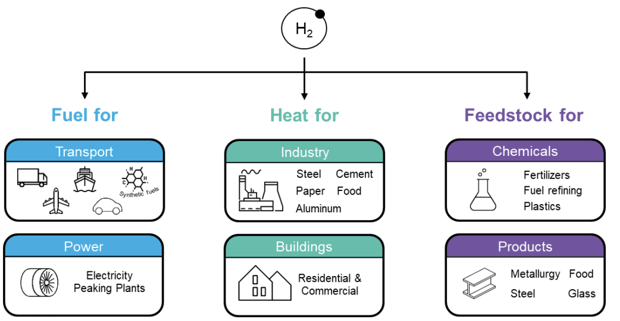
Source: BloombergNEF[4]
Global Interest in Hydrogen and Challenges in Developing a Hydrogen-Based Economy
Initial global interest in hydrogen can be traced to the 2019 Group of Twenty (G20) Summit in Japan which drew attention to it as a key industrial decarbonisation tool.[5] The coinciding launch of the International Energy Agency’s (IEA) flagship The Future of Hydrogen report established hydrogen as integral to energy transition. National hydrogen strategies subsequently increased from a small handful to over 30 hydrogen road maps by 2021.[6],[7],[8]
Subsequently, countries such as Japan and Germany attempted to fuel their hydrogen economies through ambitious targets, but encountered geographical, cost, and supply–demand mismatch constraints. Japan, for example, has implemented generous hydrogen subsidies for application in fuel cell passenger vehicles.[9] However, its supply of clean hydrogen is constrained by its geography, as the country is energy-import dependent and lacks land capacity for renewable energy expansion, which has constrained domestic green hydrogen deployment. Other forms of transport decarbonisation, therefore, remain more inexpensive and effective for Japan. Germany’s Hydrogen Import Strategy quantifies projected demand and outlines clear infrastructure linkages, but the country faces similar challenges with hydrogen cost competitiveness, as global demand has fallen short of early expectations.[10]
Despite early positive signalling, the global deployment of clean hydrogen and its derivatives have faced several interrelated challenges, namely, high production costs, infrastructural setbacks, regulatory fragmentation, and lack of secure demand off-takers. Consequently, current global hydrogen progress has fallen short of early established targets. In 2025, Bloomberg New Energy Finance (BNEF) estimated that hydrogen production would rise to 5.5 million tonnes per annum (mtpa) by 2030, well below the 25 mtpa combined global national targets.[11],[12] BNEF’s projections stem from low industry demand for hydrogen as well as technical and cost barriers inhibiting large-scale production and transport.
Hydrogen Development in GCC Countries Amidst New Geopolitical Realities
The prospect of hydrogen development remains attractive and well-suited to Gulf Cooperation Council countries (GCC), which are actively conducting feasibility studies with the aim of establishing commercial-scale hydrogen infrastructure projects.[13] First, the region seeks to diversify its economies away from fossil fuels. Simultaneously, due to increasing climate-related impacts, it is accelerating its decarbonisation efforts. Second, GCC countries are geographically well-positioned, nestled between two key import markets such as Asia and Europe, and boast abundant solar and wind resources. There is also mounting interest in nuclear energy exploration. Despite limited freshwater access, improvements in desalination technologies could facilitate water consumption for electrolysers. Third, the United Arab Emirates (UAE), Saudi Arabia, and Oman have made substantial investments exceeding US$69 billion in strengthening hydrogen infrastructure and have established partnerships with counterparts in Europe and Asia.[14] Consequently, hydrogen production costs in the Middle East are projected to decline significantly by 2030 (see Table 1).
Table 1: Cost Comparison of Grey, Blue, Green, and Pink Hydrogen in the Middle East Versus Globally
| Colour | Definition | Middle East LCOH Production Cost (US$) 2024 | Global Benchmark LCOH Production Cost (US$) 2024 | Projected Production Costs in the Middle East by 2030 | Projected Production Costs Globally by 2030 |
| Black | Produced from coal without carbon capture, utilisation, and storage (CCUS) | US$2.6–3.2 /kg | US$1.4–4.4/kg | US$2.4–2.9/kg | US$1.3–4.8/kg |
| Grey | Produced from natural gas without CCUS | US$1.0–1.3/kg | US$0.8–4.4/kg | US$0.7–1.0/kg | US$0.7–3.7/kg |
| Blue | Produced from natural gas with CCUS | US$1.5–1.7/kg | US$1.5–5.0/kg | US$1.3–1.3/kg | US$1.3–4.6/kg |
| Green | Produced from water electrolysis using renewable electricity | Electrolysis— onshore wind (US$7.4–10.8/kg)
Electrolysis— offshore wind (US$10.1–16.3/kg)
Electrolysis—solar PV (US$7.2–9.8/kg) |
Electrolysis— onshore wind (US$3.7–26.9/kg)
Electrolysis— offshore wind (US$5.0–22.3/kg)
Electrolysis— solar PV (US$3.4–26.3/kg)
|
Electrolysis— onshore wind (US$5.6–7.9/kg)
Electrolysis— offshore wind (US$7.3–11/kg)
Electrolysis—solar PV (US$4.8–6.3/kg) |
Electrolysis— onshore wind (US$2.8–19.5/kg)
Electrolysis—offshore wind (US$3.4–13.3/kg)
Electrolysis—solar PV (US$2.3–18.2/kg) |
| Pink | Produced from electrolysis using nuclear energy | – | US$6.17–8.29/kg[15] | – | US$4.73–US$6.25/kg[16] |
| Turquoise | Produced from methane pyrolysis | – | US$1.8–4.0/kg[17] | – | – |
Source: Authors’ own using information from IEA[18] and estimates from studies.
Note: Hydrogen exists in different forms, defined by its mode of production. Arguably, green hydrogen offers the cleanest option, while blue hydrogen can serve as a viable transitional low-carbon alternative.
However, hydrogen ambitions vary across the six GCC countries, with the sector largely nascent in Qatar, Kuwait, and Bahrain. As a leading exporter of liquefied natural gas (LNG), Qatar aims to develop offshore blue hydrogen initiatives in LNG-importing countries.[19] Kuwait’s 2021 White Paper Towards a Hydrogen Strategy for Kuwait declares ambitions to improve carbon capture technologies for blue hydrogen production, while Bahrain’s aim to increase blue and green hydrogen production is reflected in its industrial policy.[20],[21]
These early policy ambitions have yet to translate into continuous investments and tangible infrastructural development. Meanwhile, the UAE, Saudi Arabia, and Oman demonstrate marked policy, investment, and infrastructure momentum for hydrogen development, emerging as key linkages to fulfil hydrogen demand in Europe and Asia (see Table 2). However, these countries face similar technological, regulatory, geopolitical, and financing roadblocks.
Table 2: Production Targets, Renewable Energy Capacity, and Strategic Hydrogen Policies in Oman, Saudi Arabia, and the UAE
| Category | Sub-Category | Oman | Saudi Arabia | United Arab Emirates |
| Production Targets | Green hydrogen | 1–1.5 mtpa by 2030[22] | Yanbu project:
0.4 mtpa;[23] NGHC NEOM project: 0.22 mtpa[24]
|
1 mtpa by 2031[25] |
| Blue hydrogen | – | – | 0.4 mtpa by 2031[26] | |
| Pink hydrogen | – | – | 0.0075 mtpa[27] | |
| Other hydrogen derivatives | – | Green ammonia at NEOM: 1.2 mtpa[28]
Green ammonia at Yanbu: 2.2 mtpa[29] |
– | |
| Long-term targets | 3.25–3.75 mtpa by 2040; 7.5–8.5 mtpa by 2050[30] | 4 mtpa by 2030[31] | 7.5 mtpa by 2040; 15 mtpa by 2050[32] | |
| Renewable Energy | Total Installed Capacity (2024)[33] | 722 MW | 4,743 MW | 6,144 MW |
| Recorded LCOE costs | –
|
Solar
US$0.0104/kWh; Wind US$0.01338/kWh[34] |
Solar
US$0.0132 per kWh[35]
|
|
| Facilitating Strategic Frameworks and Policies | National Strategy | Oman National Hydrogen Strategy guiding industry development and export capacity[36] | Vision 2030 integrates hydrogen into diversification strategy | National Hydrogen Strategy 2050[37] |
| Energy and Industrial Policy Alignment | Vision 2040[38] | Saudi Green Initiative[39] and National Industrial Strategy[40] | UAE Energy Strategy 2050[41]; Industrial Decarbonization Roadmap[42] | |
| Investment and governance | Hydrom-held auctions and focus on shared infrastructure and industrial clusters[43] | Private sector participation law enables private investment[44] | Abu Dhabi Low-Carbon Hydrogen Policy[45] |
Source: Authors’ own using sources as cited.
New geopolitical realities shaped by the US–Israel conflict with Iran in 2026 have emphasised the need to fortify energy security and reduce reliance on fossil fuel imports, while exposing the susceptibility of key infrastructure to geopolitical disruption. On the one hand, rising gas and oil costs increase the appeal of renewable power by improving its cost competitiveness. On the other, attacks on critical energy infrastructure in the Gulf underscore the susceptibility of budding hydrogen infrastructure to disruption, thus increasing investor risk.
Maintaining infrastructural connectivity will also be crucial to sustain hydrogen trade, as the global hydrogen sector is still nascent, with few feasible alternative transport corridors. Furthermore, global fiscal capacity for clean energy investments may decline as financial resources are redirected as a consequence of the conflict.[46] The UAE, Saudi Arabia, and Oman, however, are better equipped to manage chokepoint disruptions through the Strait of Hormuz bypasses, reducing revenue losses and safeguarding investment continuity.[47] Reports indicate that Gulf sovereign wealth investments continue, despite economic losses and infrastructural damage from the conflict.[48]
Despite increasing regional geopolitical volatility, GCC countries remain well suited to produce clean hydrogen at scale due to their geographical advantages, infrastructural progress, and commitment to sustaining capital investments. This paper analyses the progress of and challenges shaping hydrogen development in the UAE, Saudi Arabia, and Oman. It argues that catalysing clean hydrogen development amid geopolitical hostilities will require stronger GCC institutional coordination to bridge supply-and-demand gaps, as well as a re-prioritisation of hydrogen applications to sectors with the most decarbonisation impact and the development of a complementary security architecture.
Mapping Hydrogen Progress and Potential
Table 3: Hydrogen Infrastructure Across Oman, Saudi Arabia, and the UAE
| Hydrogen Infrastructure | Oman | Saudi Arabia | UAE |
| Hydrogen Transmission Pipelines | Front-end Engineering Design (FEED)[a] Hydrogen backbone in Oman | – | Operational
35 km Air Liquide Arabia (ALAR) Yanbu–Jubail hydrogen pipeline |
| Hydrogen Ports | Feasibility Study Oman–Netherlands Liquid Hydrogen Corridor | – | – |
| Ammonia Ports | Operational
· Sur, Oman · Salalah Concept · SalalahH2 · H2Oman Feasibility Study • Duqm Special Economic Zone—Phase 2 • Green Energy Oman integrated green fuels mega project • Hyport Duqm Under Construction • Duqm Special Economic Zone – Phase 1 |
Operational
• Jubail Ammonia Port (operational) • Ras Al Khair (operational) Concept • Yanbu Under Construction • NEOM Green Hydrogen Project |
Operational
• Ruwais (operational) Under Construction • Expansion of Ruwais |
| Methanol (MetOH) Ports | Under Construction: In Duqm | – | Concept
In Abu Dhabi Final Investment Decision Ruwais |
Source: IEA[49]
Table 4: Green and Blue Hydrogen Production Projects across Oman, Saudi Arabia, and the UAE
| Country | Operational | Concept | DEMO | Feasibility Study | Construction |
| Oman | – | • H2Oman (Dhofar)—Green Hydrogen and Chemicals SPC, Phase II
• H2 Industries waste-to-hydrogen plant • Sohar port steel industry phase 1 and 2 • Omifco ammonia capture • Hydrogen project—Duqm area • TES Tree Energy Solutions Oman project • Green H₂-based ammonia plant • ELU Pro Muscat House MA Corporation MoU |
• E-methane pilot project | • Hyport at Duqm, Phase 1
• Green Energy Oman (GEO), Phase 1 (former Oman-Al Wusta green H₂ project) • Green Energy Oman (GEO), Phase 2 (former Oman-Al Wusta green H₂ project) • SalalahH2 • Hyport@Duqm, Phase 2 • Sur hydrogen cluster • BP Alternative Energy Investments projects, Dhofar POSCO green ammonia plant • Hydrom–EDF–J-POWER–Yamna Dhofar • Actis–Fortescue • Oman Shell’s Blue Hydrogen and Ammonia project (Blue Horizon) |
• Green Hydrogen and Chemicals SPC, Phase I (former ACME-Scatec Oman)
• United Solar Polysilicon (FZC) SPC |
| Saudi Arabia | – | • KEPCO, Korea Southern Power, KNOC, Samsung POSCO
• Low-carbon hydrogen plant at Shaybah natural gas liquids facility • Nordic Electrofuel e-SAF in the Middle East |
• Hydrogen and Innovation Development Centre (HIDC) | • Yanbu Green Hydrogen Hub | • NEOM Green Hydrogen Project |
| UAE | • Green Hydrogen Project (Mohammed bin Rashid Solar Park)
• Emirates Steel Industries—Al Reyadah CCUS |
• Bee’ah waste-to-hydrogen
• TAQA—Emirates Steel Green H₂ • TAQA and Abu Dhabi Ports • TA’ZIZ project—MoU ADNOC, ENEOS, Mitsui (Phase 1) • TA’ZIZ project—MoU ADNOC, ENEOS, Mitsui (Phase 2) • NWTN—CMEC Middle East green hydrogen plant • MoU IHI–ENOC • Uniper Masdar Hydrogen Solar PV Park • Green Hydrogen and Ammonia Production Project—Abu Dhabi • TES Tree Energy Solutions—UAE Project • Liberty Steel green steel • SK hydrogen-ammonia plant |
• EMSTEEL green steel | • Khalifa Industrial Zone Abu Dhabi (KIZAD) Helios Industry—Phase 1
• TA’ZIZ blue ammonia • KIZAD Helios Industry—Phase 2 • Brooge Renewable Energy’s renewable ammonia plant |
• Masdar City green H₂ • DEWA Pilot Project 2 (Alkaline) |
Source: IEA[50]
Note: As of 2022, KIZAD is under the Khalifa Economic Zones Abu Dhabi Group (KEZAD).
Key GCC Actors and Their Diversification Trajectories Towards Hydrogen-Based Products
The UAE
The primary actors driving the UAE’s hydrogen landscape include the Abu Dhabi–based energy companies Masdar and the Abu Dhabi National Oil Company (ADNOC), and to a lesser extent, Dubai’s utility provider, the Dubai Electricity and Water Authority (DEWA). Masdar has announced a target of producing 1 mtpa of green hydrogen and its derivatives by 2030, with approximately half expected to be produced domestically and the remainder developed internationally in important markets such as Saudi Arabia, Oman, and Egypt.[51]
In 2021, ADNOC joined the Hydrogen Council, an international organisation working to advance the clean hydrogen industry, with the ambition of becoming a prominent global blue hydrogen producer.[52] As an early indicator of progress, ADNOC shipped its first blue ammonia cargo to Japan in 2024.[53] However, the UAE remains a net importer of natural gas, and a focus on blue hydrogen could deepen its dependence on natural gas imports.[54] In addition, as demonstrated by the ongoing geopolitical turmoil and the effective removal of approximately 17 percent of Qatar’s LNG export capacity,[55] a blue hydrogen-based strategy could be vulnerable to natural gas supply disruptions and price volatility.
Existing Hydrogen Production
Currently, the DEWA operates a small-scale green hydrogen plant, launched in 2021, which has produced over 100 tonnes of hydrogen for domestic electricity applications.[56] Concurrently, ADNOC already produces grey hydrogen and ammonia with approximately 300,000 tonnes of hydrogen produced annually at the Ruwais Industrial Complex, primarily for industrial purposes.[57]
Low-Carbon Hydrogen Expansion
ADNOC has announced plans to develop a large-scale low-carbon ammonia facility, with construction contracts awarded and work beginning in June 2024, while commercial production is expected to start in 2027. However, the integration of carbon capture and storage (CCS) is not part of the immediate scope and the final investment decision (FID) therefore may not be considered as blue ammonia production.[58] Nonetheless, ADNOC has formulated long-term plans to expand its CCS network, targeting 10 million tonnes of carbon dioxide (CO₂) capture capacity per year by 2030,[59] to support low-carbon hydrogen and ammonia production. In terms of pink hydrogen, the UAE remains in the research and development phase, exploring the use of heat or electricity from the Barakah Nuclear Energy Plant for hydrogen production. In 2021, the Emirates Nuclear Energy Corporation signed an agreement with Électricité de France to support related R&D efforts.[60]
Export Infrastructure and Industrial Ecosystem
The development of TA’ZIZ as a leading chemicals and industrial hub presents a good opportunity to build domestic demand for low-carbon hydrogen as the UAE advances industrial decarbonisation. To enable low-carbon ammonia exports from TA’ZIZ, ADNOC committed US$2 billion towards the construction of roads and new ports with chemical terminals in Al Ruwais. Engineering, procurement, and construction (EPC) contracts for these developments have been awarded to various entities to support the development of the TA’ZIZ chemicals and transition fuels ecosystem.[61]
Several hydrogen-related projects have been proposed through memoranda of understanding (MoUs) and are in the feasibility study phase. An example is Brooge Energy’s green ammonia plant in Abu Dhabi, which has completed its feasibility study and is slated to produce 1,950 metric tonnes daily.[62] Additionally, the Abu Dhabi National Energy Company (TAQA) group and Abu Dhabi ports signed an MoU in 2021 to explore the development of a 2-gigawatt (GW) green hydrogen-to-ammonia project based in Khalifa Industrial Zone Abu Dhabi (KIZAD).[63] However, this project has not progressed beyond the early planning stages. KEZAD Group, which encompasses KIZAD, is emerging as a key green hydrogen hub in the UAE, supported by industrial infrastructure and major investments. In 2023, Masdar and AD Ports signed an MOU to explore the development of a green hydrogen production hub within KEZAD.[64] In 2025, Broaden Energy signed a 50-year land lease to establish a AED 455 million manufacturing facility utilising hydrogen, solar, and wind in the industrial processes, reinforcing KEZAD’s role in supporting the UAE’s growing green hydrogen ecosystem.[65]
Industrial Applications
Green Iron and Steel: The UAE accounts for around only 0.8 percent of the global steel export market, with China dominating production. However, China continues to rely heavily on coal-based processes and its attempts to produce low-carbon steel by adding carbon capture to existing facilities could increase costs and reduce competitiveness. The increased attractiveness of green steel, particularly from European Union (EU)-enforced Carbon Border Adjustment Mechanism (CBAM),[b] creates an opportunity for the UAE to increase its market share by adopting hydrogen reduced iron (H₂-DRI-EAF)[c] production.[66] Domestic demand for green steel is also being encouraged through initiatives such as the National Green Certificates Programme, which promotes the use of sustainable building materials.[67]
A joint pilot project by Masdar and EMSTEEL, the UAE’s largest steel producer, has demonstrated progress by successfully producing green steel using green hydrogen, a first for the Middle East and North Africa (MENA) region.[68] This was followed by EMSTEEL’s delivery of the region’s first hydrogen-based rebar using the hydrogen produced in the pilot project.[69] While these are promising steps, further scaling and technological development is still needed.
Green/Blue Chemicals and Fuels: Currently, feedstock used at TA’ZIZ are among the lowest in carbon intensity globally, with future plans including the integration of carbon capture technologies and the introduction of low-carbon steam cracking.[d],[70] The latter relies on electrification or low-carbon fuels such as blue or green hydrogen, which could stimulate demand. Additionally, Masdar, Mitsubishi Chemical Group Corporation (MCG), and INPEX Corporation have signed an agreement to study the production of the world’s first commercial-scale polypropylene using green hydrogen.[71] Moreover, Fujairah, which ranked as the world’s fourth-largest bunkering hub in 2025,[72] provides the UAE with a comparative advantage in integrating green fuels into its extensive maritime and trade infrastructure.
Green Aluminium: Primary aluminium production is a major industry in the UAE, accounting for almost half of the GCC’s total aluminium output. The country is home to one of the world’s largest aluminium producers, Emirates Global Aluminium (EGA).[73] Progress towards green aluminium remains at an early stage. While decarbonisation is a growing priority, multiple pathways are being explored beyond hydrogen. These include expanding aluminium recycling, using nuclear and solar energy for process heat instead of fossil fuels, and integrating CCUS technologies to reduce carbon emissions.[74] At present, the UAE’s push towards green aluminium is driven more by long-term strategic positioning and policy frameworks (such as Net Zero 2050 and Operation 300bn)[e],[f] than strong price signals, as green premiums remain limited. In 2024, Masdar and EGA partnered to explore low-carbon aluminium production avenues, including the development of renewable energy projects and green hydrogen production and storage.[75]
Green Fertiliser: The UAE is making steady progress on green fertiliser production. Fertiglobe, the largest nitrogen fertiliser producer in the MENA region, is advancing a UAE-based CCS ammonia production project.[76] In 2022, Masdar and Engie announced plans to study the development of a green hydrogen facility to support Fertiglobe’s ammonia production.[77] However, there has been no clear indication of progress. More concretely, the KIZAD Helios Industry project, currently in the feasibility study phase, is targeting a peak production capacity of 200,000 tonnes of green ammonia, derived from 40,000 tonnes of green hydrogen.[78]
Oman
Hydrogen activities are coordinated by the government-backed Hydrom and facilitated by the National Hydrogen Alliance or ‘Hy-Fly,’ a platform comprising 15 entities from public, private, academia, and research institutions to stimulate the development of ‘hydrogen hubs’ for domestic demand and export markets.[79]
Oman’s hydrogen strategy is centred on Hydrom-led auctions, which create a competitive framework for allocating land, renewable resources, and infrastructure.[80] To date, three auction rounds have been held, with the third round’s awardees expected in the second quarter of 2026. The first two rounds allocated eight large-scale green hydrogen projects, five in Duqm and three in Salalah.[81] The third round introduced additional incentives, including land-lease fee reduction during the development phase and corporate tax exemptions of up to 10 years.[82]
However, in late 2025, two projects (BP and the Engie-Posco consortium) were cancelled due to market uncertainty and off-take challenges. Alongside, some legacy projects that failed to align with the new framework or secure auction awards have been phased out. Nevertheless, Oman continues to make progress, with seven projects advancing as of 2025, supported by approximately 14 GW of planned electrolyser capacity.[83],[84]
Infrastructure and Projects Development
To support hydrogen transport and exports, Oman is planning a 400-km pipeline network linking production sites in Duqm and Salalah to industrial hubs and export terminals.[85] Internationally, it has signed a Joint Development Agreement with the Netherlands to explore the ‘Oman–Netherlands liquid hydrogen corridor,’ connecting Duqm to the Port of Amsterdam and logistical hubs in Germany and other European countries.[86] The Agreement envisions an integrated hydrogen chain encompassing production, conversion, transport, unloading, and industrial use.[87] However, this initiative remains in the feasibility stage.
Duqm is projected as a central platform for both international and domestic market development, supporting future hydrogen trade with Europe as well as shipments to Asian markets. Its main geographical advantage lies in providing a strategic export route via the Arabian Sea, avoiding the Hormuz Strait chokepoint.
India’s ACME Group is leading Oman’s first green hydrogen–based ammonia project, currently under construction in Duqm.[88] The facility is expected to produce 100,000 tonnes of green ammonia annually, with commissioning targeted for the first quarter of 2027.[89] The arrival of project cargo at the Special Economic Zone at Duqm (SEZAD) signals the start of large-scale infrastructure deployment. However, a challenge for Oman is the absence of an established domestic ammonia industry, which limits the ability to anchor domestic demand and necessitates an expansion of approximately 20 times its current ammonia export capacity to support its ambitions.[90]
International Partnerships and Investment Support
International partnerships are a necessary component of Oman’s hydrogen ecosystem. Chinese partners play a central role by supplying critical electrolyser technology while contributing to the development of port infrastructure, industrial zones, and ancillary facilities. To support localisation across the hydrogen value chain, Oman and China are collaborating on a manufacturing partnership to establish domestic production of electrolysers and liquefaction equipment.[91] Parallelly, Hong Kong–based Templewater, alongside the Oman Investment Authority’s (OIA) Future Fund Oman, launched a US$200 million joint fund to catalyse investments in certain sectors, including clean molecules and electrofuels in 2025.[92] Like the UAE and Saudi Arabia, Oman has also cultivated close relations with European partners, such as the Netherlands, recognising that Europe is likely to be a major source of future hydrogen demand. Accordingly, Oman’s hydrogen sector has been structured from an early stage to comply with the EU’s Renewable Fuels of Non-Biological Origin (RFNBO) requirements, enabling access to premium hydrogen markets in Europe.[93]
Industrial Applications
Green Iron/Steel: Direct reduced iron (DRI) production is expected to play a central role in Oman’s emerging green steel ecosystem. Newly proposed DRI facilities rely on flexible shaft furnace technologies, allowing operators to gradually increase hydrogen use, and in principle, operate with up to 100 percent hydrogen. Although Oman has access to relatively inexpensive natural gas that could support gas-based DRI production in the short term, its national policy is oriented towards a gradual transition to hydrogen-based steelmaking. A deterrent to gas-based development is that natural gas-based production is less likely to qualify for the price premiums associated with low-carbon steel, as their emissions would exceed the thresholds required for near-zero iron classification.[94]
The Meranti Green Steel project is an example of such a DRI facility in Duqm where hot briquetted iron (HBI)[g] and DRI will be produced using a mixture of natural gas and green hydrogen and over time hydrogen’s share will be increased. Expected to reach FID by 2026, it is intended to supply Meranti’s green steel operations in Thailand and meet European demand for lower-carbon materials. It has already secured non-binding off-take agreements.[95]
Similarly, the Jindal Shadeed Group plans to construct a ‘hydrogen-ready’ steel complex at SEZAD, initially operating on natural gas but designed to transition to green hydrogen as supply becomes available.[96] In parallel, India’s ACME Group has signed a binding agreement with Vietnamese steelmaker Stavian to supply 0.8 mtpa of hydrogen-based DRI/HBI over a 10-year period. ACME is simultaneously exploring the development of a 1.2 mtpa green DRI plant as well.[97]
Green Aluminium/Cement: Oman’s aluminium and cement sectors are currently not oriented towards hydrogen-based decarbonisation; instead, they are prioritising efficiency gains, recycling, and cleaner power sources. This is evident in the country’s largest aluminium producer, Sohar Aluminium’s strategy, where hydrogen is absent from its decarbonisation plans.[98]
Green Fertiliser: Oman is moving forward with green ammonia production, positioning itself as a potentially strong exporter of global green fertiliser. The binding agreement between Yara, a Norwegian crop nutrition company, and India’s ACME Group, for the supply of green ammonia from Oman[99] underscores Omani green ammonia’s potential integration into global fertiliser markets.
In Duqm, India’s ACME Group is developing a green ammonia facility with an initial capacity of 100,000 tonnes per year. Operations are expected to commence in the first quarter of 2027, and the facility is designed to expand, with plans targeting up to 1.2 million tonnes per year in later phases.[100] Additional large-scale projects are also emerging across Oman. In Dhofar, a consortium including Électricité de France (EDF), J-Power, and Yamna is developing a green ammonia plant with a planned production capacity of 1 mtpa.[101] The Hyport Duqm project (a partnership between DEME and OQ) is also focused on large-scale green ammonia production.[102]
Sustainable Chemicals/Fuels: Oman is exploring opportunities to develop sustainable fuels derived from green hydrogen. In November 2025, a public–private partnership led by HIF Global signed an MoU to assess the development of an e-methanol supply chain and bunkering hub at Salalah.[103] This reflects growing interest in positioning Oman as a supplier of low-carbon marine fuels as the global shipping sector begins transitioning toward alternatives. Green ammonia produced through Oman’s hydrogen projects could also serve as a marine bunkering fuel, supporting the development of new fuel supply infrastructure across Omani ports.
In December 2025, Sohar Port and Freezone (SOHAR) signed a letter of intent with Empa to explore the feasibility of a synthetic fuels facility.[104] The port’s strategic value lies in its proximity to established petrochemical infrastructure and export terminals, positioning it as a hub for hydrogen-derived chemical production, with Sohar Net Zero Alliance (SNZA) supporting the expansion of hydrogen-based initiatives.[105]
However, market conditions for sustainable fuels remain uncertain. Demand is still limited, and the cost of green methanol remains relatively high. Prices are, however, expected to decline over the next five to 10 years as technologies mature, production scales up, and demand expands.[106]
Saudi Arabia
Saudi Arabia has set some of the most ambitious hydrogen and hydrogen-derivatives targets globally, targeting 4 mtpa by 2030, as compared to the UAE and Oman’s 1–1.5 mtpa. It has taken a dual-track approach, focusing on both blue and green hydrogen as it seeks to maintain its central role in the evolving global energy landscape.[107] The sector is led by leading players such as Aramco, NEOM, and Air Products, with Aramco also being a steering member of the Hydrogen Council.
Green Hydrogen Development (NEOM/Yanbu)
Flagship hydrogen projects in Saudi Arabia, particularly NEOM, continue to progress. NEOM accounts for 76 percent of planned hydrogen investment in the Gulf through 2030[108] and is being developed as a fully integrated industrial complex at Oxagon, its industrial hub. As of the second quarter of 2025, the NEOM green hydrogen project is approximately 80 percent complete across its core components, with electrolyser commissioning and green ammonia production expected by 2027.[109]
The Yanbu Green Hydrogen Hub, announced by ACWA Power in partnership with Germany’s EnBW, is planned for Yanbu Industrial City on the Red Sea coast. With larger production targets than NEOM’s, the project is positioned as a potential major export hub for hydrogen and hydrogen derivatives, explicitly targeting international markets.[110]
Export Logistics and Port Infrastructure
The Port of NEOM commenced operations in 2023 and now serves as a key gateway for importing components required for NEOM’s industrial ecosystem development.[111] To further strengthen its logistics capacity, Container Terminal 1 is currently under development and is expected to become operational in 2026. It will support both the import of construction materials and the export of industrial products, linking Oxagon to major global shipping routes across Asia and Europe.[112] While NEOM has made notable progress, the ongoing Middle East conflict is likely to lead to delays in project development and implementation.
Concurrently, Air Liquide Arabia operates approximately 35 km of hydrogen pipelines across industrial clusters in Yanbu and Jubail, supporting hydrogen supply to refining and petrochemical industries and providing a foundation to scale hydrogen infrastructure in future.[113]
Saudi Arabia’s blue hydrogen development is supported by established CCUS assets. These include the CO₂-to-enhanced oil recovery (EOR) project at Uthmaniyah and CO₂ utilisation initiatives in Jubail, reflecting growing national expertise in carbon management.[114] This capability underpins the country’s strategy to expand blue hydrogen production.
Blue hydrogen infrastructure is increasingly concentrated in Jubail Industrial City, where hydrogen production is being integrated with CCUS systems. Phase One of a CCS hub in Jubail, led by Aramco and its partners, is expected to be completed by 2027 to support large-scale blue hydrogen and ammonia production.[115] In addition, Saudi Aramco has acquired a 50 percent stake in the Blue Hydrogen Industrial Gases Company (BHIG), which will utilise captured CO₂ from the developing Jubail CCS hub to produce blue hydrogen.[116]
International Hydrogen Trade Partnerships
To secure future demand, Saudi Arabia has actively pursued partnerships with prominent demand centres, particularly in Europe. In this regard, it differs from its GCC counterparts; it has secured an off-take agreement with Air Products entailing a 30-year exclusive agreement covering the whole of NEOM’s green ammonia output.[117] Additionally, MoUs have been signed with several countries, including Greece, France, and Germany, to support the development of green hydrogen and renewable energy export value chains linking Saudi Arabia to European markets.[118] In early 2026, ACWA signed an MoU with Germany’s Port of Rostock to develop a green ammonia supply chain.[119]
Saudi Arabia has also strengthened engagement with Asian markets, notably Japan and South Korea.[120],[121] These are promising demand centres for blue ammonia, building on their existing energy trade relationships with the Kingdom. However, progress toward binding off-take contracts has been relatively slow, due to the ongoing uncertainties around demand, pricing, and market development. Consequently, Aramco cut down its blue ammonia target of 11 mtpa to 2.5 mtpa in early 2025.[122]
Green Iron/Steel: Approximately 70 percent of Saudi Arabia’s steel production capacity already relies on DRI–electric arc furnace (EAF) processes, which are compatible with hydrogen. However, current DRI operations depend on natural gas-based synthesis gas (syngas) rather than green hydrogen. While this allows for future transition, it does not meet the EU definitions of green steel and might limit access to premium CBAM-aligned markets. For example, China’s Baowu Steel Group, Saudi Aramco, and the Public Investment Fund (PIF) announced a joint heavy-plate steel complex based on natural gas–based DRI and electric arc furnace (EAF) technology. While designed to be hydrogen-ready, no concrete timeline has been established for a transition to green hydrogen.[123] Similarly, Vale-led mega hubs intended to support decarbonisation through the production of ‘green briquettes’[h] provide limited clarity on the role and timing of green hydrogen integration.[124]
Saudi Arabia is also looking at securing upstream inputs for iron and steel making. To ensure access to high-grade iron ore pellets, a key feedstock for green iron and steel, Saudi-based Hadeed and Mauritania’s Société Nationale Industrielle et Minière (SNIM) developed the Takamul joint venture iron-ore mine in Mauritania.[125]
Green Chemicals and Fuel: In 2023, the Saudi Aramco and ENOWA signed a joint development agreement to establish a synthetic methanol demonstration plant using green hydrogen, captured CO₂, and an on-site electrolyser.[126],[127] However, there have been no publicly disclosed updates on the project’s progress. Other initiatives explored the use of captured CO₂ to produce chemicals such as ethylene.[128] These pathways are generally characterised as low carbon rather than fully green, as they rely on carbon utilisation.
Green Aluminium: Saudi Arabia’s aluminium sector, driven by the majorly state-owned company Maaden, shows limited signs of growth in hydrogen-based green aluminium. Instead, like the UAE and Oman, its focus has been on finding alternative decarbonisation pathways, including aluminium recycling and renewables to develop low-carbon hydrogen.
A Comparative Examination of the Gulf Hydrogen Ecosystem
The three Gulf states exhibit distinct models and priorities across the hydrogen value chain. The UAE’s hydrogen ecosystem is built around a cluster-based model, centred on existing industrial hubs such as Ruwais and Khalifa Economic Zones Abu Dhabi (KEZAD). This approach is highlighted in Abu Dhabi’s Low-Carbon Hydrogen Policy, which envisions hydrogen valleys where multiple hydrogen projects are co-located to stimulate demand and increase coordination.[129] This contrasts with the large greenfield megaprojects being pursued in Saudi Arabia. A further point of distinction is the UAE’s interest in pink hydrogen, albeit limited, enabled by its nuclear power capacity, which may offer a comparative advantage relative to its regional peers.
Oman’s strategy diverges from that of its neighbours by predominantly focusing on green hydrogen and derivatives. In contrast, Saudi Arabia and the UAE are leveraging extensive CCUS capabilities for more cost-effective blue hydrogen and ammonia expansion.[130] This focus on green hydrogen is beneficial as it allows concentration of resources and policy efforts. However, the much higher production costs of green hydrogen compared to blue hydrogen will remain a prominent challenge, although the competitiveness of green hydrogen may improve due to disruptions to the global natural gas markets thanks to recent blockages at the Strait of Hormuz. Oman’s structure also relies more heavily on international partners and private entities for project development and financing, while the government primarily acts as a regulator to de-risk investment.[131]
Renewable Energy: The Key to a Viable Hydrogen Ecosystem
Across the UAE, Saudi Arabia, and Oman, the development of a viable hydrogen ecosystem is underscored by efforts to scale renewable energy capacity, strengthen grid infrastructure, and provide regulatory certainty around power supply. Renewable energy targets reflect this alignment, with Oman and Saudi Arabia aiming for 30 and 50 percent of electricity generation from renewables, respectively, while the UAE targets a 50 percent share of clean energy in its total energy mix over the next decade.[132],[133],[134] Oman has explicitly allocated up to 30 GW of renewable capacity for hydrogen production, supporting compliance with the EU’s additionality requirements for renewable hydrogen.[135],[136]
In downstream applications, particularly green iron and steel, raw material quality is a constraint. Hydrogen-based DRI processes require higher-grade iron ore than conventional blast furnaces, yet only around 13 percent of globally traded ore currently meets this threshold.[137],[138] Fulfilling future demand will, therefore, require either upgrading lower-grade ore or developing new high-quality deposits, both of which will increase production costs. Oman holds a relative advantage in this segment due to its established role in importing iron ore and producing DR-grade pellets.[139],[140]
Under CBAM, projected cost increases for GCC and EU producers are expected to be similar, yet lower than for those in India and China.[141] This gives the Gulf aluminium producers, particularly those in the UAE, a modest advantage in maintaining access to EU markets. However, if CBAM expands to include indirect emissions from electricity use, as with fertilisers and cement, the Gulf countries could face a relative disadvantage compared with EU producers. In this context, scaling green aluminium production would offer a hedge against future risk.[142]
In contrast, there is limited evidence of concrete plans to deploy hydrogen in the cement sector across all three countries. Instead, their focus is on alternative fuels such as waste-derived fuels and biomass, and efficiency improvements including clinker substitution.[i],[143],[144]
Barriers to Scaling Hydrogen
The UAE, Saudi Arabia, and Oman have instituted policy frameworks to catalyse blue and green hydrogen production. However, reducing costs to scale beyond pilot projects requires bridging the gap between supply and demand to create an enabling environment for production, storage, and trade. Using the International Renewable Energy Agency’s (IRENA) framework for identifying barriers, this paper evaluates the specific technological, economic, institutional, and socio-environmental barriers inhibiting hydrogen development.[145] Given the Gulf region’s proximity to conflict-ridden countries in the Middle East and Europe, it also examines the geopolitical and security risks inhibiting hydrogen deployment.
Technological Challenges of Green Hydrogen Gas Infrastructure
There are numerous technological challenges that inhibit the catalysation of green hydrogen gas production, storage, and transport in the immediate term, making hydrogen derivatives such as ammonia and methanol more viable pathways for now.
First, electrolyser and fuel-carrier technologies remain inefficient. Current electrolyser methods risk losing heat from renewable electricity, raising overall production costs. Second, infrastructure across the supply chain to produce, transport, and store gaseous hydrogen is not aligned. Transporting green hydrogen is costly and energy intensive due to its low-energy density. Current methods of transporting hydrogen include compression into a gas and transportation via pipelines or liquefaction or synthesis into ammonia and transportation via ship.[146],[147] However, there is limited pipeline infrastructure to export hydrogen gas to European consumers, suggesting that fuel would need to be transported by ship in the near future.[148]
Hydrogen is highly flammable and requires safe storage tanks to store it at 5000 psi. Their weight would be around 65 times as much as the hydrogen they contain.[149] The technologies for producing blue and green hydrogen are also fundamentally different, which would make it challenging to switch from one to the other in the future. This would present an additional risk for investors contemplating blue hydrogen expansion in the UAE and Saudi Arabia.
Ammonia, on the other hand, is much easier to store and transport. It is more cost effective in the short term as it can be moved through existing chemical tankers and directly applied as feedstock for products like fertilisers or low-carbon fuels.[150],[151]
Economic Concerns: The Double-Cost Premium and Green Skilling
Given the technological risks and uncertainties associated with green hydrogen, a double-cost premium exists that drives a wedge between supply and demand synergies.
First, there is a product premium—that is, the difference in cost between producing green ammonia from renewables versus grey ammonia from natural gas.[152] As of 2024, the cost of green ammonia production exceeds grey ammonia production in the region by over two times (see Table 1). Second, there is a transition premium—the difference in costs between fossil-fuel and green processes.[153] Even if green ammonia declines in cost as projected, adopting it in sectors such as maritime transport remains more expensive than traditional bunker fuel, dissuading industry adoption of clean fuels. The combination of the two cost premia expands the gap between the cost of producing and leveraging green hydrogen and the price that consumers are willing to pay. Although the product premium is expected to shrink by 2030, reducing the transition premium will require more targeted incentives.
Additional costs arise across the hydrogen value chain, through distribution (compression, pipelines, and storage), conversion into transportable carriers such as ammonia or methanol, transportation, and end-use applications, such as steel production and maritime transport.[154] Such considerations are particularly important for GCC countries prioritising hydrogen exports to international markets, as they can significantly alter project economics and overall commercial feasibility.
Besides, the limited availability of freshwater across the GCC will require further expansion of desalination capacity. This may increase energy demand and necessitate additional power generation, raising the overall cost of hydrogen production. However, developing smaller and more modular desalination facilities powered by renewable energy may be beneficial for cost efficiency and security. In comparison to larger facilities, smaller units would increase redundancy and decrease susceptibility to kinetic attacks, thus maintaining water supply in times of crisis.[155]
These economic constraints are further compounded by limitations in human capital. While the GCC has a highly skilled workforce in the oil and gas industry, given the nascent level of low-carbon hydrogen, the expertise in the large-scale deployment and operation of production facilities is limited. As a result, shortages persist in specialised areas such as engineering, system integration, maintenance, and health and safety. Training programmes and educational initiatives to build these capabilities are still in the early stages of development across academia and industry.
At the same time, reliance on imported skills and technologies risks constraining long-term self-sufficiency, as it may slow the development of local technical expertise and innovations.[156]
Institutional Barriers: Limited Regulatory Standards and Inconsistent Enforcement
The three GCC countries share supportive domestic policies and long-term visions for hydrogen development. However, limited international regulatory frameworks inhibit green hydrogen’s adoption and scaling. This leads to difficulties in catalysing supply and stagnant off-take interest.
From a supply perspective, first-mover private sector players lack clarity on the integration of hydrogen into existing infrastructure, adequate safety measures, or grid integration. This inhibits progress towards future supply chain interoperability and the ability to capitalise on demand from international buyers.
From a demand perspective, the EU represents one of the Gulf’s largest potential markets for hydrogen. The EU has established policies aiming to produce 10 mtpa of clean hydrogen and import 10 mtpa of hydrogen by 2030.[157] However, industrial uptake remains limited since the enforcement of quotas is inconsistent among member states.[158] Additionally, makers of frameworks such as the Renewable Fuels of Non-Biological Origin (RFNBO) are being persuaded to adopt a more flexible approach. These potential regulatory changes may send mixed signals to investors, as doubts over compliance requirements complicate predictions regarding premium market demand. This regulatory uncertainty results in companies preferring to pay fines as opposed to absorbing the cost of transitioning to green hydrogen alternatives. Germany, on the other hand, enforces regulations aimed at decarbonising oil refineries, creating incentives for companies like TotalEnergies to adopt green hydrogen through imports.
Socio-Ecological Challenges
Hydrogen production through electrolysis requires high amounts of water. For example, in Saudi Arabia’s NEOM hydrogen project, each kg of hydrogen produced requires approximately 9 litres of fresh water, amounting to around 5.4 million litres per day at full capacity.[159] In the arid and water-stressed conditions of the Gulf, limited freshwater availability presents a huge constraint. As a result, large-scale hydrogen production will rely heavily on desalination, potentially increasing pressure on energy systems and raising concerns around competition with other water-intensive sectors, such as agriculture, if not managed efficiently and effectively. Increased desalination may exacerbate the ongoing issue of brine disposal and its impact on coastal ecosystems, emphasising the need for more robust brine management strategies, which are already limited in the Gulf region.[160]
Beyond resource constraints, hydrogen poses environmental and safety considerations. While not a greenhouse gas, hydrogen can indirectly contribute to atmospheric warming by interacting with hydroxyl radicals, which are responsible for breaking down methane,[161] and reducing their availability, leading to a longer lifetime for methane in the atmosphere.[162] Hydrogen leakages or system failures can lead to fires or explosions if not properly managed. Plus, ensuring that green hydrogen is powered exclusively by additional renewable energy (i.e. the concept of additionality) is essential, otherwise it may lead to higher CO2 emissions.[163]
Geopolitical and Security Risks
Hydrogen development remains heavily dependent on external financing, technology, and expertise across the three countries, creating potential supply-chain vulnerabilities. Oman, for instance, relies on Chinese investments and technology.[164] Although it has also pursued market partnerships in Europe and East Asia, excessive reliance on one actor risks reducing sovereignty over project development and export flexibility.
For the UAE, blue hydrogen development depends on natural gas imports, which has been affected by uncertain liquefied natural gas (LNG) outputs from Qatar due to the US–Israel conflict with Iran.
Furthermore, the targeting of Gulf infrastructure during the conflict has unveiled the region’s vulnerabilities. For example, Saudi Arabia’s integration of hydrogen in infrastructure megaprojects such as NEOM increases susceptibility to systemic collapse due to kinetic attacks. In the absence of regional hydrogen pipeline infrastructure, exports are likely to rely on seaborne transport of hydrogen derivatives, particularly to European markets. Hydrogen trade may therefore face logistical constraints and geopolitical risks similar to fossil fuel shipments.[165] Furthermore, even though the three states offer alternative routes that bypass the Strait of Hormuz, the ongoing conflict has illustrated that even the region’s alternative port infrastructure in Fujairah, Salalah, and Yanbu remains vulnerable.[166],[167],[168]
The commercial viability of many hydrogen projects hinges on exports to international markets. This exposes them to policy changes, regulatory shifts, and evolving demand conditions in importing countries, emphasising the importance of balancing European and Asian exports with strong domestic or regional markets.
Table 5: Hydrogen Opportunities and Challenges in Saudi Arabia, the UAE, and Oman
| Country | Opportunities and Challenges | ||||
| Technological | Economic | Institutional | Socio-Environmental | ||
| Saudi Arabia | Opportunities | Favourable wind and solar energy.
Fifth-largest domestic natural gas reserves to anchor blue hydrogen.
Houses existing domestic hydrogen pipelines. |
Partnerships with EU and East Asian countries offer potential export pathways.
Key Industrial Applications: Green-steel sector is considered higher value. |
Participation in the Hydrogen Council helps promote hydrogen market development and policy discussions. | Green job growth. |
| Challenges | Blue hydrogen progress may limit transition to green hydrogen since infrastructure between the two is incompatible. | Strategy depends on economic or geopolitical situations.
Lack of binding off-take contracts.
Key Industrial Applications: ‘Hydrogen ready’ but gas-reliant steel sector does not comply with CBAM markets. |
Lack of clarity on industry sector-specific transition to green hydrogen. | Limited water availability for electrolysers increases desalination and energy dependencies. | |
| UAE | Opportunities | Expanding solar capacity and low-cost renewable energy.
Existing nuclear energy. Opportunity for pink hydrogen technology.
|
Cluster-based industrial hub model provides guaranteed domestic demand for hydrogen.
Key Industrial Applications: Potential for green steel and green fertiliser. |
Establishing legislative mechanisms for low-carbon hydrogen transition, like hydrogen certifications.
Updated gas regulations for hydrogen pipelines to include hydrogen blending.[169]
Participation in the Hydrogen Council helps promote hydrogen market development and policy discussions.
|
Green job growth. |
| Challenges | Previous fall in research and development funding for hydrogen.
Dependency on natural gas imports exposes the country to global gas price volatility, which would affect blue hydrogen. |
Energy competition with powering AI data centres due to the immaturity of the global green hydrogen market.[170]
Fluctuating oil prices and geopolitical tensions can impact hydrogen deployment.
Key Industrial Applications: Limited pricing support for green aluminium. Hydrogen use competes with preferred alternative fuels like biomass for cement decarbonisation. |
Lack of alignment between local hydrogen regulations and certifications with regional and global standards.[171] | Limited water availability for electrolysers increases desalination and energy dependencies. | |
| Oman | Opportunities | Hydrogen infrastructure creation via diversified international partnerships (Europe, Asia, and the Gulf). | Finance mobilisation through international partnerships.
Favourable taxation policies.
Leveraging of Special Economic Zones with ammonia facilities guarantees domestic off-take.[172]
Key Industrial Applications: Potential for green steel. Potential for green fertiliser export. |
Streamlined regulatory processes, standards, and certifications.
|
Land permits granted through Hydrom-led auctions.[173]
Green job growth. |
| Challenges | Technology dependence on Chinese partnerships.
|
Lacks an established domestic ammonia industry to anchor demand and requires extensive export capacity expansion.[174]
Key industrial applications: Demand uncertainty for green methanol use in sustainable fuels. |
Lacks internationally established regulatory frameworks to encourage interoperability for exports. | Limited water availability for electrolysers, increasing reliance on seawater desalination and energy dependencies. | |
Source: Authors’ own using sources as cited.
Recommendations
The deployment and catalysation of clean hydrogen require the convergence of several factors: 1) abundant renewable energy sources; 2) net-zero climate or decarbonisation legislation; 3) harmonised standards for hydrogen use; 4) targets or quotas with investment mechanisms; 5) heavy transport emissions; 6) mandates for low-emission products; 7) industrial decarbonisation policies; and 8) hydrogen-ready equipment.[175]
This paper showcases the region’s abundant renewable energy sources and provides evidence of its supporting climate and decarbonisation legislation. It also reveals constraints such as regulatory harmonisation, missing industry-specific quotas and decarbonisation mandates, and fragmented technological equipment. Given their shared challenges, this paper proposes the development of a GCC Hydrogen Strategic Working Group and Forum for knowledge exchange and research progress. Such a group would position these Gulf countries as leaders in developing unified hydrogen infrastructure standards and safety protocols to create new markets, enhance interoperability, and improve regional cooperation.
The proposed group should coordinate on the following pillars:
R&D Exchanges to Advance Technologies
Given the countries’ common technological challenges, the working group should foster R&D to improve electrolyser technology efficiency, storage of renewables and clean hydrogen, and grid connectivity. Electrolyser technologies would benefit from technological improvements to reduce the intermittency of renewable energy technologies, such as solar and wind. Green hydrogen production would be strengthened by advancements in hydrogen storage and smart-grid systems that facilitate energy dispatch from solar to hydrogen production to minimise energy loss and enhance load balancing.[176] These initiatives can supplement similar efforts led by the GCC Interconnection Authority.
A regional platform would allow each country to exchange knowledge on hydrogen development strategies and overcoming common challenges. Saudi Arabia and the UAE can learn from Oman’s auction structure and land allocation mechanisms, while including equity considerations. Likewise, Saudi Arabia and Oman can apply the UAE’s industrial clustering and common-user infrastructure strategies to drive efficiency, reduce costs, and generate domestic demand.[177] Additionally, this platform would accelerate research on shared challenges such as reducing the impact of electrolysers on scarce water resources, potentially through wastewater reuse or by mitigating the negative environmental effects of desalination.
Currently, the region convenes annual events, such as the Abu Dhabi Sustainability Week’s Green Hydrogen Summit and the Green Hydrogen Summit Oman, to discuss hydrogen regulation progress, financing, and infrastructure.[178] However, a formal regional working group would help ensure coordination and integration of conference outcomes between public, private, and academic stakeholders.
Harmonisation of Technical and Certification Standards
Advancements in R&D can feed into the joint development of harmonised technical and certification standards. This includes establishing clarity on pipeline tariffs for hydrogen, third-party access requirements, and certification of hydrogen gas quality.[179] Developing unified standards at a regional level would help increase the potential for long-term interoperability, boosting investor confidence. By cooperating as a unit, these GCC countries can jointly develop strong measuring, reporting, and verification (MRV) systems to fulfil CBAM requirements and advance clean hydrogen integration in sectors such as steel, aluminium, and fertilisers and raise shared concerns to EU markets, as necessary.
Financial De-Risking to Bridge the Hydrogen Price Gap and Improve Bankability
Given the Gulf’s financing capacity and proclivity for establishing supply chain networks with political and economic allies, the countries within the region are already well-positioned to handle instability. To further safeguard its hydrogen progress, the UAE, Saudi Arabia, and Oman should develop a financing strategy focused on 1) securing long-term off-takes; 2) leveraging Sovereign Wealth Funds (SWF) alongside sustainable finance mechanisms; 3) applying insurance schemes to de-risk investments; and 4) developing a security architecture to safeguard physical infrastructure and minimise risk premium costs.[180]
Securing long-term off-take agreements is essential to take hydrogen projects beyond the feasibility stage. This can be achieved through government-led mandates and quotas to stimulate domestic industry demand or through common-user infrastructure (CUI).[181] Implementing public sector-led mandates and quotas would encourage hydrogen integration in relevant industries, bridging the demand gap. Employing CUI would group renewable energy, electrolysers, and industrial users, reducing project costs, improving efficiency, overcoming transport challenges, and allowing smaller hydrogen developers to gain access to capital.
Gulf SWFs are increasingly deploying capital to diversify economies and support low-carbon transitions.[182] Pairing them with sustainable finance mechanisms such as green sukuk, green bonds, or sustainability-linked bonds would further lower the cost of capital to build hydrogen infrastructure such as electrolysers, blended pipelines, and storage facilities. Ensuring access to affordable renewable energy can be supported by feed-in tariffs to lower costs.
Lastly, combining investments with insurance policies that cover construction delays or external disruptions can help mitigate financial losses. Given the geopolitical volatility of the region and the risk of infrastructure attacks, acquiring political risk insurance from multilateral development banks would further safeguard infrastructure development.[183] Combining such insurance mechanisms with a stronger diplomatic and military security apparatus would protect physical infrastructure. For instance, working with the UN Security Council to increase shipping protection across trade corridors may appease investor hesitation in hydrogen investments.
Demand Stimulation Prioritisation and Building Regional Value Chains for Key Industries
While green hydrogen is often presented as a solution to decarbonise hard-to-abate sectors, demand is likely to be stronger in certain applications. Understanding where hydrogen offers the greatest value can help policymakers prioritise efforts for demand stimulation and create a more enabling environment for its deployment. In this regard, Michael Liebreich’s Hydrogen Ladder evaluates potential hydrogen applications on factors such as cost, scientific feasibility, and geopolitical considerations, demonstrating which hydrogen sectors will most likely serve as the dominant decarbonisation pathway with a larger market share.[184] Fertilisers and methanol rank highest. Shipping and steel also show potential for hydrogen adoption. In contrast, aluminium ranks lower, as electrification is a more cost-effective alternative.
Although the UAE, Saudi Arabia, and Oman have built external partnerships to build demand for hydrogen or derivative exports, there are opportunities to build cohesive trade corridors at a regional level between the GCC countries. Regarding the green steel industry, for instance, Oman can serve as a feedstock hub by converting iron ore into DR-grade pellets. Saudi Arabia and the UAE will soon have the industrial capacity through respective mega-hubs or KEZAD to convert pellets from Oman into green HBI to use domestically or export to EU and Asian markets.[185]
Similarly, accelerating green fertiliser development, particularly in the UAE and Oman, and developing export markets, would reduce exposure to volatile gas prices and geopolitical shocks, in addition to decarbonising fertiliser production.[186] The recent Strait of Hormuz closure exposed trade flow bottlenecks through the Gulf, therefore, investments in alternate sea-road trade corridors would prevent supply chains from being affected by this vulnerability. Oman’s ability to bypass the Strait of Hormuz through the Port of Duqm offers another opportunity to strengthen the resilience of green fertiliser trade.[187]
Conclusion: What Does the Future of Hydrogen in the Region Entail?
This paper examines the unique clean hydrogen development trajectories in the UAE, Saudi Arabia, and Oman. Overall, most of the hydrogen and derivative projects across the discussed Gulf states remain at the concept or feasibility stage. The UAE and Saudi Arabia are developing strong domestic markets with an outlook towards exporting across Europe and Asia, while Oman focuses on cultivating its export markets for green ammonia and green iron to similar markets. All three countries face shared challenges, including the lack of regulatory standards to advise coordinated infrastructural development, limited binding long-term off-takes to scale beyond pilot projects, water and energy pressures, forthcoming CBAM requirements testing their product competitiveness in the EU market, and mounting security risks. Uncertainty in EU and Asian demand, combined with delays in technological advancements, inhibit the green hydrogen economy from progressing.
Contrary to global anticipation that GCC countries’ investments would decline due to the US–Israel–Iran war, Gulf sovereign wealth funds remain committed to accelerating clean energy investments domestically and abroad.[188] Paired with increasingly competitive costs for green hydrogen due to higher gas prices, this trajectory may positively shape the region’s hydrogen economy prospects. This paper therefore proposes a shift towards regional cooperation to exchange research and development on hydrogen infrastructure, harmonise technical standards, identify plausible financing strategies, and build regional value chains to catalyse hydrogen deployment across key industries while factoring in shared geopolitical, security, and environmental constraints. Through this approach, the Gulf region will be well positioned to lead in the deployment of low-cost clean hydrogen.
Leigh Mante is Junior Fellow, Climate and Energy, ORF Middle East.
Reem Sagahyroon is Research Assistant, Climate and Energy, ORF Middle East.
The authors acknowledge the use of ChatGPT 5.5 for language refinements.
All views expressed in this publication are solely those of the authors, and do not represent the Observer Research Foundation, either in its entirety or its officials and personnel.
Endnotes
[a] FEED refers to the phase following feasibility studies that ensures the details of the planned project are visualised before construction, including the technical specifications needed and costs required.
[b] CBAM is an EU-implemented tool that requires EU importers to purchase CBAM certificates, reflecting the carbon embedded. This sets a carbon price on carbon-intensive imports. Currently, CBAM covers iron, steel, cement, fertilisers, aluminium, electricity, and hydrogen.
[c] The ‘H₂-DRI-EAF’ procedure uses hydrogen to produce the intermediary product known as direct reduced iron, followed by an electric arc furnace (EAF) to produce steel.
[d] ‘Steam cracking’ is a petrochemical process that uses high temperature to induce thermal decomposition of hydrocarbons.
[e] The UAE’s ‘Net Zero 2050 Strategy’ outlines programmes across six key sectors—power, industry, transport, buildings, waste, and agriculture—to support its emission-reduction targets.
[f] ‘Operation 300bn’ refers to the UAE’s strategy to develop the industrial sector and increase its contribution to its GDP from AED 133 billion to AED 300 billion by 2031. The strategy also aims to enhance the efficiency and sustainability of production cycles and supply chains, including aluminium.
[g] ‘Hot briquetted iron’ is a compressed form of direct reduced iron.
[h] ‘Green briquettes’ refer to a lower-carbon method of preparing iron for steelmaking by using a reduced temperature and coal-intensive process.
[i] ‘Clinker’ is an intermediary product during cement production made via an energy-intensive process of heating raw materials in rotary kilns.
[1] United Nations Industrial Development Organization, “What Is the Industry Sector’s Share of Global Greenhouse Gas Emissions?” November 2024, https://decarbonization.unido.org/resources/what-is-the-industry-sectors-share-of-global-greenhouse-gas-emissions/.
[2] IRENA, “Hydrogen,” https://www.irena.org/Energy-Transition/Technology/Hydrogen.
[3] Erfan Abbasian Hamedani, Seyed Ali Alenabi, S. Talebi, “Hydrogen as an Energy Source: A Review of Production Technologies and Challenges of Fuel Cell Vehicles,” Energy Reports, 2024, 3778–3794, https://doi.org/10.1016/j.egyr.2024.09.030.
[4] BNEF, Hydrogen Economy Outlook, March 2020, https://data.bloomberglp.com/professional/sites/24/BNEF-Hydrogen-Economy-Outlook-Key-Messages-30-Mar-2020.pdf.
[5] Hydrogen Council, “G20 in Japan: Hydrogen Takes Centre Stage,” 2019, https://hydrogencouncil.com/en/g20-in-japan-hydrogen-takes-centre-stage/.
[6] IEA, The Future of Hydrogen, Paris, International Energy Agency, June 2019, https://www.iea.org/reports/the-future-of-hydrogen.
[7] OECD, Global Hydrogen Review 2021, October 2021, https://www.oecd.org/en/publications/global-hydrogen-review-2021_39351842-en.html.
[8] McKinsey and Company, Hydrogen Insights, February 2021, https://hydrogencouncil.com/wp-content/uploads/2021/02/Hydrogen-Insights-2021.pdf.
[9] BloombergNEF, “Japan Can Meet Net-Zero Goal with Minimal Reliance on Hydrogen, Report Shows,” July 25, 2023, https://about.bnef.com/insights/clean-energy/japan-can-meet-net-zero-goal-with-minimal-reliance-on-hydrogen-report-shows/.
[10] Tomoki Matsuno, “Japan’s Hydrogen Gamble: What the World Can Learn from This High-Stakes Energy Bet, “World Economic Forum, April 29, 2025, https://www.weforum.org/stories/2025/04/japan-hydrogen-energy/.
[11] BloombergNEF, “The Hydrogen Hurdle: Costs, Policy And Progress,” November 2025, https://about.bnef.com/insights/clean-energy/the-hydrogen-hurdle-costs-policy-and-progress/.
[12] Gerben Hieminga and Coco Zhang, “Hydrogen Stuck in the Pilot Phase,” ING, January 2026, https://think.ing.com/articles/energy-hydrogen-stuck-in-the-pilot-phase/#:~:text=While%20global%20production%20is%20expected,at%20least%20in%20political%20terms.
[13] Frederic Schneider, “Green Hydrogen Prospects in the Gulf,” ORF Middle East, February 2026, https://orfme.org/expert-speak/green-hydrogen-prospects-in-the-gulf/.
[14] World Future Energy Summit, “Smooth Transition – The Middle East can become the World’s Greatest Hydrogen Hub,” https://www.worldfutureenergysummit.com/en-gb/future-insights-blog/blogs/middle-east-worlds-green-hydrogen-hub.html.
[15] Semih Sadi Kilic et al., “The Hydrogen-Nuclear Nexus: Levelized Cost Benchmark of Pink Hydrogen from Small Modular Reactor Driven Alkaline Electrolysis,” International Journal of Hydrogen Energy 189 (2025), https://doi.org/10.1016/j.ijhydene.2025.152160.
[16] Sadi Kilic et al., “The Hydrogen-Nuclear Nexus.”
[17] Adrian Paredes Bozzo and Zukui Lui, “Sensitivity Analysis and Stochastic Optimization of Levelized Cost of Hydrogen Production Through Methane Pyrolysis,” The Canadian Journal of Chemical Engineering (2025), https://doi.org/10.1002/cjce.70207.
[18] IEA, “Hydrogen Tracker,” September 2025, https://www.iea.org/data-and-statistics/data-tools/hydrogen-tracker.
[19] Dawud Ansari, “The Hydrogen Ambitions of the Gulf States,” SWP, 2022, https://www.swp-berlin.org/10.18449/2022C44/.
[20] KFAS, “White Paper Towards a Hydrogen Strategy for Kuwait,” January 2021, https://pure.kfas.org.kw/en/impacts/white-paper-towards-a-hydrogen-strategy-for-kuwait/.
[21] The Emirates Center for Strategic Studies and Research, “Hydrogen in The Arabian Gulf Countries,” https://www.ecssr.ae/en/products/2/195472.
[22] Hydrom, “Oman Green Hydrogen Strategy” (PowerPoint) May 2024.
[23] “ACWA Power Partner with L&T on Yanbu Green Ammonia Project (Saudi Arabia),” Enerdata, https://www.enerdata.net/publications/daily-energy-news/acwa-power-partner-lt-yanbu-green-ammonia-project-saudi-arabia.html.
[24] NEOM Green Hydrogen Company, “World’s Largest Green Hydrogen Plant Reaches 80% Construction Completion Across All Sites,” NGHC, https://nghc.com/news/worlds-largest-green-hydrogen-plant-reaches-80-construction-completion-across-all-sites/.
[25] UAE Ministry of Climate Change & Environment, The United Arab Emirates’ First Long-Term Strategy (LTS), Dubai, UAE, 2023, https://unfccc.int/sites/default/files/resource/UAE_LTLEDS.pdf
[26] UAE Ministry of Climate Change & Environment, The United Arab Emirates’ First Long-Term Strategy (LTS).
[27] UAE Ministry of Climate Change & Environment, The United Arab Emirates’ First Long-Term Strategy (LTS).
[28] ACWA, “NEOM Green Hydrogen Project,” https://acwapower.com/en/what-we-do/projects/neom-green-hydrogen-project/.
[29] Ronan Kavanagh, “Acwa CEO on Saudi Rollout, China, Green Hydrogen,” Energy Intelligence, February 25, 2026, https://www.energyintel.com/0000019c-8b40-d613-a5be-eb4f45220000.
[30] Hydrom, “Oman Green Hydrogen Strategy” (PowerPoint) May 2024.
[31] Ministry of Economy and Planning, Saudi Arabia a Story of Transformation, https://www.vision2030.gov.sa/media/kgynbj22/story-of-transformation-2024.pdf.
[32] UAE Ministry of Climate Change & Environment, The United Arab Emirates’ First Long-Term Strategy (LTS).
[33] IRENA, Renewable Energy Statistics 2025, Abu Dhabi, International Renewable Energy Agency, 2025, https://www.irena.org/-/media/Files/IRENA/Agency/Publication/2025/Jul/IRENA_DAT_RE_Statistics_2025.pdf.
[34] “Saudi Arabia Awards 4.5 GW Renewable Energy Projects,” ZAWYA, October 28, 2025, https://www.zawya.com/en/projects/utilities/saudi-arabia-awards-45-gw-renewable-energy-projects-jugjnz9i.
[35] IRENA, “Renewable Power Generation Costs in 2020,” Abu Dhabi: International Renewable Energy Agency, 2021, https://www.irena.org/-/media/Files/IRENA/Agency/Publication/2021/Jun/IRENA_Power_Generation_Costs_2020.pdf.
[36] Hydrom, “Oman Green Hydrogen Strategy.”
[37] U.ae, “National Hydrogen Strategy,” https://u.ae/en/about-the-uae/strategies-initiatives-and-awards/strategies-plans-and-visions/environment-and-energy/national-hydrogen-strategy.
[38] Oman Vision 2040 Implementation Follow-up Unit, Oman Vision 2040 Report (2024-2025), https://www.oman2040.om/OV2040Report2024-2025?lang=en.
[39] Ministry of Economy and Planning, Saudi Green Initiative, https://www.vision2030.gov.sa/en/explore/projects/saudi-green-initiative.
[40] Ministry of Economy and Planning, National Industrial Strategy, https://www.vision2030.gov.sa/en/explore/strategies/national-industrial-strategy.
[41] U.ae, “UAE Energy Strategy 2050,” https://u.ae/en/about-the-uae/strategies-initiatives-and-awards/strategies-plans-and-visions/environment-and-energy/uae-energy-strategy-2050.
[42] UAE Ministry of Industry & Advanced Technology, “Industrial Decarbonization Roadmap,” https://moiat.gov.ae/en/decarbonization-roadmap.
[43] Hydrom, “Oman Green Hydrogen Strategy.”
[44] Ministry of Investment of Saudi Arabia, The Private Sector Participation Law, https://misa.gov.sa/app/uploads/2025/08/Private-Sector-Participation-Law-2.pdf.
[45] UAE Department of Energy, “Abu Dhabi Public Policy on Low-Carbon Hydrogen,” https://doe.gov.ae/-/media/Project/DOE/Department-Of-Energy/Media-Center-Publications/Policy/Abu-Dhabi-Public-Policy-on-Low-Carbon-Hydrogen.pdf.
[46] Nicholas Wagner, Sacha Bazin, and Ojasvee Arora, “How war in the Middle East is reshaping Asia’s energy transition?” World Economic Forum, May 6, 2026, https://www.weforum.org/stories/2026/05/transition-how-middle-east-war-reshaping-asia-energy-equation/.
[47] Arab News, “Global energy investment to hit record $3.4tn despite Middle East conflict: IEA,” https://www.arabnews.com/node/2645474/business-economy.
[48] Melissa Hancock, “The U.S. and Europe Feared the Iran Conflict Would Curtail the Gulf’s Appetite for Global Investments. The Opposite Is True,” Fortune, June 2, 2026, https://fortune.com/2026/06/02/us-europe-iran-curtail-gulf-appetite-global-investments/.
[49] IEA, Hydrogen Production and Infrastructure Projects Database, https://www.iea.org/data-and-statistics/data-product/hydrogen-production-and-infrastructure-projects-database, IEA, https://www.iea.org/data-and-statistics/data-explorers.
[50] IEA, Hydrogen Production and Infrastructure Projects Database.
[51] Masdar, “Masdar Accelerates Green Hydrogen Ambitions After Joining Forces with UAE Energy Champions,” https://masdar.ae/en/news/newsroom/masdar-accelerates-green-hydrogen-ambitions.
[52] ADNOC, “ADNOC Joins Hydrogen Council, a Global Coalition of Leading Companies Deploying Hydrogen Solutions.”
[53] ADNOC, “ADNOC Delivers First Ever Bulk Shipment of CCS-Enabled Certified Low-Carbon Ammonia to Japan,” https://www.adnoc.ae/en/news-and-media/press-releases/2023/adnoc-delivers-first-ever-bulk-shipment-of-ccs-enabled-certified-low-carbon-ammonia-to-japan.
[54] Lucas Lamby et al., “Catalyzing Green Growth in the UAE: Growth Opportunities in a Decarbonizing World,” Cambridge, Growth Lab, 2023, https://growthlab.hks.harvard.edu/wp-content/uploads/2025/11/2023-11-glwp-256-UAE-greengrowth-report.pdf.
[55] Norton Rose Fulbright, Impact of the Middle East Conflict on Asia-Pacific Power Markets, 2026, https://www.nortonrosefulbright.com/en/knowledge/publications/27ecec96/impact-of-the-middle-east-conflict-on-asia-pacific-power-markets.
[56] Dubai Electricity & Water Authority, “DEWA’s Green Hydrogen Project Surpasses 100 Tonnes in Output Since 2021 Launch,” https://www.dewa.gov.ae/en/about-us/media-publications/latest-news/2025/08/dewas-green-hydrogen-project-surpasses.
[57] John Benny, “Adnoc to Set Up New Vertical in Decarbonisation Push,” The National, December 6, 2022, https://www.thenationalnews.com/business/energy/2022/12/06/adnoc-to-set-up-new-vertical-in-decarbonisation-push/.
[58] Dii, Renewables, Hydrogen and Energy Storage Developments in the MENA Region, Munich: Dii GmbH, 2026, https://abudhabisustainabilityweek.com/-/media/adsw-revamp-new/media/reports/2026/mena-energy-outlook-2026.pdf.
[59] ADNOC, “2030 Sustainability Strategy,” https://www.adnoc.ae/en/2030-sustainability-strategy
[60] Dania Saadi, “UAE’s ENEC May Develop More Nuclear Power Plants Locally, Internationally in Future,” S&P Global, March 3, 2022, https://www.spglobal.com/energy/en/news-research/latest-news/electric-power/030322-uaes-enec-may-develop-more-nuclear-power-plants-locally-internationally-in-future.
[61] ADNOC, “TA’ZIZ Announces over $2 Billion Awards for Key Infrastructure Projects”, November 6, 2024, https://www.adnoc.ae/en/news-and-media/press-releases/2024/taziz-announces-over-2-billion-awards-for-key-infrastructure-projects.
[62] Department of Energy, The Future of Ammonia-Based Fuel and Ammonia for Energy Storage & Delivery, 2024, https://www.doe.gov.ae/-/media/Project/DOE/Department-Of-Energy/Media-Center-Publications/English-Files/DOE-Future-Foresight-Reports—AmoniaENG.pdf.
[63] Abu Dhabi Ports and TAQA, “TAQA Group and Abu Dhabi Ports Planning 2 GW
Green Hydrogen to Ammonia Project,” https://adxservices.adx.ae/cdn/contentdownload.aspx?doc=2369283.
[64] Masdar, “AD Ports Group and Masdar to Explore the Development of a Green Hydrogen Hub Within KEZAD,” https://masdar.ae/en/news/newsroom/ad-ports-group-and-masdar-to-explore-the-development-of-a-green-hydrogen-hub.
[65] “Broaden Energy to Establish AED455 Million Facility in KEZAD,” Emirates News Agency, May 22, 2025, https://www.wam.ae/en/article/bjswrz5-broaden-energy-establish-aed455-million-facility.
[66] Lamby et al., “Catalyzing Green Growth in the UAE: Growth Opportunities in a Decarbonizing World.”
[67] Masdar, “Masdar and EMSTEEL Announce Successful Pilot Project Using Green Hydrogen to Produce Green Steel”, October 28, 2024, https://masdar.ae/en/news/newsroom/masdar-and-emsteel-announce-successful-pilot-project-using-green-hydrogen-to-produce-green-steel.
[68] Masdar, “Masdar and EMSTEEL Announce Successful Pilot Project Using Green Hydrogen to Produce Green Steel.”
[69] WAM, “’EMSTEEL’ Delivers First Hydrogen-Based Rebar to ‘Aldar’”, August 25, 2025, https://www.wam.ae/en/article/15qjp0n-emsteel-delivers-first-hydrogen-based-rebar-aldar.
[70] TAZIZ, “The UAE’s World-Scale Chemicals and Transition Fuels Ecosystem,” https://www.taziz.com/.
[71] Masdar, “Masdar, Mitsubishi Chemical Group and INPEX Explore Setting Up World’s First Commercial-Scale Polypropylene Production Using Green Hydrogen and CO2,” July 18, 2023, https://masdar.ae/en/news/newsroom/setting-up-worlds-first-commercial-scale-polypropylene-production.
[72] Frank Tetzel, Hydrogen Without Illusions: MENA, China, and the New Geopolitics of Energy Corridors, MENA2050, 2026, https://www.mena2050.org/news/hydrogen-without-illusions%3A-mena%2C-china%2C-and-the-new-geopolitics-of-energy-corridors.
[73] Emirates Global Aluminium, “About Us,” https://www.ega.ae/en/about-us.
[74] “GCC Gears up for Green Aluminium Production Ahead of EU Carbon Tax.”
[75] Masdar, “Masdar and EGA Form Alliance to Work Together on Aluminium Decarbonisation and Growth Through Renewables,” April 17, 2024, https://masdar.ae/en/news/newsroom/masdar-and-ega-form-alliance-to-work-together-on-aluminium-decarbonisation.
[76] Jeffrey McDonald, “UAE’s Fertiglobe Aims to Become ‘Integrated Global Nitrogen Champion:’ CEO,” S&P Global, November 11, 2025, https://www.spglobal.com/energy/en/news-research/latest-news/fertilizers/111125-uaes-fertiglobe-aims-to-become-integrated-global-nitrogen-champion-ceo.
[77] Fertiglobe, “Fertiglobe Announces Collaboration Agreement with Masdar and ENGIE to Co-develop Green Hydrogen for Ammonia Production,” 19 January 2022, https://fertiglobe.com/fertiglobe-announces-collaboration-agreement-with-masdar-and-engie-to-co-develop-green-hydrogen-for-ammonia-production/.
[78] KEZAD Group, “AED3.67 bn ‘Helios Industry’ Plant to Export Green Ammonia from Abu Dhabi,” May 25, 2021, https://www.kezadgroup.com/en/news-and-media/2021/05/25/aed367-bn-helios-industry-plant-to-export-green-ammonia-from-abu-dhabi.
[79] IEA, Renewable Hydrogen from Oman, France: International Energy Agency, https://www.oecd.org/content/dam/oecd/en/publications/reports/2023/06/renewable-hydrogen-from-oman_c63723a7/d6bc1fc9-en.pdf.
[80] Hydrom, “Oman Green Hydrogen Strategy.”
[81] Renewables, Hydrogen and Energy Storage Developments in the MENA Region.
[82] Hydrom, “Oman Green H2 Auction” (PowerPoint), November 2025, https://hydrom.om/Media/Pdf/Oman-Green-H2Auction-Round3-Auction.pdf.
[83] Stefan Krumpelmann, “Oman Stays Upbeat on Long-Term Green H2 Prospects,” December 1, 2025, https://www.argusmedia.com/en/news-and-insights/latest-market-news/2760613-oman-stays-upbeat-on-long-term-green-h2-prospects.
[84] Renewables, Hydrogen and Energy Storage developments in the MENA region.
[85] Polly Martin, “Final Investment Decision on Oman’s 300-400km Hydrogen Pipeline Network to Be Taken in 2027,” HydrogenInsight, April 25, 2025, https://www.hydrogeninsight.com/policy/final-investment-decision-on-omans-300-400km-hydrogen-pipeline-network-to-be-taken-in-2027/2-1-1811338.
[86] “The Sultanate of Oman Signs Historic Agreement to Establish the World’s First Liquid Hydrogen Corridor to Europe,” Zawya, April 16, 2025, https://www.zawya.com/en/press-release/companies-news/the-sultanate-of-oman-signs-historic-agreement-to-establish-the-worlds-first-liquid-hydrogen-corridor-to-europe-tpe351dd.
[87] Tetzel, Hydrogen Without Illusions.
[88] John Calabrese, “Oman’s Hydrogen Horizon: Linking Local Industry to Global Decarbonization,” Arab Gulf States Institute, October 2025, https://agsi.org/analysis/omans-hydrogen-horizon-linking-local-industry-to-global-decarbonization/.
[89] “ACME Group Receives $140m Initial Funding for Oman Green Ammonia Project,” Oman Sustainability Week, April 18, 2025, https://omansustainabilityweek.com/newfront/news/13750.
[90] Michaël Tanchum, “MENA’s Emergence as a Hub for Renewable Energy Supply Chains,” Middle East Institute, December 2024, https://mei.edu/publication/menas-emergence-hub-renewable-energy-supply-chains/.
[91] Calabrese, “Oman’s Hydrogen Horizon: Linking Local Industry to Global Decarbonization.”
[92] TempleWater, “Templewater and Oman Investment Authority to Accelerate Clean Energy Through First-of-its-Kind Fund,” https://www.templewater.com/news/templewater-and-oman-investment-authority-to-accelerate-clean-energy-through-first-of-its-kind-fund.
[93] Tetzel, Hydrogen Without Illusions.
[94] Soroush Basirat, “Oman Forges Ahead as a Green Iron and Steel Hub,” Institute for Energy Economics and Financial Analysis, January 2026, https://ieefa.org/resources/oman-forges-ahead-green-iron-and-steel-hub.
[95] Meranti Green Steel, “Meranti Green Steel Announces Strategic Green Iron Project in Oman,” https://www.merantigreensteel.com/blog/meranti-green-steel-announces-strategic-green-iron-project-in-oman.
[96] Soroush Basirat and Simon Nicholas, “Green Iron and Steel Offer MENA a Chance to Shine,” Institute for Energy Economics and Financial Analysis, 2023, https://ieefa.org/sites/default/files/2023-11/Green%20iron%20and%20steel%20offer%20MENA%20a%20chance%20to%20shine_nov23.pdf.
[97] “Another Green Iron Project Mulled in Oman,” Oman Sustainability Week, October 12, 2025, https://omansustainabilityweek.com/newfront/news/another-green-iron-project-mulled-in-oman.
[98] Sohar Aluminium, 2024 Sohar Aluminium Sustainability Report, 2025, https://www.sohar-aluminium.com/sites/default/files/2025-05/Sustainability-Report-2024.pdf.
[99] Yara, “Yara and ACME Signed a Binding Agreement for Supply of Green Ammonia,” https://www.yara.com/corporate-releases/yara-and-acme-signed-a-binding-agreement-for-supply-of-green-ammonia/.
[100] ACME Group, “ACME Group Achieved Financial Closure of Rs 4000 Crore Debt for the First Phase of Green Hydrogen and Ammonia Project in Oman from REC,” https://www.acme.in/media-news?id=20.
[101] Émirats Arabes Unis, “EDF Group to Drive Green Energy Production in Oman with Large-Scale Green Ammonia Project,” https://uae.edf.com/en/news/edf-group-to-drive-green-energy-production-in-oman-with-large-scale-green-ammonia-project.
[102] DEME, “Kick-off of the HYPORT Duqm Green Hydrogen Project,” https://www.deme-group.com/news/kick-hyportr-duqm-green-hydrogen-project.
[103] “New E-Methanol Project and Bunkering Hub Weighed in Oman,” Oman Sustainability Week, November 6, 2025, https://omansustainabilityweek.com/newfront/news/18052.
[104] Conrad Prabhu, “Oman’s First Synthetic Fuels Project Weighed at Sohar Freezone,” Oman Daily Observer, December 4, 2025, https://www.omanobserver.om/article/1180631/business/economy/omans-first-synthetic-fuels-project-weighed-at-sohar-freezone.
[105] World Port Sustainability Program, “Sohar Port and Freezone – Sohar Net Zero Alliance,” https://sustainableworldports.org/project/sohar-port-and-freezone-sohar-net-zero-alliance/.
[106] International Chamber of Shipping, “Oman Positioning as Global Green Fuel Hub,” https://www.ics-shipping.org/news-item/oman-positioning-as-global-green-fuel-hub/.
[107] Lyse Mauvais, “Energy Leadership Quest Takes Saudi Arabia from Big Oil to Big Hydrogen,” Heinrich-Böll-Stiftung, September 2024, https://eu.boell.org/en/2024/09/26/energy-leadership-quest-takes-saudi-arabia-big-oil-big-hydrogen.
[108] Matt Smith, “Middle East to Capture 10% of Global Hydrogen Investment,” AGBI, September 9, 2025, https://www.agbi.com/renewable-energy/2025/09/middle-east-to-capture-10-of-global-hydrogen-investment/.
[109] NEOM Green Hydrogen Company, “World’s Largest Green Hydrogen Plant Reaches 80% Construction Completion Across All Sites,” https://nghc.com/news/worlds-largest-green-hydrogen-plant-reaches-80-construction-completion-across-all-sites/.
[110] “Renewables, Hydrogen and Energy Storage Developments in the MENA Region.”
[111] NEOM, “‘Port of NEOM’ Open for Business,” https://www.neom.com/en-us/newsroom/neom-port-business.
[112] NEOM, “Port of NEOM Strengthens Role in Global Supply Chain Connectivity.” https://www.neom.com/en-us/newsroom/port-of-neom-strengthens-role-in-global-supply-chain-connectivity.
[113] Air Liquide, “Industry,” https://sa.airliquide.com/industry.
[114] Jane Nakano, “Saudi Arabia’s Hydrogen Industrial Strategy,” Center for Strategic & International Studies, January 2022, https://www.csis.org/analysis/saudi-arabias-hydrogen-industrial-strategy.
[115] Aramco, “Aramco, Linde and SLB Sign Shareholders’ Agreement for One of the Largest CCS Hubs Globally,” https://www.aramco.com/en/news-media/news/2024/aramco-linde-and-slb-sign-shareholders-agreement-for-one-of-the-largest-ccs-hubs-globally.
[116] Aramco, “Aramco Completes Acquisition of 50% Stake in Blue Hydrogen Industrial Gases Company,” https://www.aramco.com/en/news-media/news/2025/aramco-completes-acquisition-of-50-percent-stake-in-blue-hydrogen-industrial-gases-company.
[117] OECD, “Case Study NEOM,” https://www.oecd.org/content/dam/oecd/en/about/programmes/cefim/green-hydrogen/NEOM-case-study.pdf.
[118] ACWA, “In the Presence of the Minister of Energy, Saudi Arabia Solidifies International Partnerships to Export Renewable Energy and Green Hydrogen to Europe, Leveraging its Leadership in IMEC,” https://acwapower.com/en/media-center/latest-news/in-the-presence-of-the-minister-of-energy-saudi-arabia-solidifies-international-partnerships-to-export-renewable-energy-and-green-hydrogen-to-europe-leveraging-its-leadership-in-imec/.
[119] “His Royal Highness Prince Abdulaziz bin Salman Witnesses the Signing of a Landmark Green Ammonia Corridor MoU Between Acwa and German Counterparts” ACWA, https://acwapower.com/en/media-center/latest-news/his-royal-highness-prince-abdulaziz-bin-salman-witnesses-the-signing-of-a-landmark-green-ammonia-corridor-mou-between-acwa-and-german-counterparts/.
[120] Aramco, “Blue Hydrogen and Blue Ammonia,” https://www.aramco.com/en/what-we-do/energy-innovation/advancing-energy-solutions/blue-hydrogen-and-blue-ammonia.
[121] AL-Monitor Staff, “Saudi Arabia Sends Blue Ammonia to South Korea,” Al-Monitor, December 20, 2022 https://www.al-monitor.com/originals/2022/12/saudi-arabia-sends-blue-ammonia-south-korea.
[122] Reem Shams Eddine, “Aramco Significantly Cuts Blue Ammonia Target,” Energy Intelligence, https://www.energyintel.com/00000195-6ce2-d68d-a9b5-7def15e20000.
[123] IEA, China’s Official Energy Finance in Emerging and Developing Economies, 2025, https://iea.blob.core.windows.net/assets/ab4a7941-6bea-48fd-93b8-33f24fea3338/ChinasOfficialEnergyFinanceinEmergingandDevelopingEconomies.pdf.
[124] IEA, China’s Official Energy Finance in Emerging and Developing Economies.
[125] Fadi Al-Noaimi, Leveraging Green Trade: The MENA Region’s Opportunity in the Global Green Iron
and Steel Market, Amsterdam, 2025, https://static1.squarespace.com/static/67003cdee27c7a2550e3e450/t/69a81fd40fce8e19bd6c9e0d/1772625876348/Leveraging%2BGreen%2BTrade_.pdf.
[126] Aramco, “Aramco and ENOWA to Develop First-of-its-Kind E-Fuel Demonstration Plant,” https://www.aramco.com/en/news-media/news/2023/aramco-and-enowa-to-develop-first-of-its-kind-efuel-demonstration-plant.
[127] King Abdullah University of Science and Technology, “Saudi Innovation Converts Greenhouse Gas into Valuable Product,” https://www.kaust.edu.sa/en/news/saudi-innovation-converts-greenhouse-gas-into-valuable-product.
[128] King Abdullah University of Science and Technology, “Saudi Innovation Converts Greenhouse Gas into Valuable Product.”
[129] Department of Energy, Abu Dhabi Public Policy on Low-Carbon Hydrogen, https://doe.gov.ae/-/media/Project/DOE/Department-Of-Energy/Media-Center-Publications/Policy/Abu-Dhabi-Public-Policy-on-Low-Carbon-Hydrogen.pdf.
[130] Lamby et al., “Catalyzing Green Growth in the UAE: Growth Opportunities in a Decarbonizing World.”
[131] Piotr Schulkes, “Hy Hopes: The Goals and Challenges of Oman’s Hydrogen Strategy,” Noria Research, November 2025, https://noria-research.com/mena/hy-hopes-the-goals-and-challenges-of-omans-hydrogen-strategy/.
[132] Foreign Ministry of Oman, Government of Oman, https://www.fm.gov.om/en/38872/.
[133] Embassy of the United Arab Emirates Washington DC, “UAE Energy Diversification,” https://www.uae-embassy.org/discover-uae/climate-and-energy/uae-energy-diversification.
[134] UNDP, “The Saudi Shift: Laying the Groundwork for a Clean Energy Future,” https://www.undp.org/saudi-arabia/press-releases/saudi-shift-laying-groundwork-clean-energy-future.
[135] Hydrom, “Oman Green Hydrogen Strategy.”
[136] European Commission, “Renewable Hydrogen,” https://energy.ec.europa.eu/topics/eus-energy-system/hydrogen/renewable-hydrogen_en.
[137] Lamby et al., “Catalyzing Green Growth in the UAE: Growth Opportunities in a Decarbonizing World.”
[138] Rafal Malinowski et al, Making Net Zero Possible, Mission Possible Partnership, 2022, https://3stepsolutions.s3-accelerate.amazonaws.com/assets/custom/010856/downloads/Making-Net-Zero-Steel-possible.pdf.
[139] Malinowski et al, Making Net Zero Possible.
[140] Fadi Al-Noaimi, “Leveraging Green Trade: The MENA Region’s Opportunity in the Global Green Iron and Steel Market,” Carboun Institute, https://static1.squarespace.com/static/67003cdee27c7a2550e3e450/t/69a81fd40fce8e19bd6c9e0d/1772625876348/Leveraging%2BGreen%2BTrade_.pdf.
[141] Niven Winchester, The EU’s CBAM and Gulf Countries: An Analysis of Early Evidence, ORF Middle East, 2026, https://www.orfonline.org/public/uploads/posts/pdf/20260322195513.pdf.
[142] Winchester, The EU’s CBAM and Gulf Countries.
[143] Julia Binder and Esther Salvi, “Cementing the Future: How City Cement is Pioneering Low-Carbon Solutions for Saudi Arabia’s Vision 2030,” IMD, February 2026, https://www.imd.org/ibyimd/best-practice-in-sustainable-business-transformation/cementing-the-future-how-city-cement-is-pioneering-low-carbon-solutions-for-saudi-arabias-vision-2030/.
[144] Aldar, “Concrete Change: The Hidden Progress Behind Abu Dhabi’s Transformation,” https://www.aldar.com/en/explore-aldar/sustainability/concrete.
[145] IRENA, Green Hydrogen Strategy: A Guide to Design, Abu Dhabi: International Renewable Energy Agency, 2024, https://www.irena.org/-/media/Files/IRENA/Agency/Publication/2024/Jul/IRENA_Green_hydrogen_strategy_design_2024.pdf.
[146] IRENA, Shaping Sustainable International Hydrogen Value Chains, Abu Dhabi: International Renewable Energy Agency, 2024, https://www.irena.org/-/media/Files/IRENA/Agency/Publication/2024/Sep/IRENA_Shaping_sustainable_hydrogen_value_chains_2024.pdf.
[147] Science Direct, “Hydrogen Transportation,” https://www.sciencedirect.com/topics/engineering/hydrogen-transportation.
[148] IRENA, “Hydrogen.”
[149] Dubai Future Foundation, Hydrogen: From Hype to Reality, https://www.dubaifuture.ae/wp-content/uploads/2021/10/Hydrogen-From-Hype-to-Reality-EN-v1.0.pdf
[150] IRENA, “Shaping Sustainable International Hydrogen Value Chains.”
[151] Dii, Unlocking the Hydrogen Economy: How Common User Infrastructure drives Project Bankability, Dii Desert Energy, 2025, https://dii-desertenergy.org/wp-content/uploads/2025/10/Common-User-Infrastructures_final.pdf.
[152] Jonas Moberg, “BNEF Estimates 5 Million Tonnes of Clean Hydrogen by 2030 When the IEA Says We Need 300 Million Tonnes by 2050 – It Is Time for Policy Action,” Global Hydrogen Organisation, https://gh2.org/blog/bnef-estimates-5-million-tonnes-clean-hydrogen-2030-when-iea-says-we-need-300-million-tonnes#:~:text=Blog-,BNEF%20estimates%205%20million%20tonnes%20of%20clean%20hydrogen%20by%202030,needs%20truly%20low%20carbon%20molecules.
[153] Moberg, “BNEF Estimates 5 Million Tonnes of Clean Hydrogen by 2030 When the IEA Says We Need 300 Million Tonnes by 2050.”
[154]Max Ludwig et al., The Green Tech Opportunity in Hydrogen, Boston Consulting Group, 2021, https://web-assets.bcg.com/pdf-src/prod-live/capturing-value-in-the-low-carbon-hydrogen-market.pdf
[155] Sunena Gupta, “From Efficiency to Resilience: Rethinking Water Security in the Middle East,” Cleantech Group, April 2, 2026, https://cleantech.com/from-efficiency-to-resilience-rethinking-water-security-in-the-middle-east/.
[156] Elliott Meighan et al., “Low Carbon Hydrogen Readiness in the United Arab Emirates: Status, SWOT Analysis and Strategy Matrix,” Next Sustainability, 6, no.100212 (2025), https://www.sciencedirect.com/science/article/pii/S2949823625001151?ref=pdf_download&fr=RR-2&rr=9e16a2244c653415.
[157] IEA, Global Hydrogen Review 2025, Paris, International Energy Agency, 2025, https://iea.blob.core.windows.net/assets/a6c466dd-b6f0-44bd-a60a-6940eccfb1c3/GlobalHydrogenReview2025.pdf.
[158] BloombergNEF, “The Hydrogen Hurdle: Costs, Policy and Progress.”
[159] Mauvais, “Energy Leadership Quest Takes Saudi Arabia from Big Oil to Big Hydrogen.”
[160] Mohammad Al-Saidi et al, “The Perils of Building Big: Desalination Sustainability and Brine Regulation in the Arab Gulf Countries,” Water Resources and Industry, 32 no.100259 (2024), https://www.sciencedirect.com/science/article/pii/S2212371724000210.
[161] Ayesha Tandon, “Hydrogen Emissions Are ‘Supercharging’ the Warming Impact of Methane,” Carbon Brief, December 17, 2025, https://www.carbonbrief.org/hydrogen-emissions-are-supercharging-the-warming-impact-of-methane/.
[162] Tandon, “Hydrogen Emissions Are ‘Supercharging’ the Warming Impact of Methane.”
[163] Maarten de Vries et al., Additionality of Renewable
Electricity for Green Hydrogen Production in the EU, CE Delft, 2022, https://cedelft.eu/wp-content/uploads/sites/2/2022/12/CE_Delft_220358_Final_report.pdf.
[164] Piotr Schulkes, “Hy Hopes: The Goals and Challenges of Oman’s Hydrogen Strategy,” Noria Research, November 2025, https://noria-research.com/mena/hy-hopes-the-goals-and-challenges-of-omans-hydrogen-strategy/.
[165] Schneider, “Green Hydrogen Prospects in the Gulf.”
[166] Elshan Aliyev, “UAE’s Fujairah Storage Tanks Hit by Drones,” Argus Media, March 3, 2026, https://www.argusmedia.com/en/news-and-insights/latest-market-news/2795400-uae-s-fujairah-storage-tanks-hit-by-drones.
[167] United Arab Emirates Ministry of Foreign Affairs, “UAE Condemns Unprovoked Iranian Drone Attack on Salalah Port in Oman,” March 11, 2026, https://www.mofa.gov.ae/en/mediahub/news/2026/3/12/uae-oman.
[168] Shruthi Nair, “Yanbu Attacks Expose Saudi Oil Export Vulnerability,” July 28, 2026, https://www.agbi.com/analysis/oil-and-gas/2026/07/yanbu-attacks-expose-saudi-oil-export-vulnerability/
[169] World Future Energy Summit, “Green Hydrogen and Future Fuels,” 2025, https://www.worldfutureenergysummit.com/content/dam/sitebuilder/rxae/worldfutureenergysummit/docs/WFES-ADSW-Report-2025-Green-Hydrogen-and-Future-Fuels.pdf.coredownload.504138533.pdf.
[170] Mitsui & Co., Green Hydrogen in the Middle East: Expectations vs. Reality – High Costs and Weak Demand Drive Uncertainty, December 2025, https://www.mitsui.com/mgssi/en/report/detail/__icsFiles/afieldfile/2026/02/10/2512_e_kanaya_e.pdf.
[171] Elliott Meighan et al., “Low Carbon Hydrogen Readiness in the United Arab Emirates: Status, SWOT Analysis, and Strategy Matrix,” Next Sustainability 6 (2025), https://doi.org/10.1016/j.nxsust.2025.100212.
[172] Emiliano Bellini, “United Solar Begins Production at Omani Polysilicon Factory,” February 2026, https://www.pv-magazine.com/2026/02/09/united-solar-begins-production-at-omani-polysilicon-factory/.
[173] Hydrom, Oman Green Hydrogen Strategy, 2024, https://hydrom.om/Media/Pdf/Oman-Green-Hydrogen-Strategy-2024.pdf.
[174] Michael Tanchum, “MENA’s Emergence as a Hub for Renewable Energy Supply Chains,” Middle East Institute, 2024, https://mei.edu/publication/menas-emergence-hub-renewable-energy-supply-chains/.
[175] BNEF, Hydrogen Economy Outlook: Key Messages, 2020, https://data.bloomberglp.com/professional/sites/24/BNEF-Hydrogen-Economy-Outlook-Key-Messages-30-Mar-2020.pdf.
[176] Meighan et al., “Low Carbon Hydrogen Readiness in the United Arab Emirates: Status, SWOT Analysis, and Strategy Matrix.”
[177] Dii, Unlocking the Hydrogen Economy.
[178] Abu Dhabi Sustainability Week, “Green Hydrogen Summit,” https://abudhabisustainabilityweek.com/en/adsw/green-hydrogen-summit.
[179] World Future Energy Summit, “Green Hydrogen and Future Fuels.”
[180] Abdulla bin Adel Fakhro, “How Friendshoring Is Transforming the Gulf into a Global Trade Hub,” World Economic Forum, June 2025, https://www.weforum.org/stories/2025/06/friendshoring-gulf-global-trade/.
[181] Dii, Unlocking the Hydrogen Economy.
[182] Karim Elgendy, “Green Industrialization: An Opportunity for MENA Economies,” Carboun Institute, September 2025, https://www.carboun.com/green-industrialization-opportunity-mena.
[183] Trinity LLP, “Political Risk in Emerging Market Green Hydrogen Projects,” https://www.trinityllp.com/wp-content/uploads/2024/04/Political-Risk-in-Emerging-Market-Green-Hydrogen-Projects.pdf.
[184] Michael Liebreich/Liebreich Associates, Clean Hydrogen Ladder, Version 5.0, 2023, https://docs.cpuc.ca.gov/PublishedDocs/SupDoc/A2209006/8694/585485597.pdf.
[185] “Leveraging Green Trade: The MENA Region’s Opportunity in the Global Green Iron and Steel Market.”
[186] Michael Tanchum, “MENA’s Emergence as a Hub for Renewable Energy Supply Chains,” December 2024, https://mei.edu/publication/menas-emergence-hub-renewable-energy-supply-chains/.
[187] Rumaitha Al Busaidi and Sarah Mostafa-Kamel, “Gulf Nation Ports Deliver Water, Energy and Food. What Happens Next?” World Economic Forum, March 2026, https://www.weforum.org/stories/2026/03/gulf-nation-ports-water-energy-food/.
[188] Christopher Gooding, “Sovereign Wealth in Wartime,” Arab Gulf States Institute, https://agsi.org/analysis/sovereign-wealth-in-wartime/.