 Global
Event Reports | 10 June, 2026
Roundtable Roundup: Agentic AI for Government Services
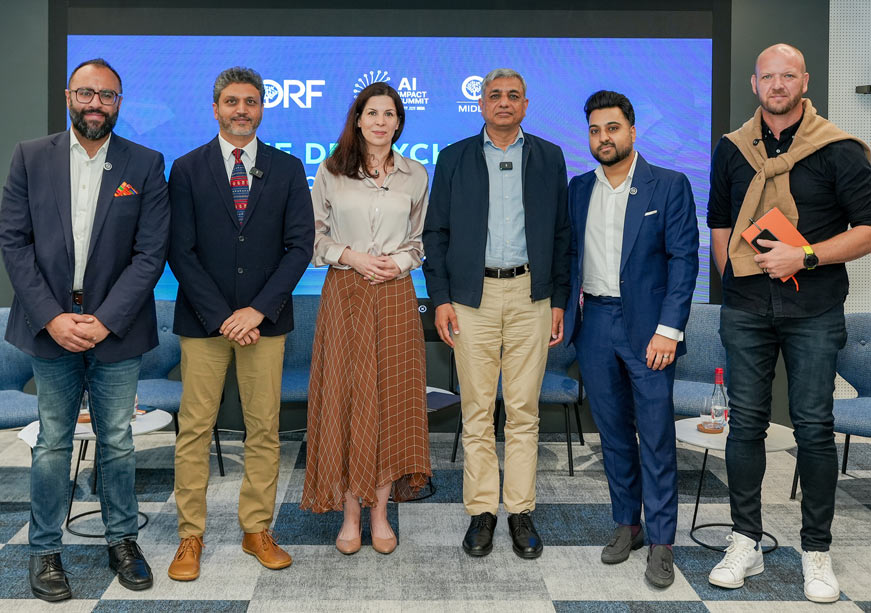
The Observer Research Foundation (ORF) Middle East convened a closed-door roundtable as part of its Market to Policy series to examine the growing role of artificial intelligence (AI) in government services and the transition from digitised public administration towards more autonomous, agentic systems.
The role of AI in public services is increasingly moving beyond simple automation and chatbot interfaces towards more autonomous “agentic” AI (AAI) systems capable of planning, coordinating and executing complex tasks with varying degrees of human intervention. While governments worldwide have spent the past decade digitising public services and building digital public infrastructure, AAI presents the possibility of a new phase of public-sector transformation in which AI systems can coordinate actions across multiple departments and services on behalf of citizens and businesses. This shift is particularly relevant in the Gulf region, where governments have invested heavily in digital transformation initiatives over the past decade. The UAE, for example, has announced ambitions to transition 50 percent of government sectors and services to AAI over the next two years.
The potential benefits are significant. AAI systems promise to reduce administrative burdens, eliminate duplication across government entities, improve accessibility through multilingual and personalised interfaces, and provide faster and more seamless service delivery. For governments, such systems may help address rising service demand while improving operational efficiency and policy implementation. For citizens and businesses, they offer the prospect of seamless interactions via a single interface capable of coordinating services across multiple agencies.
However, the transition also raises important questions around accountability, transparency, cybersecurity, data governance, and public trust. AAI systems are capable of initiating actions, making recommendations or coordinating decisions with increasing levels of autonomy. As governments explore these technologies, policymakers face the challenge of balancing efficiency gains with appropriate human oversight, ensuring that public-sector AI remains auditable, equitable, resilient and aligned with citizens’ rights.
Challenges and Considerations
- The transition to agentic government requires institutional integration rather than simply deploying new AI tools.
Participants noted that the concept of AAI is often misunderstood as the deployment of a single technology. Instead, AAI was described as an architectural approach capable of integrating existing government data systems and decision-making processes across departments and agencies. In practical terms, the objective is to create a more seamless citizen experience by reducing fragmentation between government entities and allowing systems to coordinate actions on behalf of users and public service employees.
The United Arab Emirates (UAE) enters this transition from a relatively strong position due to its mature digital government infrastructure and widespread adoption of digital identity systems, resulting in a “very high” digital competitiveness ranking. However, significant challenges remain around coordinating processes across ministries and jurisdictions, particularly given the UAE’s federal structure and multiple regulatory environments within even single emirates. Participants stressed that many existing public services remain siloed, making interoperability and workflow integration a prerequisite for any successful deployment of agentic systems.
Discussion also focused on identifying which services are most suitable for early experimentation. Participants generally agreed that “high-volume, low-risk” administrative services such as licence renewals, parking services, and permit applications offer the most practical starting point. By contrast, high-impact decisions involving healthcare, immigration, social welfare, security screening, or judicial outcomes were viewed as areas where human decision-making should remain central as any false decisions would impact directly upon basic rights.
Participants repeatedly emphasised that access to a human decision-maker should remain a fundamental element of agentic public services. Systems should include straightforward escalation pathways, appeals mechanisms, and the ability to reverse or review decisions when rights or entitlements may be affected. All participants agreed that auditability, traceability, and reversibility should be built into agentic systems from the outset.
- Accountability, oversight, and workforce adaptation will determine public trust in agentic systems.
In the debate over who should be accountable when an AI agent initiates, recommends, or executes a government action, software developers, system integrators, government agencies, or individual public officials all emerge as potential holders of legal and operational accountability.
To avoid accountability gaps, clear lines of responsibility were recommended to be established before deployment. Suggestions included assigning named officials to oversee high-autonomy systems, requiring comprehensive audit logs for all AI-enabled decisions, and introducing independent certification and assurance mechanisms prior to deployment. Participants argued that institutions should be capable of monitoring the full lifecycle of agentic workflows, understanding how decisions are reached, and identifying failures before they create systemic problems. This would require continuous monitoring capabilities rather than relying solely on retrospective audits.
The discussion also addressed the implications for public-sector employment. Participants observed that efficiency gains generated by AI could alter the role of government employees, However, rather than eliminating jobs entirely, participants suggested that many human roles may evolve towards auditing, supervising, managing and improving AI-enabled systems. This shift would require significant investments in technical training, upskilling and institutional capacity-building.
Importantly, participants argued that legislation and regulatory frameworks should be developed prior to large-scale deployment. Establishing governance standards in advance was viewed as essential for building public trust and reducing uncertainty for both public institutions and technology providers.
- Data governance, cybersecurity, and resilience must be built into agentic systems from the outset.
Considering that agentic government systems will require far greater levels of data sharing across ministries and public entities than existing digital government services, data governance was inevitably discussed as one of the most important enabling conditions for successful deployment. Participants emphasised the need for clear data categorisation frameworks, transparency regarding how data is collected and shared, and stronger public awareness of individual data rights.
Participants with data security backgrounds indicated that highly sensitive government and citizen data would likely need to remain hosted domestically, however, it was also stressed that localisation alone does not guarantee resilience. Recent cloud service disruptions and regional geopolitical tensions were cited as reminders that business continuity planning, redundancy, and operational resilience must remain central considerations in system design for the Gulf Cooperation Council (GCC) region especially.
While human error remains the primary source of cybersecurity incidents, particularly through phishing attacks, poor data handling practices and misuse of digital tools, AAI was nevertheless perceived as introducing new risks. For example, autonomous agents may be capable of impersonating other agents or accessing information across systems in unintended ways if governance controls are weak. Participants therefore advocated for strong identity management, continuous monitoring, and built-in “kill switches” that allow systems to be halted quickly if unexpected behaviour emerges.
Policy Recommendations
- Prioritise low-risk, high-volume services while preserving human review for high-impact decisions.
Governments should begin deployment in administrative areas where decisions are highly repetitive, easily reversible and carry limited consequences for citizens. Services involving healthcare, immigration, welfare, taxation, security screening, and judicial outcomes should continue to maintain robust human oversight and accessible appeals mechanisms.
- Establish comprehensive accountability and certification frameworks before large-scale deployment.
Governments should develop clear liability frameworks that assign legal responsibility for agentic systems, require auditability across all stages of decision-making and establish independent certification mechanisms to assess system performance, reliability and compliance.
- Build resilient data governance and cybersecurity architectures.
Agentic systems should incorporate privacy-by-design principles, transparent data-sharing frameworks, domestic hosting arrangements for sensitive information where appropriate, strong observability capabilities, and emergency intervention mechanisms such as kill switches. Cybersecurity strategies should place equal emphasis on technological controls and human behaviour.
- Invest in public-sector capability building and citizen trust.
Governments should support workforce upskilling programmes focused on AI supervision, auditing, and governance while simultaneously improving public awareness of data rights, AI-enabled decision-making and avenues for human recourse. Accessibility across languages, education levels and digital literacy levels should remain a central design principle.
Conclusion
AAI has the potential to significantly improve government service delivery by reducing administrative friction, improving coordination between agencies, and creating more personalised citizen experiences. However, the transition from digital government to agentic government represents a broader institutional transformation rather than a purely technological upgrade. Success will depend not only on advances in AI capabilities, but also on the establishment of robust accountability frameworks, resilient data governance systems, effective cybersecurity protections and maintaining public trust. As governments across the GCC increasingly explore agentic models, the challenge will be ensuring that efficiency gains are balanced with transparency, human oversight, and the protection of basic rights.
Elizabeth Heyes is a Junior Fellow in Emerging Technologies at the ORF Middle East
The author acknowledges the use of ChatGPT 5.5 to generate a draft outline for this paper.