 Global
Expert Speak | 25 May, 2026
The Return of Nuclear Competition
The following excerpt is from Chapter 3 — New Arenas of Great-Power Competition of ORF Global Quarterly: Disruption and Recalibration.
In early February 2026, the Trump Administration announced that it would not extend the Strategic Arms Reduction Treaty (New START), allowing it to lapse.[1] This decision is best understood in the context of intensifying strategic competition between the United States (US) and China over trade, critical minerals, and supply chains, as well as their reciprocal efforts to expand and modernise nuclear arsenals. The emerging nuclear competition is increasingly being shaped by a key structural driver: the expansion of Chinese military power.
Given this backdrop, two issues warrant closer examination. The first is the potential resumption of nuclear testing by certain Nuclear-Weapon States (NWS). The second concerns regional proliferation, the erosion of extended deterrence guarantees, the weakening of monitoring and surveillance mechanisms, and the broader decline of nuclear arms control—developments that risk intensifying nuclear competition.
Testing New Nuclear Designs
China, according to the United States (US), conducted a nuclear test in June 2020. While Beijing has vehemently denied the claim, two seismic events in close proximity to each other was detected by an International Monitoring Station (IMS) of the Comprehensive Test Ban Treaty Organization (CTBTO) in Kazakhstan.[2] The tremor was recorded at 2.75 on the seismic scale.[3] Although clear evidence of China’s conduct of a supercritical nuclear test is unavailable from Open Source Intelligence (OSINT), if such a test did occur as American officials allege, China may have carried out a secretive decoupling test designed to conceal seismic and optical activity.[4] The latter is likely to have been detected by American intelligence, which possesses advanced seismic monitoring capabilities. If China did conduct a test, it was likely associated with a newly designed warhead. At the United Nations Conference on Disarmament (UNCD) in early February 2026, an American official presented data supporting Washington’s claim.[5] China, for its part, declared the American allegation “completely groundless.”[6]
As Table 1 indicates, among all NWS, Beijing has a strong incentive to conduct additional testing, having carried out only about 46 nuclear tests (including the June 2020 test)—far fewer than the US which has conducted more than 1,000, and Russia, with over 700. This disparity may partly explain China’s decision to test what was most likely a newly designed low-yield device.
Table 1. Nuclear Tests, by Country
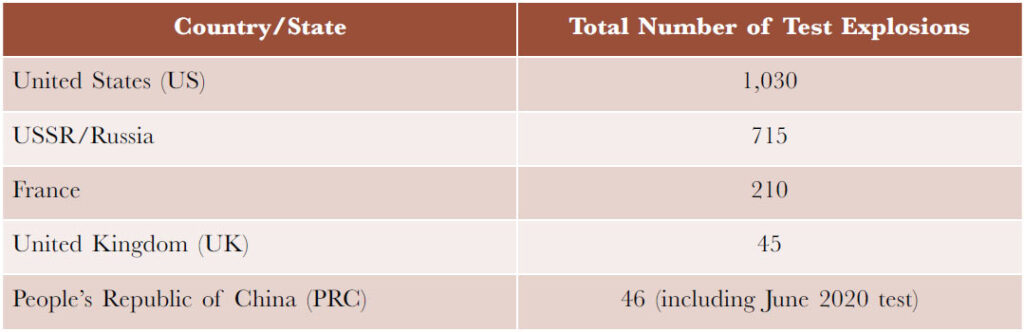
Source: Arms Control Association[7]
Regardless of the uncertainty around China’s alleged nuclear test in 2020, it has at the very least provided an impetus for a renewed round of nuclear testing. The June 2020 test during the first Trump Administration—an event Washington highlighted and raised an alarm over—reinforced the push for nuclear testing under the second Trump Administration. In October 2025, the Trump Administration announced that it would resume nuclear testing,[8] ending a hiatus of more than three decades. The US has several new warhead designs developed under its Reliable Replacement Warhead (RRW) programme, initiated in early 2005 by the United States Congress.[9]
These factors have created the conditions for competitive nuclear modernisation among the US, China, and Russia, with potential implications for other nuclear-armed states. They also explain why Washington declined to renew the New START Treaty, which expired on 4 February 2026.
Arms Control Takes a Back Seat
The American decision to let the New START Treaty lapse indicates that the US views nuclear arms control more as a constraint than as a mechanism for regulating and managing nuclear competition. Concluded in 2011, the treaty capped strategic nuclear weapons at 1,550 and required renewal every five years.[10]
Meanwhile, China has emerged as a key variable in contemporary nuclear competition. The growth in China’s capabilities represents the most critical factor driving the revival of nuclear competition among the nuclear powers. Chinese nuclear capabilities are expanding rapidly,[11] which the US regards as both a strategic challenge and threat. Beijing is expanding its triad of nuclear delivery capabilities.[12] Although the US and Russia possess about 90 percent of the world’s nuclear weapons, the Trump Administration has called for a trilateral agreement among Washington, Moscow, and Beijing, framing it as a “new, improved, and modernized treaty designed to endure well into the future.”[13] The US does not regard Russia as a peer competitor, despite its nuclear strength.[14] A tripartite agreement has been rejected by both Moscow and Beijing.[15] The latter considers its arsenal, despite ongoing expansion, too limited to justify constraints imposed by an arms control agreement. Moscow, meanwhile, prefers an agreement that also includes the other two recognised nucleararmed states, France and the United Kingdom (UK), whose arsenals are smaller than China’s.[16]
The European states with nuclear weapons are also considering the possibility of an independent “Euro-deterrent”. This reassessment comes against the backdrop of the Russian invasion of Ukraine, rising doubts about US commitment to extended deterrence for Washington’s European allies in the North Atlantic Treaty Organization (NATO) under the Trump Administration, and the rapid expansion of the nuclear arsenals of China, India, Pakistan, and North Korea.[17] France maintained an independent nuclear deterrent, whereas the UK has relied on the US for Trident missiles and their maintenance. There is now a call for a “fully independent British nuclear deterrent.”[18] France has offered to extend its nuclear deterrent guarantee to European allies—signalling a shift in Paris’ defence policy.[19] A plausible outcome could be France and the UK consolidating their capabilities in coordination with Germany to establish an independent European nuclear deterrent, particularly if Washington’s nuclear guarantee weakens.
The growth in China’s nuclear capabilities represents the most critical factor driving the revival of nuclear competition among the nuclear powers.
In contrast to Europe, Northeast Asia remains a key region where the American nuclear umbrella is expected to remain robust. In an official communiqué and in official testimony before the United States House Foreign Affairs Subcommittee on East Asia and the Pacific, the Trump Administration has emphasised that for Japan and South Korea, the US’s nuclear deterrent guarantee will remain intact and robust.[20]
Beyond proliferation arising from competition among the NWS and de-facto nuclear-armed states, a bilateral nuclear pact between Saudi Arabia and Pakistan, concluded in September 2025, could trigger regional proliferation in West Asia.[21] The Saudi–Pakistan nuclear partnership is likely to intensify Iran’s drive to develop its nuclear weapons capability. Iran’s nuclear ambitions, regardless of the ruling regime, pose a proliferation risk, as they could compel Türkiye and Egypt to reconsider both their nuclear posture and their designation as Non- Nuclear Weapon States (NNWS). Consequently, horizontal proliferation may potentially gain greater traction as strategic competition and the pursuit of dominance among the region’s major powers generate strong incentives for nuclear expansion. Dyadic conflicts between India and China, and between India and Pakistan—rooted in deep territorial, historical, and cultural animosities—are also likely to accelerate vertical proliferation as part of this renewed round of strategic competition among the NWS.
More broadly, nuclear proliferation driven by uncertainties surrounding Washington’s extended deterrence guarantee to NATO’s European members is creating conditions for a potential Euro-deterrent. In addition, the integrity and reliability of monitoring mechanisms of the CTBTO for detecting seismic activity triggered by nuclear tests have come under scrutiny, particularly following the alleged Chinese nuclear test of June 2020. Finally, the expiration of the New START Treaty will serve as a catalyst for vertical proliferation in strategic nuclear weapons.
Conclusion
Various factors are driving the revival of nuclear competition among major powers. However, the most decisive factor shaping this shift is dyadic great-power strategic competition between the US and China. Beijing has abandoned its selfrestraint on nuclear expansion and now seeks to neutralise American nuclear superiority both quantitatively and qualitatively. Although Russia retains a substantially larger nuclear arsenal than China, the US-Russia nuclear relationship is increasingly becoming only secondary to the nuclear rivalry between Beijing and Washington. Sino-Russian cooperation on arms control, even if only tacit, is intended to create leverage and counterbalance American nuclear strength. The possible emergence of a Euro-deterrent would introduce a quadrangular contest involving the designated NWS and Germany. Nuclear states with smaller arsenals such as India, Pakistan, and North Korea may seek to expand their capabilities. China-US nuclear competition could adversely affect the China- India nuclear dyad by compelling New Delhi to pursue further nuclear expansion.
This, in turn, would place greater competitive pressure on the India–Pakistan nuclear dyad. Beyond South Asia, regional proliferation in the Middle East is likely to intensify in the wake of the Saudi Arabia-Pakistan nuclear pact and Iran’s renewed nuclear ambitions. Türkiye and Egypt, in responding to the acquisition of and cooperation of key states in securing nuclear weapons, risk undermining nuclear restraint and weakening the broader non-proliferation regime.
Kartik Bommakanti is Senior Fellow, Defence and National Security, Observer Research Foundation.
[1] Jack Detsch, “Trump Says He Won’t Extend Nuclear Arms Treaty with Russia,” Politico, February 5, 2026, https://www.politico.com/news/2026/02/05/trump-nuclear-arms-treaty-russia-00767497.
[2] “12 Seconds Apart: Twin Seismic Pulses in China That Set Off US Nuclear Alarm,” NDTV, February 19, 2026, https://www.ndtv.com/world-news/china-nuclear-test-how-a-2020-tremor-through-central-asia-unmasked-chinasnuclear- secrets-11057352.
[3] “12 Seconds Apart: Twin Seismic Pulses in China That Set Off US Nuclear Alarm”.
[4] Joseph Rodgers and Joseph S. Bermudez Jr., “Satellite Imagery Analysis of China’s Alleged 2020 Nuclear Test at Lop Nur,” Center For Strategic & International Studies, February 13, 2026, https://www.csis.org/analysis/satellite-imageryanalysis- chinas-alleged-2020-nuclear-test-lop-nur#:~:text=While%20the%20U.S.%20Geological%20Survey,hide%20 optical%20and%20seismic%20signatures.
[5] Rodgers and Bermudez Jr, “Satellite Imagery Analysis of China’s Alleged 2020 Nuclear Test at Lop Nur”.
[6] Richard Stone, “Allegations of a Chinese Nuclear Blast May Reignite Weapons Testing,” Science, February 24, 2026, https://www.science.org/content/article/allegations-chinese-nuclear-blast-may-reignite-weapons-testing.
[7] Nuclear Testing Tally: Fact Sheet & Briefs, Arms Control Association, October 2025, https://www.armscontrol.org/ factsheets/nuclear-testing-tally#:~:text=United%20Kingdom:%20(45%20total%20nuclear,Not%20a%20CTBT%20 signatory.
[8] Max Matza, “Trump Directs Nuclear Weapons Testing to Resume for First Time in Over 30 Years,” BBC, October 30, 2025, https://www.bbc.com/news/articles/c4gzq2p0yk4o.
[9] Jonathan Medalia, “The Reliable Replacement Warhead Program: Background and Current Developments,” CRS Report for Congress, June 12, 2007, pp. 17-25.
[10] “New START Treaty,” U.S. Department of State, https://www.state.gov/new-start-treaty.
[11] Hans M. Kristensen et al., “Chinese Nuclear Weapons, 2025,” Bulletin of Atomic Scientists, March 12, 2025, https:// thebulletin.org/premium/2025-03/chinese-nuclear-weapons-2025/.
[12] Ann Scott Tyson, “As US and Russia Unbind from Nuclear Treaty, China’s Arsenal Has Been Growing,” The Christian Science Monitor, March 3, 2026, https://www.csmonitor.com/World/Asia-Pacific/2026/0303/As-US-and-Russia-unbindfrom- nuclear-treaty-China-s-arsenal-has-been-growing.
[13] Fred Weir, “Russia is Finding Post-START Arms Control a Harder, Multipolar Project,” The Christian Science Monitor, February 13, 2026, https://www.csmonitor.com/World/Europe/2026/0213/new-start-russia-us-arms-controlnuclear- weapons-china#:~:text=%E2%80%9CThe%20U.S.%20clearly%20doesn’t,one%20is%20on%20the%20 horizon.%E2%80%9D; Xiaodon Liang, “New START Expires As U.S. Urges ‘Modernized’ Treaty,” Arms Control Today, March 2026, https://www.armscontrol.org/act/2026-03/news/new-start-expires-us-urges-modernized-treaty.
[14] Weir, “Russia is Finding Post-START Arms Control a Harder, Multipolar Project”.
[15] Enoch Wong, “China Rejects Trump Proposal to Join US-Russia Nuclear Disarmament Talks,” South China Morning Post, August 27, 2025, https://www.scmp.com/news/china/diplomacy/article/3323375/china-rejects-trump-proposal-joinus- russia-nuclear-disarmament-talks.
[16] Weir, “Russia is Finding post-START Arms Control a Harder, Multipolar Project”.
[17] Paula Soler, “Q&A: What Does the End of Nuclear Arms Control Mean for Europe,” The Parliament, February 6, 2026, https://www.theparliamentmagazine.eu/news/article/qa-what-does-the-end-of-nuclear-arms-control-mean-for-europe.
[18] Brian Wheeler, “UK Must Build Own Nuclear Missiles, Say Lib Dems,” BBC, March 15, 2026, https://www.bbc.com/news/articles/cy0dz1k0rr4o.
[19] President Delivers Speech on France’s Nuclear Deterrence, Embassy of France (UK), March 4, 2024, https://uk.diplomatie.gouv.fr/en/president-delivers-speech-frances-nuclear-deterrence.
[20] Ministry of Foreign Affairs, Government of India, https://www.mofa.go.jp/press/release/pressite_000001_02104.html; “Rep. Bera Presses Trump Official on U.S. Extended Deterrence Commitments to South Korea,” U.S. Representative Ami Bera, March 26, 2026, https://bera.house.gov/news/press-releases/rep-bera-presses-trump-official-on-us-extendeddeterrence- commitments-to-south-korea.
[21] “Pakistan Extends Nuclear Deterrence to Saudi Arabia,” Arms Control Association, October 2025, https://www. armscontrol.org/act/2025-10/news-briefs/pakistan-extends-nuclear-deterrence-saudi-arabia.