 Global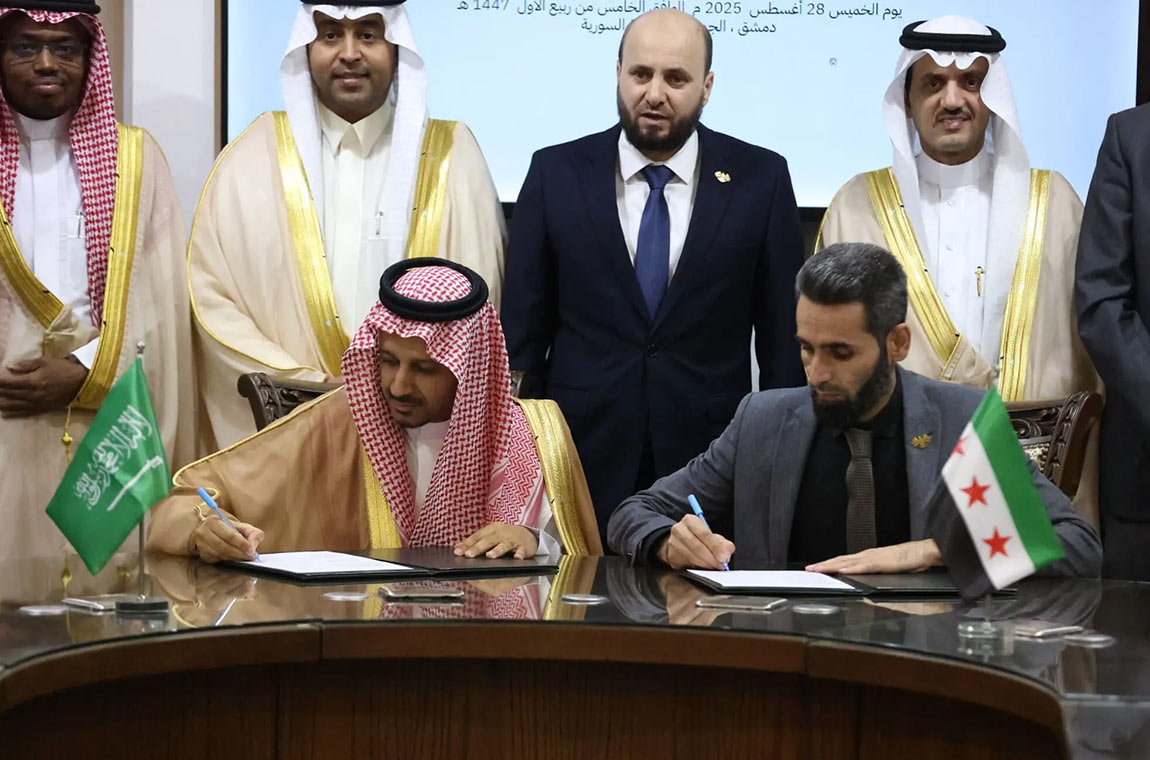
Expert Speak | 18 September, 2026
Gulf Strategies in Post-Sanctions Syria
Spotlight
- Gulf nations are executing distinct geopolitical strategies in Syria, with some prioritising cross-border transit networks and institutional banking links while others anchor their presence through maritime gateways and urban commercial nodes.
- Far from fragmenting regional logistics, inter-Gulf competition is actively accelerating infrastructure integration in Syria, where transit systems and urban real-estate developments overlap.
- The central policy challenge for Damascus is to assert active regulatory discipline and ensure that incoming foreign capital builds sovereign state capacity rather than leading to fragmented foreign control.
The removal of Syria from the United States (US) State Sponsors of Terrorism list on 24 August 2026 erased an important barrier that had kept Damascus largely disconnected from global capital markets. The subsequent processing of Syria’s first international Visa and Mastercard transactions provided a visible signal of its return to international financial networks. While these regulatory shifts do not constitute immediate economic normalisation—Syria remains constrained by institutional fragility, damaged physical assets, and deep security risks—they mark a move away from enforced isolation towards an increasingly competitive landscape for foreign investment.
Gulf Arab states have rapidly capitalised on this institutional opening. Saudi Arabia and the United Arab Emirates (UAE) are emerging as two of the most consequential foreign investors in post-conflict Syria. While both capitals view Damascus through the lens of infrastructure, logistics, and trade, their operational frameworks reflect distinct strategic priorities. Beyond individual commercial deals, Riyadh’s and Abu Dhabi’s expanding footprints are not only financing Syria’s physical recovery, but also actively competing to build the broader geoeconomic networks through which the Levant will reintegrate into the Middle Eastern order.
Two Strategies, One Opening
The divergence between the two Gulf strategies is structural: Saudi Arabia is establishing the outward-facing land corridors, financial channels, and media frameworks through which regional reintegration must pass, while the UAE is instituting an operational presence across the maritime gateways and urban commercial nodes that anchor this economic activity. For both countries, however, the strategic rationale extends beyond commercial returns. Embedding capital in Syria’s critical infrastructure and economic networks also creates channels of influence, allowing Saudi Arabia and the UAE to shape the country’s regional economic orientation while strengthening their broader positions in the Levant.
Embedding capital in Syria’s critical infrastructure and economic networks also creates channels of influence, allowing Saudi Arabia and the UAE to shape the country’s regional economic orientation while strengthening their broader positions in the Levant.
In late August 2026, Riyadh and Damascus signed four Memoranda of Understanding (MoUs) encompassing transport corridors, rail networks, civil aviation, and postal interconnectivity. These MoUs prioritise institutional capacity building, technical feasibility studies, and direct grid rehabilitation, supported by administrative measures, such as streamlined visa procedures for logistics operators. Concurrently, the establishment of a joint Saudi-Syrian banking mechanism in August 2026 provides a regulated channel to clear cross-border corporate transactions and manage sovereign capital flows.
This structural push is reinforced by an institutional narrative framework. On 30 August 2026, the Saudi Broadcasting Authority and Syria’s General Organization of Radio and TV signed another MoU in Riyadh to expand broadcasting cooperation, technical exchanges, and joint content production. This state media alignment is far from a symbolic gesture: it can help manage public perceptions, normalise institutional reintegration, and create a more favourable environment for long-term economic engagement.
The Saudi approach focuses on macro-level network connectivity. Transport links govern physical supply chains, while financial channels enable cross-border transactions and investment. Since these structural agreements focus on long-term connectivity rather than immediate financial returns, their primary dividend at this stage is institutional: establishing the clearing mechanisms and regulatory standards required for sustained market re-entry.
In parallel, the UAE is operating as a commercial catalyst, deploying capital across high-value urban assets, logistics networks, and direct private-sector joint ventures. Rather than focusing solely on public infrastructure, Abu Dhabi is integrating real-estate development with strategic supply-chain hubs, formalising this push through the reactivated UAE–Syria Joint Business Council. This model is anchored by two flagship investments: a US$7-billion mixed use real-estate project by developer Arada in partnership with the Syrian Sovereign Fund in ‘New Damascus,’ and the Dubai-based DP World’s US$800 million 30-year concession to modernise and operate the Port of Tartus. While Arada’s project, spanning four million square metres, brings together residential, commercial, healthcare, and educational facilities, DP World establishes a direct Emirati footprint over Syria’s primary Mediterranean trade gateway.
Network Overlap and Strategic Interdependence
The functional divergence between Saudi Arabia and the UAE should not be mistaken for a static division of labour. Transit links, municipal infrastructure, and urban centres are inherently intertwined; therefore, Saudi and Emirati interests continuously converge. This dynamic demonstrates how regional geoeconomic competition between regional actors can accelerate infrastructure integration rather than fragmenting it, particularly where transport and logistics networks overlap. The planned US$2 billion Damascus Metro project illustrates this convergence, attracting consortiums aligned with both Saudi and Emirati capital under Build-Operate-Transfer frameworks. An urban transit network could consequently connect residential and commercial developments with the wider transport infrastructure being rehabilitated through Saudi-backed initiatives.
In post-conflict geoeconomics, structural influence is not acquired by securing the largest volume of isolated contracts, but by shaping the central systems around which the economy reorganises. Arterial transport corridors dictate trade orientation; financial clearing houses set transaction standards; and urban developments concentrate real-estate value and corporate talent. External actors that embed themselves within these core assets can gain lasting influence over the domestic economy’s direction.
In post-conflict geoeconomics, structural influence is not acquired by securing the largest volume of isolated contracts, but by shaping the central systems around which the economy reorganises.
In Syria’s context, this phenomenon was qualified by an unprecedented financial deficit. In October 2025, World Bank assessments estimated Syria’s post-conflict reconstruction needs at US$216 billion. Given the magnitude of this recovery burden, Syria cannot rely on a single foreign patron, making multi-actor investment a necessity. However, capital deployment is never strategically neutral. The physical and financial networks built during this initial reconstruction will influence which regional markets Syrian enterprises can access, which transport corridors gain dominance, and how foreign states exert influence across the Levant.
Geoeconomic Corridors and Competing Turkish Influence
The strategic value of post-sanctions Syria extends far beyond its domestic consumer market; it rests on the nation’s spatial role as a primary hinge connecting the Gulf Cooperation Council (GCC) nations, the Levant, Türkiye, and the Eastern Mediterranean. It also intersects directly with the broader geoeconomics of the India–Middle East–Europe Economic Corridor (IMEC). It complements Syria’s own “Four Seas and Its Nine Corridors Initiative” as well, which seeks to position Damascus at the centre of ground- and sea-based trade in electricity, oil, and goods linking the Persian Gulf, the Caspian, the Black Sea, and the Mediterranean.
Although the initial 2023 IMEC framework routed its Northern Corridor through Jordan and Israel to Mediterranean ports, modern multimodal networks operate flexibly rather than statically. Given the persistent political, military, and security bottlenecks surrounding the original Israeli transit leg, a Syrian route could theoretically offer an alternative overland alignment. By creating overland rail corridors from Saudi Arabia through Jordan and Syria towards the modernisation hub at Tartus, Gulf states could also gain an additional path to Eastern Mediterranean maritime lanes.
Simultaneously, Saudi and Emirati capital deployment in Syrian transport corridors could serve as a counterweight to growing Turkish economic influence. Unchecked Turkish infrastructure expansion risks creating a structural dependency on Levantine transit routes. By financing Syrian road rehabilitation, railway modernisation, and central financial systems, Riyadh and Abu Dhabi can help anchor Syrian transit architecture to GCC financial hubs rather than Turkish logistical networks. This approach will position Syria as a two-way corridor, enabling Gulf capital to access Turkish and European markets while potentially giving Damascus greater bargaining power over the infrastructure underpinning these connections.
However, this geographic leverage carries clear limits. As regional actors compete over who finances, operates, and secures these overlapping corridors, an institutionally fragile Syria risks being drawn into external geopolitical contests that it is not yet stable enough to participate in.
The Governance Threshold: Institutional Capacity and Regulatory Oversight
For Damascus, the emerging geoeconomic ‘rivalry’ between Riyadh and Abu Dhabi presents a strategic opportunity to convert vulnerability into sovereign leverage. The presence of competing partners avoids asymmetrical reliance on a single patron.
However, without active regulatory discipline, foreign inflows risk creating insulated economic enclaves and purely extractive transit corridors that yield minimal domestic return. To secure tangible developmental gains, Damascus must establish clear conditions to ensure that investment generates domestic value, tying Saudi transport corridors to local export integration and conditioning Emirati real-estate megaprojects on technology transfers, local sourcing, and skilled job creation.
The central policy challenge facing Damascus is not choosing a preferred Gulf partner, but demonstrating the governance standards, administrative capacity, and regulatory discipline required to manage sovereign funds and the external competition surrounding them transparently and effectively.
Ultimately, these incoming investments represent an immediate institutional stress test for the Syrian state. The central policy challenge facing Damascus is not choosing a preferred Gulf partner, but demonstrating the governance standards, administrative capacity, and regulatory discipline required to manage sovereign funds and the external competition surrounding them transparently and effectively. If its central governance is incapable of steering this competition, Damascus risks falling victim to foreign extraction, losing regulatory control over strategic assets, and seeing its sovereign authority diluted by the competing external powers. However, should Syrian state institutions channel this competitive capital into a cohesive national strategy, regional rivalry can serve as the engine for post-conflict recovery. If Damascus fails this institutional test, it will simply exchange past political isolation for a new form of fragmented geoeconomic dependency.
Giada Kabrit is Program Assistant and Intern Coordinator, ORF Middle East.
The author acknowledges the use of ChatGPT 5.5 for language refinements prior to submission.