 Global
Expert Speak | 02 October, 2026
Mapping Critical Minerals in the UAE: Strategic Demand, Supply Gaps and Climate Trade-Offs
Spotlight
- The UAE needs a national critical minerals list and cannot borrow one from the IEA, USGS or EU.
- The UAE’s mineral demand has two tiers—broad/recurrent minerals like copper, aluminium, and steel for existing infrastructure and narrow/irreplaceable minerals such as lithium, cobalt, and REEs tied to the transition targets.
- The UAE is working towards closing the supply gap. Currently, it is stronger for aluminium, copper, and lithium but absent for titanium, PGMs, gallium, and tantalum.
Critical minerals have gained considerable prominence in government economic and national security agendas. This increased focus has emerged from concerns over supply-chain concentration and geopolitical exposure, be it the Chinese export restrictions on rare earth elements (REEs) or conflict-driven disruptions in the Middle East. The United Arab Emirates (UAE) is responding by leveraging its financial capital and geographic position to secure supply chains, even though it has limited mineral wealth of its own and remains structurally import dependent for raw-material processing.
Despite their significance to its industrial growth ambitions, the UAE still lacks a national critical minerals list. Adopting a critical minerals list from the United States Geological Survey (USGS), European Union (EU), or International Energy Agency (IEA) would not work for the UAE as a hydrocarbon-rich, mineral-poor economy pursuing rapid diversification. This article identifies which minerals are critical for the nation by mapping mineral demand across its strategic sectors and examines its supply position vis-à-vis these.
A UAE-Specific Approach to Criticality
The relevance of critical minerals to the UAE’s economic growth stems from its strategic commitments. These include Operation 300 bn, the Energy Strategy 2050, the National Space Strategy 2030, the Dubai Industrial Strategy 2030, and the Etihad Rail, among others, in policy areas on circular economy, green growth, industry, and artificial intelligence (AI).
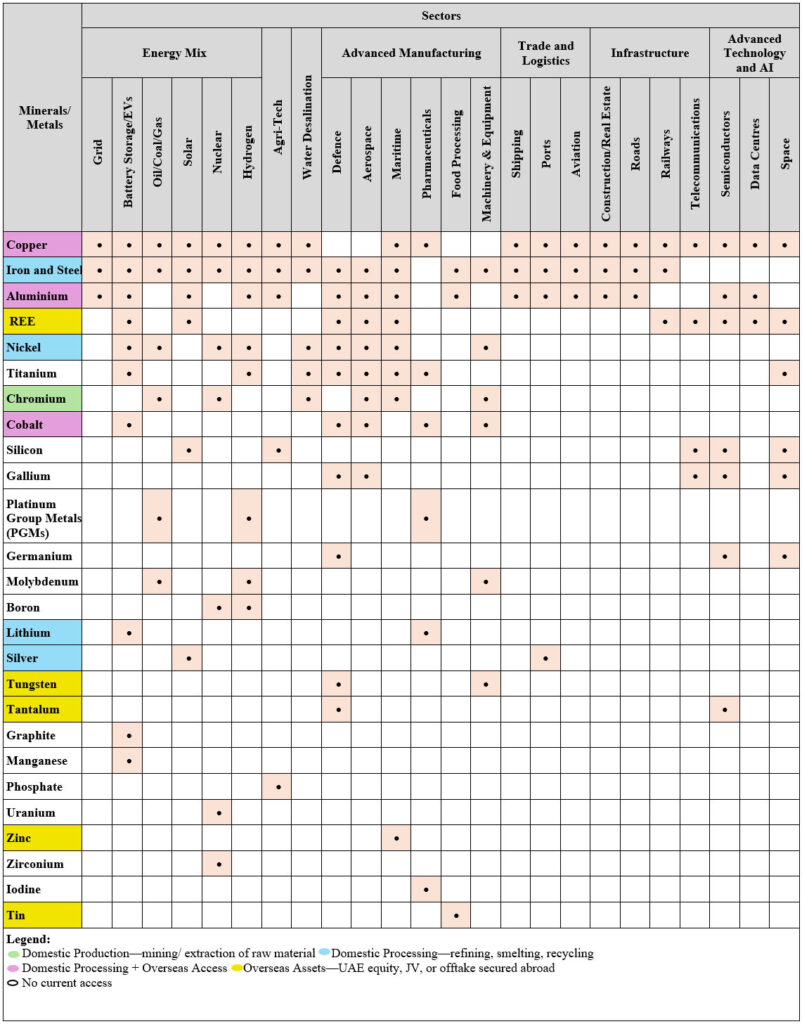
These policies identify 24 sectors (see Table 1) across energy, resource security, advanced manufacturing, trade and logistics, infrastructure, and advanced technology that the UAE is focusing on and that have large material requirements. The 24 sectors were mapped against the individual minerals that each depends on to build a mineral-by-sector matrix of critical minerals for the UAE. This list measures criticality by how often the mineral occurs across UAE’s strategic sectors. Due to the non-availability of data, criticality is not measured by the volume of the mineral required or its supply chain.
- The energy mix includes the electricity grid, battery storage and Electric Vehicles (EVs), traditional hydrocarbons, solar, nuclear, and hydrogen. These form the baseline of the UAE’s transition and diversification agenda using the widest spread of minerals.
- The agri-tech and water desalination sectors provide resource security. They have a smaller mineral footprint but are crucial for the country. Advanced manufacturing sectors include defence, aerospace, maritime, pharmaceuticals, food processing, and machinery and equipment. These have been split into two distinct types of demands—sectors with existing capacity including aluminium and fabricated metals, food processing, and pharmaceuticals; and sectors where the mineral demand is tied to the UAE’s future targets including defence, aerospace, and maritime.
- The trade and logistics, as well as infrastructure sectors, including shipping, ports, aviation, roads, railways, and construction, are mineral-light and already served by existing steel and aluminium supply chains.
- The advanced technology and AI sectors (semiconductors, space, and data centres) are the newest and fastest growing but also the most speculative categories. Data-centre demand is real and current while semiconductor demand remains contingent on the UAE’s chip-manufacturing ambitions.
Table 1: The UAE’s Strategic Sections: A Mineral-Wise Breakdown
Source: UAE’s Strategic Sectors.
Note: Mineral input requirements for each sector were identified from technical and industry literature on end-use applications of critical minerals, including IEA sectoral reports, USGS Mineral Commodity Summaries, and sector-specific engineering and industry sources.
Table 1 measures criticality by recurrence, which is only one dimension. It does not encapsulate how essential a mineral is within the sectors or how concentrated is its global supply. Judging purely by recurrence, copper, iron and steel, and aluminium dominate the matrix, but going by strategic intensity and supply risk, minerals that appear in only one or two sectors, such as lithium, are equally critical. Hence, the matrix helps identify two tiers rather than a single ranking.
- Tier 1—Broad/ Recurrent Minerals: Copper (20), iron and steel (19), aluminium (18), REEs (10), nickel (9), and titanium (8) recur across most of the UAE’s strategic sectors, including grid, infrastructure, defence, aerospace, and space, making them critical. Since the UAE imports raw minerals entirely and does not have any domestic mineral wealth, criticality is a function of their occurrence across sectors. A supply gap in any of these minerals would stall multiple sectors simultaneously.
- Tier 2—Concentrated, Low-Substitutability Minerals: Lithium, cobalt, Platinum Group Metals (PGMs), gallium and tantalum recur in fewer sectors but each of these is the most crucial input for its respective sector. Lithium and cobalt are crucial to battery storage and EV targets under the Energy Strategy 2050 and the Net Zero 2050 strategy. PGMs are necessary for green hydrogen, while gallium and tantalum are necessary for defence electronics and semiconductors. The global supply for each mineral is concentrated in a small number of producing and processing countries with few or no substitutes available with existing technology. Their criticality is a function of their depth, and a shortfall would stall the specific industry targets.
Both tiers point to two different kinds of exposures for the UAE. Tier 1 covers the existing infrastructure and industrial base while Tier 2 covers the UAE’s forward-looking transition and diversification agenda. Identifying what the country needs is only half the picture; securing the necessary material is the other.
The UAE’s Supply Position: Mining, Processing, and Overseas Access
Separating the UAE’s position according to upstream access, midstream capacity, and downstream recovery makes it clearer where the country’s supply chains are genuinely secure and where they remain exposed.
Upstream: Raw Material Access
Within the Tier 1 minerals, UAE has the strongest capacity for aluminium. It can acquire aluminium through the Emirates Global Aluminium (EGA) bauxite operations in Guinea and also has domestic alumina refining and smelting capacities, completing the mineral value chain.
For other critical minerals, upstream access has largely been built through overseas equity rather than domestic reserves. In February 2026, Abu Dhabi’s International Resources Holding (IRH) acquired a 51 percent controlling stake in Zambia’s Mopani Copper Mines. The UAE also has a share in copper cathodes produced by the Democratic Republic of Congo’s (DRC) state mining company, Gecamines. Additionally, IRH acquired a majority stake in DRC’s Alphamin Resources mining in one of the world’s largest tin deposits. The UAE has also begun building upstream access for REEs. New Energi Metals Holdings (NEM) signed a Memorandum of Understanding (MoU) with Indonesia in 2026 to explore niobium and REEs in Gabon and Indonesia.
On the other hand, nickel and titanium have no upstream or midstream domestic capacity in the UAE; there is complete import dependency for both. Additionally, the UAE has no domestic uranium reserves and no enrichment capability under the 2009 bilateral nuclear cooperation agreement and non-proliferation policy with the US. The Barakah Nuclear Energy Plant’s fuel security is met entirely through long-term supply contracts with external producers. The UAE cannot close this processing gap through investments and building infrastructure.
Midstream: Processing and Refining
Iron ore is not domestically mined in the UAE, creating an upstream gap, but its EMSTEEL Group operates a domestic integrated steel plant using imported ore and pellets. Similarly, the UAE-based Titan Lithium has built a processing plant in Abu Dhabi Khalifa Industrial Area, producing battery-grade lithium compounds from ore sources in Zimbabwe. It has also signed a supply agreement with Mercedes-Benz for EVs, building midstream capacity for lithium. The UAE is also building midstream capacity for cobalt with DRC with a copper-cobalt refinery. PGMs, gallium and tantalum currently have no domestic mining, processing, or partnerships.
Downstream: Circular Recovery
Circular recovery is another way to secure mineral value chains. EGA acquired assets in 2024 for aluminium recycling in Europe. EMSTEEL has also signed an MoU on circular steel production through scrap and waste recovery. There was also a joint venture in January 2026 between MoEI-BEEAH-LOHUM for recovering lithium, cobalt, and nickel from end-of-life batteries. The UAE also has a commercial scrap sector across copper, aluminium, and steel.
Beyond specific mineral partnerships, the UAE has also signed an MoU with the US on critical minerals cooperation and similar agreements with India, Canada, Australia, Argentina, and Uzbekistan.
Closing the Gap: Towards a National Critical Minerals List
There is a gap between the demand and supply of these minerals in the UAE. Several of the minerals that the nation depends on are ones for which no domestic, offshore, or circular access has yet been built, compounding their criticality.
Criticality must be derived from its own strategic sectors, not borrowed from the USGS, EU or IEA’s lists
While the UAE is securing access to the minerals it lacks through offshore equity and offtake agreements, can it go further and build genuine domestic processing? It has the capacity to do so through investment companies such as ADQ, Mubadala, and IRH. The constraint is technological, not financial. Refining and separating technologies come from either China or the West, making mineral selection geopolitical rather than an industrial decision. The MoU signed with the US offers supply security and access to US-based capital and technology, but rather than pursuing this selectively, the UAE is simultaneously building midstream and circular capacity.
To return to the original premise of this article, the UAE does not have a national critical minerals list. Criticality must be derived from its own strategic sectors, not borrowed from the USGS, EU or IEA’s lists, because the minerals required in a hydrocarbon-rich but low-mineral-wealth economy that is diversifying are vastly different from a manufacturing or mining economy. The UAE’s list needs to understand the country’s economic strategies, supply position, and its net zero targets.
Ishita Kapoor is an applied economist working on critical minerals and sustainable mining.
The author acknowledges the use of Claude Sonnet 5 for language refinements and constructing the mineral-by-sector demand matrix.