 Global
Expert Speak | 23 November, 2026
Framing an Effective Policy Response to South–South Migration
The following excerpt is from the Chapter 1 — ORF Global Quarterly: Societies in Transformation
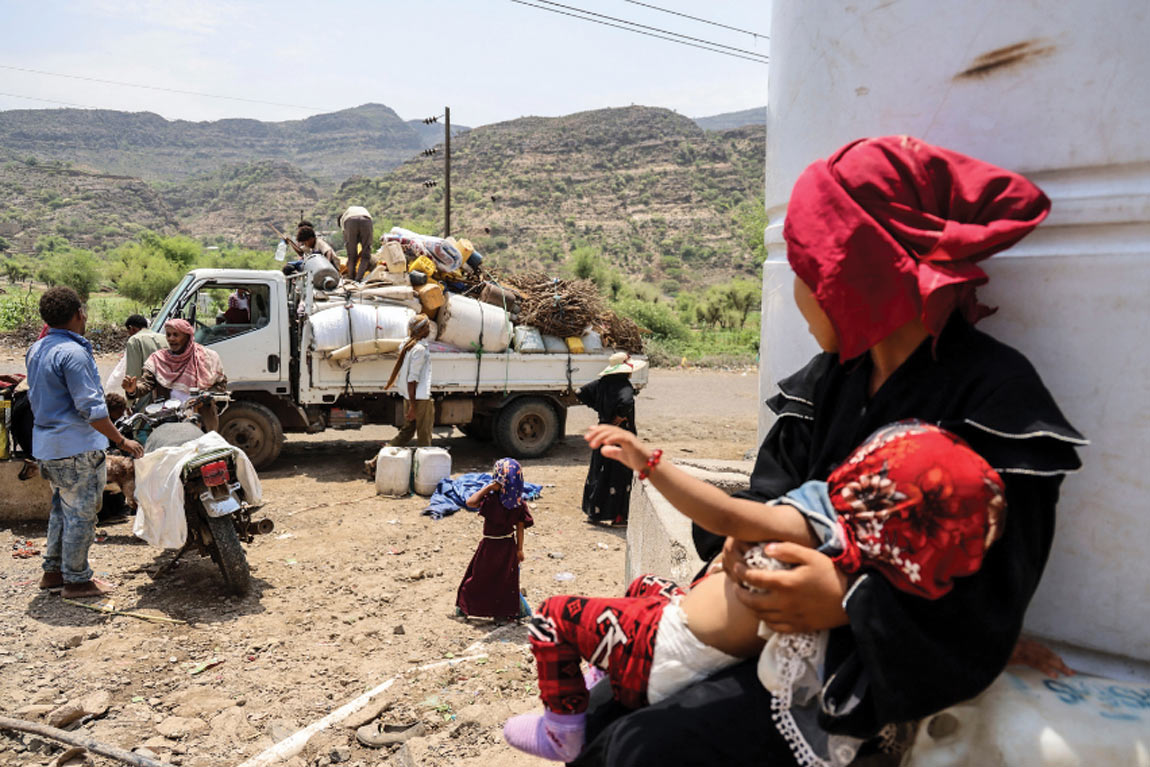
In 2025, when more than 62.2 million incidents of internal displacements were recorded,[1] conflict and violence accounted for more displacements (32.3 million) than disasters (29.9 million), for the first time in history.[2] These drivers, however, overlap: 42 countries experienced displacement associated with both conflict and disasters, highlighting the growing intersection of climate hazards, insecurity, and human migration.[3]
By the end of 2025, the number of people recorded as internally displaced was pegged at 82.2 million.[4] The World Bank projects that without adequate climate and development action, up to 216 million people could become internal climate migrants by 2050, including 86 million in Sub-Saharan Africa and 40 million in South Asia.[5] These figures suggest that most future climaterelated migration will occur across national borders in the Global South, underscoring the need for stronger domestic and international displacement planning and preparedness.
Figure 1 illustrates the scale and changing nature of internal displacement over the past decade.
Figure 1: Internal Displacement, by Direct Cause (2016–2025)
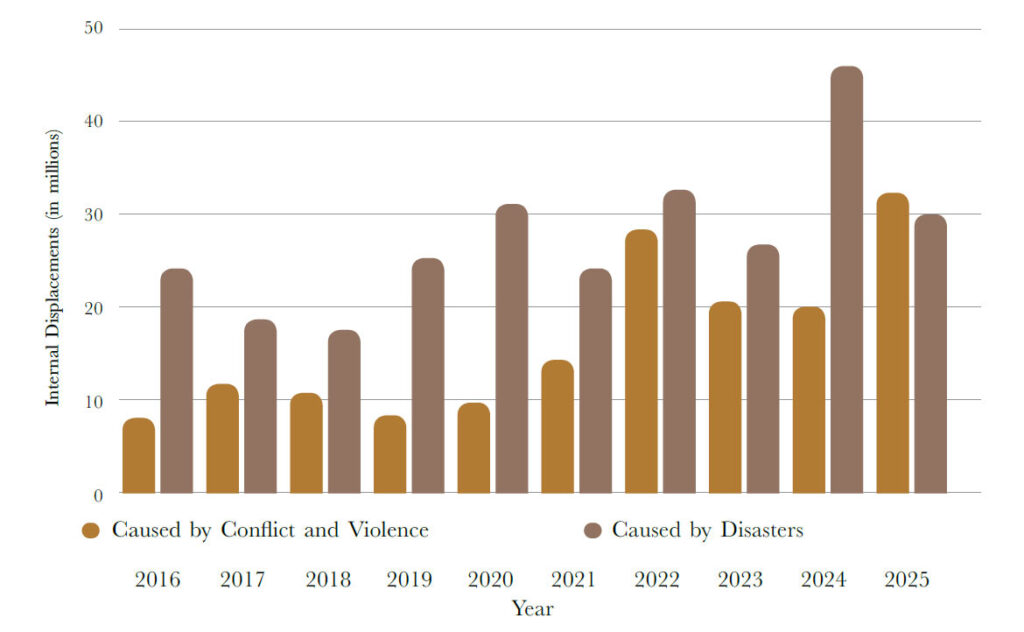
Source: Authors’ own, using data from the Internal Displacement Monitoring Centre[6]
Note: Internal displacements: The number of forced movements of people within the borders of their country recorded during the year.
This article uses a number of important terminologies in its analysis:
• Climate migration: Movement influenced by climate pressures such as water scarcity, declining agricultural productivity, sealevel rise, and flooding, often alongside socioeconomic vulnerabilities.
• Environmental migrant: A descriptive rather than a distinct legal category under international law.
• Climate refugee: Although widely used in public discourse, ‘climate refugee’ is not formally recognised under the 1951 Refugee Convention, which defines a refugee as a person outside their country who, owing to a well-founded fear of persecution on specified grounds, is unable or unwilling to seek that country’s protection.[7]
• Asylum seeker: A person seeking international protection whose claim for refugee status has not yet been determined.[8]
• Internally displaced persons (IDPs): Those who flee conflict, violence, or disasters, but remain within their country.
• Cross-border South-South migration (SSM): Movement from one Global South country to another, either voluntarily or forcibly.[9]
These overlapping pressures of climate and conflict are also reshaping the geography of migration through the rise of SSM.[10] While policy debates have traditionally focused on South– North flows, migration between developing countries already constituted approximately 37 percent of international migration in 2020, compared to 35 percent for South–North migration.[11] Countries of the Global South host at least 40 percent of international migrants and more than 85 percent of refugees and asylum seekers.[12] Mobility within the Global South thus covers voluntary labour migration and forced displacement, increasingly shaped by the interaction of climate hazards, conflict, and economic insecurity.
In this context, this essay examines the drivers, human-security consequences, regional patterns, and governance gaps shaping climateand conflict-induced SSM. It argues for a protection-oriented approach that addresses the vulnerabilities and lived realities of displaced populations, particularly livelihood loss, gendered risks, and gaps in existing protection systems.
Drivers of South–South Migration
Climate Hazards
Sudden climate hazards, such as floods and cyclones, can destroy housing and force immediate displacement. In South Sudan, 80 percent of flood-affected IDPs moved because their homes were destroyed. In South Asia, disasters displaced 7.9 million people in 2025, with Pakistan accounting for the highest number of incidents of flood displacement.[13]
Slow-onset stressors such as drought, water stress,[14] and sea-level rise gradually undermine livelihoods rather than forcing immediate evacuation.[15] For example, Lake Chad lost 90 percent of its surface area between 1963 and 1990, contributing to incremental movement in Nigeria, Niger, Chad, and Cameroon.[16] Rising seas present a different pressure over the longer term, threatening the habitability of low-lying coastal states; for example, a projected 1-metre rise in sea level would affect 5 to 7 percent of the populations of the Bahamas, Guyana, and Suriname.[17]
Conflict, Political Instability, and Resource Competition
Conflict and violence triggered 32.2 million new or repeated internal displacements in 2025, a 60 percent increase from 2024 and more than double the decadal average.[18] The Democratic Republic of the Congo (DRC) recorded 9.7 million conflict-related movements in 2025, a third of the global total.[19] While the DRC saw the most individual movements, Sudan had the world’s largest internally displaced population for a third consecutive year, with approximately 9.1 million people having to move to new locations by the end of 2025.[20] The conflict in Sudan has been marked by a staggering civilian toll, including the deliberate destruction of displacement sites such as the Zamzam camp, which forced nearly 500,000 people to flee.[21]
This massive displacement is aggravated by the widespread collapse of essential infrastructure—hospitals, water and sanitation systems, power, communications, and transport networks required to sustain basic services—as fighting increasingly targets densely populated urban hubs. When conflict engulfs these centres, damage to critical infrastructure not only triggers immediate displacement but also disrupts public services across the country, undermining emergency humanitarian assistance, including the delivery of food, water, and medical care, as well as long-term economic recovery. In the DRC, the M23 movement[22] seized provincial capitals in early 2025, resulting in the destruction of airports and the looting of banks.[23]
The Climate–Conflict Nexus
Climate change functions as a “threat multiplier”, exacerbating food insecurity and prompting competition over scarce resources, such as pasture and water.[24] However, scholars caution that relying solely on this framing can lead to what is called ‘climate reductionism’, where complex social and political transformations are attributed primarily to environmental change.[25] This approach can depoliticise migration by downplaying the role of structural inequalities, governance failures, institutional fragility, and conflict dynamics.
The experience of South Sudan is a case in point. A quarter of surveyed IDPs reported a link between climate change and conflict, including armed violence, crime, and intercommunal clashes.[26] More broadly, that 42 countries recorded displacement linked to both conflict and disasters in 2025 demonstrates the limitations of policy frameworks that treat these drivers as discrete categories.[27] Responses focused on a single trigger risk underestimating both the scale and duration of displacement. When conflict and disasters occur simultaneously or reinforce one another, their combined effects can create complex, prolonged barriers to durable solutions. Destroyed housing, loss of property and identity records, and the presence of unexploded materiel, for instance, can prevent or delay safe return, local integration, or resettlement even after the immediate environmental hazard has passed.
Human Security Consequences of Climate- and Conflict-Induced Displacement
Displacement often strips households of land, crops, and livestock, increasing food and water insecurity. In 2025, over 85 million people were displaced across food-crisis contexts, experiencing greater hunger than host communities.[28] Among the flood-affected IDPs in South Sudan, for example, 64 percent lost their crops and 55 percent their entire livestock, while 42 percent who attempted to introduce new livestock subsequently lost them too.[29] Displacement can also create new health vulnerabilities as a result of overcrowding, inadequate sanitation, and exposure to waterborne diseases.[30]
These vulnerabilities are gendered. Migrant women frequently face lower wages, informal employment, social exclusion, and heightened risks of abuse, while sociocultural barriers can restrict their access to shelters and independent migration. In India’s construction sector, migrated women earn INR 200–300 per day, compared to the INR 350–550 earned by men for comparable labour. In Southeast Asia, women migrants are often concentrated in low-wage, informal service work—including jobs and tasks that operate outside of formal legal regulations, written contracts, and tax systems—where they lack legal protection and are vulnerable to abuse.[31]
Displacement also increases exposure to trafficking, debt bondage, and exploitation, particularly through informal intermediaries. Children face acute risks and exposure to harm. In South Sudan, 65 percent of surveyed IDPs perceived children to be at high risk during flight, with specific fears of kidnapping (69 percent), physical violence (69 percent), and trafficking (48 percent).[32]
At the same time, not all affected persons can migrate. Many are trapped because of lack of financial resources, social networks, or physical capacity; often they are also unable to leave their caregiving responsibilities.[33] Displacement and immobility, therefore, represent interconnected dimensions of human precarity, disproportionately affecting already vulnerable populations.
For those who do migrate, movement can strengthen household resilience through remittances that support consumption, education, and healthcare. Sustained migration, however, may simultaneously reduce the availability of younger workers in their origin communities, including for agriculture. At destinations, migrants may settle in informal areas with inadequate housing, water, and sanitation. Pressure on public services and increased job demand can fuel tensions and xenophobia within the host region. Support for local services can reduce pressure on hosts while making settlement safer for new arrivals. Therefore, the impacts of SSM depend on both the displaced and the host communities’ capacity to manage these outcomes.
South–South Migration: Governance and Policy Responses
SSM is overwhelmingly regional, temporary, and cyclical, shaped by lower travel costs and shared linguistic, cultural, and historical ties, which make neighbouring countries the most accessible destinations. This regional pattern is particularly evident in Africa, where about 80 percent of African migrants remain on the continent, illustrating the importance of proximity and established regional mobility networks.[34]
Effective governance therefore requires coordinated approaches linking climate, conflict, livelihoods, migration, disaster management, development, and humanitarian policies. Demographic changes will further shape mobility and employment: India, Nigeria, Pakistan, the DRC, Egypt, Bangladesh, and Ethiopia are projected to add over 500 million urban residents between 2025 and 2050.[35] Consequently, development planning must integrate migration, particularly housing, jobs, infrastructure, and services.
Regional and sub-regional mechanisms should strengthen cooperation among countries of origin, transit, and destination through information sharing, joint risk assessments, early-warning systems, and coordinated disaster response. South–South partnerships can facilitate the exchange of policy practices, technical expertise, finance, and institutional capacity, while regional organisations can develop common approaches to cross-border and internal mobility.
Regional mechanisms in the Global South already offer useful models for addressing migration induced by climate crises, disasters, conflicts, and loss of livelihood. In East Africa, the Intergovernmental Authority on Development (IGAD) has adopted a Free Movement Protocol that facilitates cross-border movement during disasters.[36] The Economic Community of West African States (ECOWAS), for its part, supports labour mobility though free movement and regional cooperation, while the Southern African Development Community (SADC) has developed frameworks on movement and labour migration.[37] At the continental level, the African Union has also strengthened cooperation through initiatives addressing migration, environment, and climate change.
In Southeast Asia, the Association of Southeast Asian Nations (ASEAN) is working to address the linkages between migration, environmental change, and disasters. The Pacific Islands Forum’s Regional Framework on Climate Mobility offers a particularly relevant model of rights-based, people-centred regional cooperation encompassing migration, displacement, and planned relocation.[38] Additionally, the Charter of the Bay of Bengal Initiative for Multi-Sectoral Technical and Economic Cooperation (BIMSTEC), adopted in 2022, marks an important shift by recognising that regional peace and stability depend on addressing terrorism, transnational crime, natural disasters, climate change, and communicable diseases in an integrated manner.[39]
The United Nations (UN) system provides policy guidance, technical assistance, and operational support across migration governance, refugee protection, and climaterelated displacement, including through different agencies and specialised mandates. These areas, however, remain institutionally fragmented, with no single UN framework comprehensively addressing their intersections.
The International Organization for Migration (IOM) supports migration governance and climate mobility planning; the United Nations High Commissioner for Refugees (UNHCR) provides legal and operational protection guidance; and the UN Framework Convention on Climate Change’s Task Force on Displacement advises countries on averting, minimising, and addressing climate-related displacement, including through national planning, better data collection, and stronger legal and institutional frameworks.[40] Together, these mechanisms could help bridge protection gaps by translating international guidance into coordinated regional and national action plans.
However, implementation continues to be constrained by limited financing and institutional capacity. Gaps in documentation, inadequate border infrastructure, and limited disaggregated data hinder migration identification and protection, pushing many towards even more precarious choices such as smugglers, increasing their vulnerability to trafficking, exploitation, and abuse. A protection-oriented approach is therefore essential—one that strengthens crosssectoral coordination, anticipates emerging mobility, and ensures timely and equitable access to assistance and protection.
Climate-related cross-border displacement can create protection gaps, as climate impacts alone generally do not meet the 1951 Refugee Convention definition, though refugee protection may apply when combined with persecution or conflict.[41] Gaps are acute in the Global South, requiring temporary status, documentation, non-refoulement, basic services, safe mobility, and protection from exploitation and genderbased violence. The challenge lies in translating international commitments into coordinated, funded, rights-based action.
In conclusion, for the Global South, addressing these protection gaps requires three priorities: national preparedness by integrating mobility into adaptation, disaster-risk reduction, and early-warning systems; safe mobility pathways through simpler documentation, recognition of status and skills where feasible, and contingency arrangements for cross-border displacement; and destination capacity through greater investment in housing, health, education, water and sanitation, and social protection for migrants and host communities.[42]
Climate change and conflict will increasingly shape where, how, and why people move across the Global South. Treating these pressures separately risks overlooking how climate hazards, insecurity, and economic vulnerability interact to produce both internal displacement and cross-border migration. The policy challenge is to ensure that when people move, they can do so safely, voluntarily, and with access to adequate protection and basic services. A more effective approach requires the Global South countries to move beyond reactive crisis management towards anticipatory, coordinated systems that connect climate adaptation, disaster preparedness, migration governance, and social protection. Strengthening such cooperation can help turn mobility into a more practical and manageable part of development and human security.
Caroline Arkalji is Junior Fellow, ORF America.
Anasua Basu Ray Chaudhury is Senior Fellow, Neighborhood Initiative, ORF.
The authors acknowledge the use of NotebookLM for preliminary literature survey, organising and comparing findings. Grammarly was used for language refinements prior to submission. The originality, analysis, and conclusions remain the authors’ own.
[1] Internal Displacement Monitoring Centre, 2026 Global Report on Internal Displacement, Geneva, Internal Displacement Monitoring Centre, May 12, 2026, https://www.internal-displacement.org/global-report/grid2026/.
[2] Internal Displacement Monitoring Centre, “2026 Global Report on Internal Displacement.”
[3] “2026 Global Report on Internal Displacement.”
[4] “2026 Global Report on Internal Displacement.”
[5] Abdulaziz I. Almulhim et al., “Climate-Induced Migration in the Global South: An In Depth Analysis,” npj Climate Action 3, 47 (2024), June 14, 2024, https://doi.org/10.1038/s44168-024-00133-1.
[6] “2026 Global Report on Internal Displacement.”
[7] United Nations High Commissioner for Refugees (UNHCR), “The 1951 Refugee Convention and 1967 Protocol relating to the Status of Refugees,” https://www.unhcr.org/media/convention-and-protocol-relating-status-refugees.
[8] United Nations High Commissioner for Refugees (UNHCR), “Who is an ‘asylum-seeker’?” https://www.unhcr.org/ about-unhcr/who-we-protect/asylum-seekers.
[9] United Nations Commission on Human Rights, “Guiding Principles on Internal Displacement,” February 11, 1998, https://digitallibrary.un.org/record/535577?v=pdf.
[10] Sunaina Kumar et al., “Education, Skills, Labor, and Immigration, Turning Risks Into Opportunities,” ORF Global Quarterly, ed. Sharon Stirling and Eszter Karascony, January 2026, https://www.orfonline.org/public/uploads/posts/ pdf/20260129154213.pdf.
[11] Francesco Carella, “The Governance of South–South Migration: Same or Different?” in The Palgrave Handbook of South– South Migration and Inequality, ed. Heaven Crawley and Joseph Kofi Teye (Cham: Palgrave Macmillan, 2024), https://link. springer.com/chapter/10.1007/978-3-031-39814-8_27.
[12] Kerilyn Schewel and Alix Debray, “Global Trends in South-South Migration,” in The Palgrave Handbook of South–South Migration and Inequality, ed. Heaven Crawley and Joseph Kofi Teye (Cham: Palgrave Macmillan, 2024), https://link. springer.com/chapter/10.1007/978-3-031-39814-8_8.
[13] Mohammad Harun, Ashiqur Pahman, and Jannatul Ferdous, “Vulnerabilities of Climate Change-Induced Displacement and Migration in South Asia,” Discover Global Society, September 28, 2025,https://link.springer.com/article/10.1007/ s44282-025-00237-x; Internal Displacement Monitoring Centre, “2026 Global Report on Internal Displacement.”
[14] Water stress occurs when the demand for freshwater exceeds the available supply to meet human needs.
[15] Peter Schulte, “Defining Water Scarcity, Water Stress, and Water Risk,” Pacific Institute, February 4, 2014, https://pacinst.org/water-definitions/.
[16] Yahe Li, “Shallow Dive: The Data Behind the Impacts of Lake Chad’s Shrinkage,” World Bank Blogs, April 5, 2024, https://blogs.worldbank.org/en/opendata/shallow-dive–the-data-behind-the-impacts-of-lake-chad-s-shrinka.
[17] Almulhim et al., “Climate-Induced Migration in the Global South.”
[18] “2026 Global Report on Internal Displacement.”
[19] “2026 Global Report on Internal Displacement.”
[20] “2026 Global Report on Internal Displacement.”
[21] United Nations Office for the Coordination of Humanitarian Affairs, “Sudan: Displacement from Zamzam camp, North Darfur State Flash Update No. 01,” April 15, 2025, https://www.unocha.org/publications/report/sudan/sudandisplacement- zamzam-camp-north-darfur-state-flash-update-no-01-15-april-2025/.
[22] The Mouvement Du 23 Mars (M23) is an armed group operating in the DRC that has been the recipient of arms and related materiel, including advice, training, and assistance related to military activities.
[23] Council on Foreign Relations, “Conflict in the Democratic Republic of Congo,” Global Conflict Tracker https://www. cfr.org/global-conflict-tracker/conflict/violence-democratic-republic-congo.
[24] Ferdous Sultana and Jürgen Scheffran, “Climate Change as a Threat Multiplier: Expert Perspectives on Human Security in Bangladesh,” Geographies 5, no.4, (2025), https://doi.org/10.3390/geographies5040077.
[25] Buket Ökten Sipahioglu, “Climate Migration, Development and Sustainability in the Global South: A Critical Assessment,” Social Sciences 15, no.8, (2026), https://www.mdpi.com/2076-0760/15/8/521.
[26] Mixed Migration Center, Climate Change, Internal Mobility, and Conflict Dynamics: Country Brief – South Sudan, Geneva, Mixed Migration Center, April 2026, https://reliefweb.int/report/south-sudan/country-brief-south-sudan-climate-changemobility- and-conflict-dynamics-april-2026.
[27] “2026 Global Report on Internal Displacement.”
[28] Vibhu Mishra, “Two-thirds of Global Hunger Concentrated in 10 Conflict-Hit Countries,” United Nations, April 24, 2026, https://news.un.org/en/story/2026/04/1167374.
[29] “Climate Change, Internal Mobility, and Conflict Dynamics.”
[30] “Climate Change, Internal Mobility, and Conflict Dynamics.”
[31] Harun, Pahman, and Ferdous, “Vulnerabilities of Climate Change-Induced Displacement and Migration in South Asia.”
[32] “Climate Change, Internal Mobility, and Conflict Dynamics.”
[33] Lisa Thalheimer et al., “Prioritizing Involuntary Immobility in Climate Policy and Disaster Planning,” Nature Communications, March 16, 2025, https://www.nature.com/articles/s41467-025-57679-9.
[34] Otto N. Chabikuli and Hind Satti, “Africa’s Internal Migration Crisis,” Think Global Health, August 25, 2025, https://www.thinkglobalhealth.org/article/africas-internal-migration-crisis.
[35] United Nations Department of Economic and Social Affairs, World Urbanization Prospects 2025: Summary of Results, November 2025, https://desapublications.un.org/publications/world-urbanization-prospects-2025-summary-results.
[36] Intergovernmental Authority on Development (IGAD), “Protocol on Free Movement of Persons in the IGAD Region,” Environmental Migration Portal, February 26, 2020, https://environmentalmigration.iom.int/sites/g/files/tmzbdl1411/ files/event/file/Final%20IGAD%20PROTOCOL%20ENDORSED%20BY%20IGAD%20Ambassadors%20and%20 Ministers%20of%20Interior%20and%20Labour%20Khartoum%2026%20Feb%202020.pdf.
[37] Economic Community of West African States (ECOWAS), “ECOWAS Unveils Regional Labour Migration Strategy to Drive Mobility, Rights, and Integration in West Africa,” May 15, 2025, https://www.ecowas.int/ecowas-unveils-regionallabour- migration-strategy-to-drive-mobility-rights-and-integration-in-west-africa/; Southern African Development Community (SADC), “SADC Develops Regional Migration Policy Framework,” October 22, 2020, https://www.sadc. int/latest-news/sadc-develops-regional-migration-policy-framework.
[38] Pacific Islands Forum, “Pacific Regional Framework on Climate Mobility,” November 10, 2023, https://forumsec.org/ sites/default/files/2024-02/Pacific%20Regional%20Framework%20on%20Climate%20Mobility.pdf.
[39] Bay of Bengal Initiative for Multi-Sectoral Technical and Economic Cooperation (BIMSTEC), “BIMSTEC Charter,” March 30, 2022, https://bimstec.org/images/content_page_pdf/1696679710_BIMSTEC%20Charter.pdf.
[40] International Organization for Migration (IOM), “Task Force on Displacement,” Environmental Migration Portal, https://environmentalmigration.iom.int/task-force-displacement.
[41১] United Nations High Commissioner for Refugees (UNHCR), “Law and Policy for Protection and Climate Action,” https://www.unhcr.org/us/law-and-policy-protection-and-climate-action.
[42] Alina Narusova-Schmitz and Micaela Lincango, “Addressing Climate Mobility: The Role of Local and Community Action,” World Migration Report 2026 (Geneva: International Organization for Migration, 2026), https://publications.iom. int/books/world-migration-report-2026-chapter-6; United Nations High Commissioner for Refugees (UNHCR), “Law and Policy for Protection and Climate Action;” United Nations Framework Convention on Climate Change (UNFCCC), “Human Mobility, Including Migration, Displacement and Planned Relocation,” https://www.unfccc.int/process/ bodies/constituted-bodies/WIMExCom/TFD.